Copra Marketing Plan Under
pp. 9-10 · Read in the full issue
Fire
New Guinea Seeks Compulsory Pool :: Big Firms Being Roughly Treated :: Implications of Levers' New Mill in Sydney
SHARP difficulties have developed in the operation of the copra market ing pool which, as indicated in August, was expected to apply to the Mandated Territory of New Guinea in mid-September.
Regulations were made and a Copra Control Committee (Messrs. Hogan, Ar cher and Mackenzie) was appointed; but it was assumed a month ago that the procedure would be somewhat as follows: Copra planters would apply where neces ary to the Committee for assistance, and the Committee would guarantee £4/10/per ton on their plantation for copra produced. The Committee would be re sponsible for shipping the copra to a suitable central point for marketing, and would divide equally among the planters on a basis of tonnage supplies, whatever sum remained from the price received after costs of transport, etc., had been deducted. It was assumed that the Com mittee would sell the copra thus taken over to the big firms engaged in buying copra and shipping it abroad.
There was consternation when it was discovered that that was not by any means the plan of the Administration or of Canberra.
It was to be a compulsory pool—that is, all the copra produced in New Guinea was to go into the pool whether the producer wished it or not; the NG Copra Committee was to have absolute authority in disposing of copra and in distributing any further returns above the £4/10/per ton.
This led to confusion, because only some 25 per cent, of New Guinea’s copra is produced by small, independent plan ters. All the rest is copra produced under the control of big interests—and the lat ter insisted that they were completely capable not only of selling at more than £4/10/- all the copra they produced, but also of providing transport.
BUT the Government said that all the copra must go into the pool. The firms asked why, when the procedure would almost certainly result in a serious diminution in the net return they other wise would receive for the copra they produced. , , Important copra interests begged the Australian Government to let the in dustry run free. It was emphasised that,
although some copra marketing plan probably was necessary to assist the in dustry early in 1941, there was no neces sity for it now—the various producing and marketing organisations had found ways out of the impasse, and there was now a market for all South Pacific copra. Why should New Guinea be subject to this crippling marketing plan, while all the other territories were allowed to run free?
Up to the time of writing, however, Canberra and Rabaul have proved ob durate. They insist that all the copra produced in New Guinea shall go into the pool.
There are indications, moreover, that, at the instigation of the Commonwealth Government, other South Sea territories may now be brought under the com pulsory copra pool, and that the complete pooling and marketing plan, under the control of a board in Sydney, will be set up as originally proposed—that is, it will not be confined to New Guinea only.
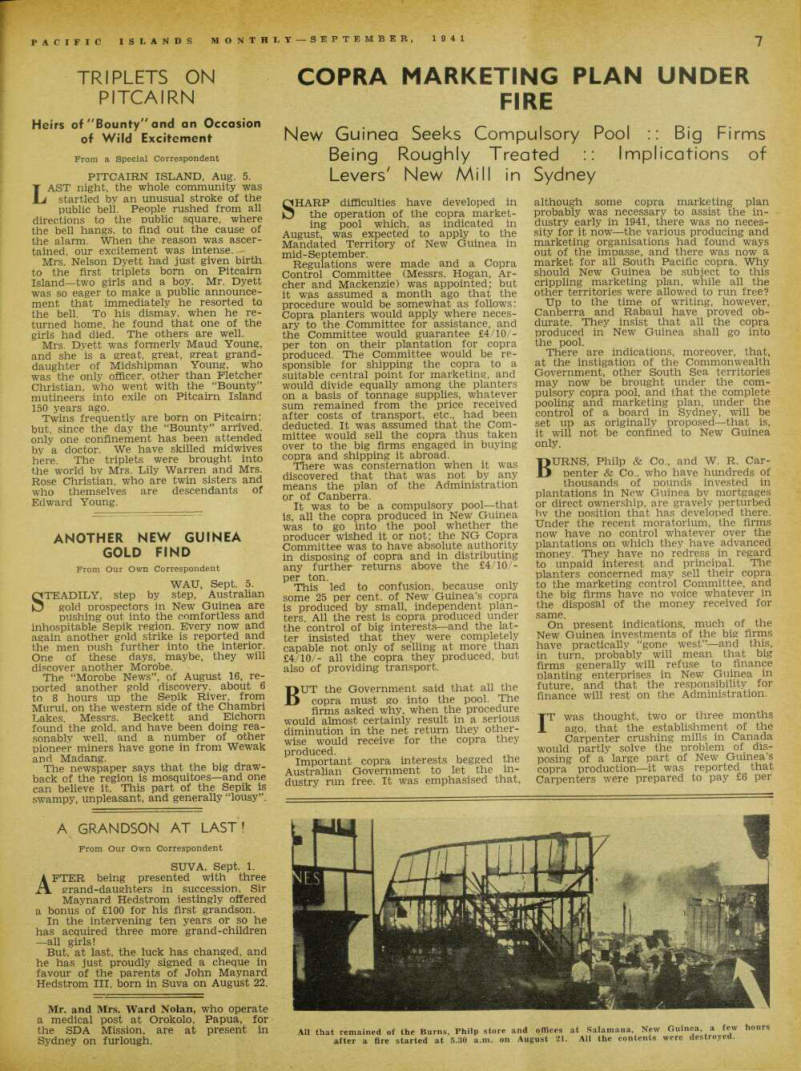
BURNS, Philp & Co., and W. R. Car penter & Co., who have hundreds of thousands of pounds invested in plantations in New Guinea bv mortgages or direct ownership, are gravely perturbed hv the nosition that has developed there.
Under the recent moratorium, the firms now have no control whatever over the plantations on which they have advanced money. They have no redress in regard to unpaid interest and principal. The planters concerned may sell their copra to the marketing control Committee, and the big firms have no voice whatever in the disposal of the money received for same.
On present indications, much of the New Guinea investments of the big firms have practically “gone west”—and this, in turn, probably will mean that big firms generally will refuse to finance nlanting enterprises in New Guinea in future, and that the responsibility for finance will rest on the Administration.
IT was thought, two or three months ago, that the establishment of the Carpenter crushing mills in Canada would partly solve the problem of dis posing of a large part of New Guinea’s copra production—it was reported that Carpenters were prepared to pay £6 per
ton Australian at New Guinea ports for nigh grade copra.
But the Governmental authority has shown little inclination to co-operate with Carpenters in the matter—and it is now suggested that it is influenced in this attitude by the fact that the world powerful Lever interests are establishing in Sydney a new crushing mill, capable of dealing with 40,000 tons of copra p.a., in addition to the existing Lever mill, which can handle about 20,000 tons p.a. (copra which generally comes from the Lever plantations in the Solomons).
Some suggest that the Commonwealth authority regards with complacency the possibility of New Guinea copra being sold to the Lever interests in Australia at £4/10/- per ton, rather than to the Carpenter mill in Canada at £6 per ton —but such an idea surely is absurd.
The feeling among planters against the Unilever combine is so strong that, if the Commonwealth dared to plav into the hands of Lever interests as sug gested, there would be such resentment among planters that it would be bound to have reaction in the Commonwealth Parliament.
Nevertheless, strange and as yet un explained things are going on. rfTHE position may be simplified by the A fact that low grade copra only will be wanted by the new Lever mill in Sydney, while the new Carpenter mill in Canada wants high grade. But. if that is not to be the position, we vet may witness the extraordinary sight of the Carpenter interests, which nominally own or control plantations all over New Guinea, paying the Dutch East Indies or the Philippines £6 per ton for copra for the Canadian mill, while the New Guinea copra is being shipped to Sydney at less than £5 per ton.
The position is the subject of a series of conferences now proceeding. Unless it is delicately handled, it is going to have a serious reaction upon the economic future of the Territory.
One can only wonder why the Aus tralian authority persisted in its conra marketing plan, when it was obvious that the industry was finding its own way out of its troubles.
A consideration of the circumstances, combined with the curious results flowing from the present moratorium in New Guinea, might suggest that it is the de liberate policy of the New Guinea Ad ministration to smash the commercial power of the big firms in New Guinea.
There may be something to commend such a policy—no one loves monopolies— but this seems to be the worst possible time in history to put it into operation.
Mr. L. H. Hilder, chief clerk in the Papuan Lands Department, has been ap pointed Government Storekeeper at Pt.
Moresby.