Soldiers From
pp. 50-51 · Read in the full issue
Tahiti
Embarkation Ceremonies
From Our Own Correspondent
Papeete, May 10.
THE first contingent of Tahitian soldiers —with all the parade, and stately ceremony, and the heartbreak of partings—left Papeete, in April, on a British transport.
The occasion brought to memory the day, 26 years ago, when Tahitian soldiers, for the first time, embarked to fight on faraway battlefields. There is this dif ference, however: In 1915, they went as conscripts; in 1941, they go as volunteers to fight in the armies of Free France.
These volunteers have come from all parts of the colony—even from the Austral Islands, the Tuamotus and the distant Gambiers. So many have offered themselves that many have been placed on a waiting list, to be called up when earlier contingents shall have been equipped and trained.
Their battle colours are the Cross of Lorraine, banner of Free France, and the red, white and red flag of Tahiti. The former was presented by the Governor of French Oceania, at a ceremony shortly before the day of departure. The Tahitian flag was presented, at the same occasion, by Princess Terri-Nui-o-Tahiti, the eldest daughter of the last king, Pomare V, In 1915, French Oceania contributed a full battalion to the army of France.
The training centre was at New Cale donia. In those days, the voyage to Noumea was by way of Wellington and Sydney. Irregular steamer service made necessary considerable delays at both New Zealand and Australia.
It was the season of southern winter.
The New Zealand Government, in the person of an officer of the Quarter master’s Department, took charge of our Tahitian soldiers, 'provided them with woollen uniforms, found them comfort able quarters, and treated them with great kindness.
And so it was with every contingent from the Islands. Steamers returning to Tahiti bore letters to the parents of these young men. They told how this officer had gone beyond the mere execution of his duties and had taken them in his personal charge and made them forget that they were homesick aliens in a strange land.
The gratitude felt by the parents was deep and lasting. Its measure was known to this writer, because most of the letters addressed to the New Zealand officer were brought to him for translation into English.
But expression of gratitude did not suffice. When the war was over, the native people of Tahiti and Moorea formally invited the officer and his family to visit their islands.
It is quite certain that no one, since Captain Cook, has ever received so affec tionate a welcome as that accorded by the native people of the islands to this kindly officer, on his arrival at Tahiti.
He was feted with royal honours by every district of Tahiti in turn; while Moorea, on the night of the full moon, staged an all-night festival of old time splendour. For over a month the islands paid honour to their guest and he sailed
away loaded with gifts of native work manship.
A generation has passed; but that NZ officer who showed kindness to our Tahitian soldiers is still remembered with undiminished affection and gratitude.
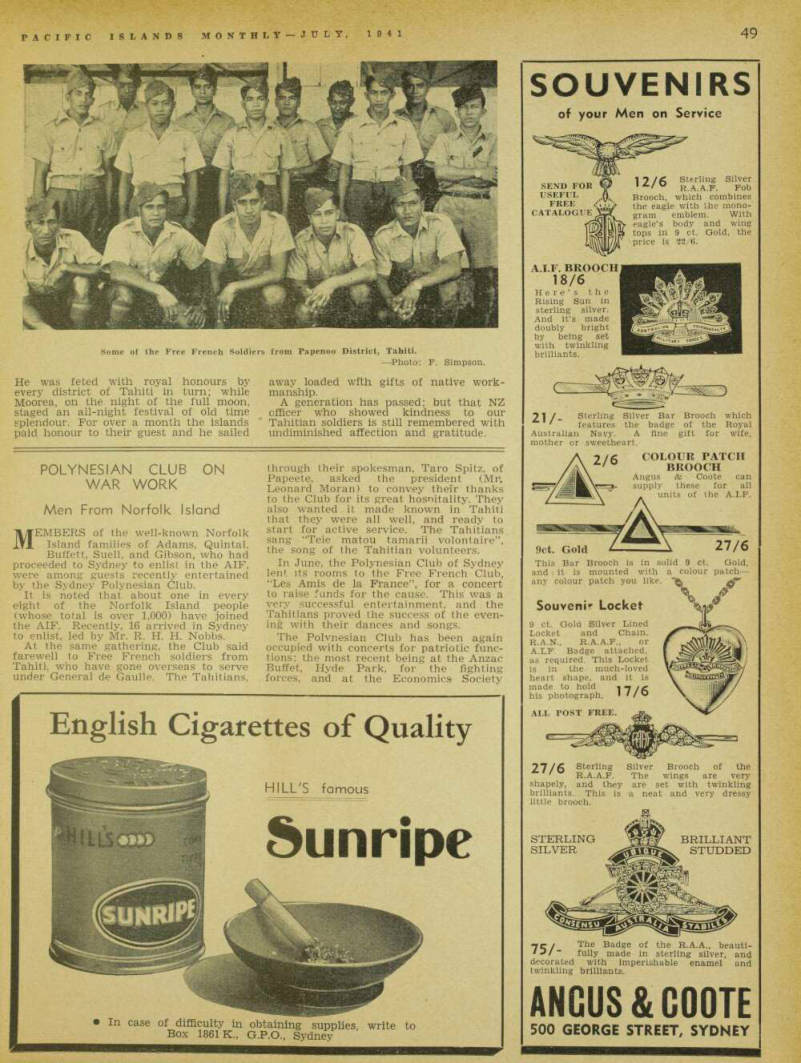
Some of the Free French Soldiers from Papenoo District, Tahiti.
Photo: F. Simpson.