Still Another
pp. 48-49 · Read in the full issue
Minister !
A Pessimistic Review of a Damnable System
TH E Australian-Pacific Territories (Papua, New Guinea, Norfolk Island, Nauru) are to meet their seventh Minister in 31 years. Mr. T. J. Collins has been moved on to the portfolio of PMG, and Mr. Allen McDonald, who first entered the Commonwealth Parliament only a few months ago, has taken over External Territories.
The Islands know nothing about Mr.
McDonald; and, it is presumed, he knows less about the Islands. He appears to be a man of outstanding ability, otherwise he would not, so soon, have been called into the Ministry. But even a Gladstone or Disraeli would be of little use in the Territories job, until in long, painful months, he had learned something about the tropical Territories.
The Territories are so utterly defence less, in that they have no Parliamentary representative to fight for them, and they are so completely dependent upon this Minister. Nominally, they are governed by Administrators. Actually— due to a combination of weakness among Administrators, and bureaucratic arro gance at Canberra —all administrative decisions of any importance are left to the Minister.
It is an axiom in New Guinea that, if you want anything done quickly, you must dig up a couple of hundred pounds for expenses, and fiy straight to Can berra. rpHERE have been seven Ministers X since 1937 —Sir George Pearce, Mr.
W. M. Hughes, Mr. E. J. Harrison, Mr. J. A. Perkins (for a couple of days only), Mr. Howard Nock, Mr. Collins, and Mr. McDonald. The best of them were the hard-working, conscientious three —Messrs. Harrison, Nock, and Collins. If they had been dealing with Australian conditions, they would have been admirable Ministers.
But those tropical Pacific territories call for highly specialised knowledge and the application of different principles of colonial administration: and the in experienced Australian Ministers, finding what they were up against, invariably sat back for a few months, to learn something about the job. And, in each case —Harrison, Nock and Collins —the Minister was shifted on to another de partment, just as he was getting hold of Territories affairs, and likely to do some thing worth-while.
The other Ministers only emphasised other weaknesses of the system.
Sir George Pearce —who held the port folio for some weary years—seemed little more than a rubber stamp. Mr. Hughes went to the other extreme, and would take advice from no one. A man with his record was not discomfited by the task of ruling New Guinea. He dashed up there by ’plane in 1938, racketed around the Territory, selected Salamaua as the capital and the Black Cat as the route of the goldfields road —two decisions which still are causing a heap of trouble —and zoomed back to Australia. Prob ably, by now, he has forgotten he ever was in New Guinea —but New Guinea will not soon forget him. Nevertheless, better a decade of Hughes, with his quick decisions, hatred of bureaucracy and capacity for getting things done, than the slow strangulation of the present system.
FOR ten years, Australian Pacific Territories have been crying out for the inauguration of some kind of
consistent policy, to which administration, development and settlement might ad here; and, for ten years, the Territories portfolio has been only a plaything for Canberra.
There is a re-shuffle in Cabinet. In come a couple of new “Assistant Ministers”.
To one of them, the Prime Minister tosses External Territories. “Here!” he says. “Grab this, and practise on it, while I’m sorting out a better Depart ment for you”.
Sometimes, the young Ministers, like Mr.
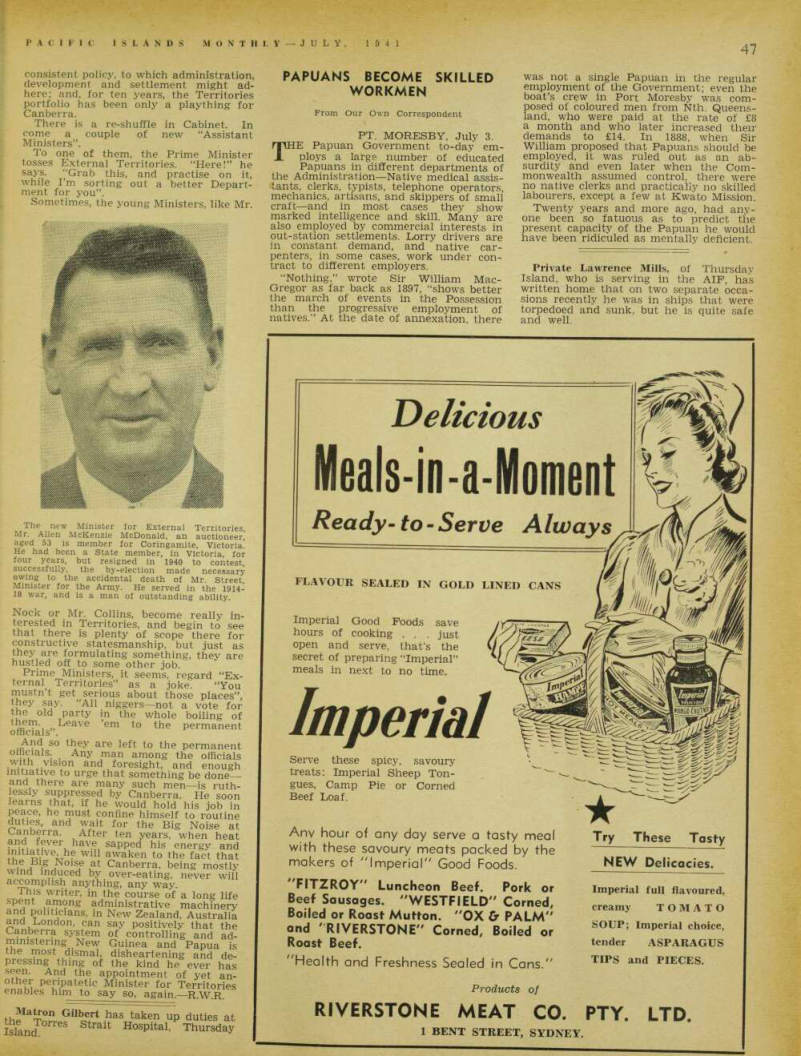
The new Minister for External Territories, Mr. Allen McKenzie McDonald, an auctioneer, aged 53 is member for Coringamite, Victoria!
He had been a State member, in Victoria, for four years, but resigned in 1940 to contest, successfully, the by-election made necessary owing to the accidental death of Mr. Street Minister for the Army. He served in the 1914- 18 war, and is a man of outstanding ability.
Nock or Mr. Collins, become really in terested in Territories, and begin to see that there is plenty of scope there for constructive statesmanship, but just as they are formulating something, they are hustled off to some other job.
Prime Ministers, it seems, regard “Ex ternal Territories” as a joke. “You mustn’t get serious about those places”, they say. “All niggers—not a vote for the old party in the whole boiling of „ Leave ’ era to the permanent officials .
And so they are left to the permanent officials. Any man among the officials with vision and foresight, and enough initiative to urge that something be done— and there are many such men—is ruth essly suppressed by Canberra. He soon learns that, if he would hold his job in peace, he must confine himself to routine duties, and wait for the Big Noise at Canberra. After ten years, when heat ai ™ f? ver have sapped his energy and initiative, he will awaken to the fact that the Big Noise at Canberra, being mostly wind induced by over-eating, never will accomplish anything, any way.
This writer, in the course of a long life spent among administrative machinery and politicians, in New Zealand, Australia r-o^v. London ’ san5 an say Positively that the Canberra system of controlling and ad ministering New Guinea and Papua is the most dismal, disheartening and de pressing thing of the kind he ever has seen. And the appointment of yet an other peripatetic Minister for Territories enables him to say so, again.—R.W.R. the la Tn, n ,»?' l =T t has taken up duties at str ait Hospital, Thursday