Graft and Corruption in Chungking : What Japan
pp. 38-39 · Read in the full issue
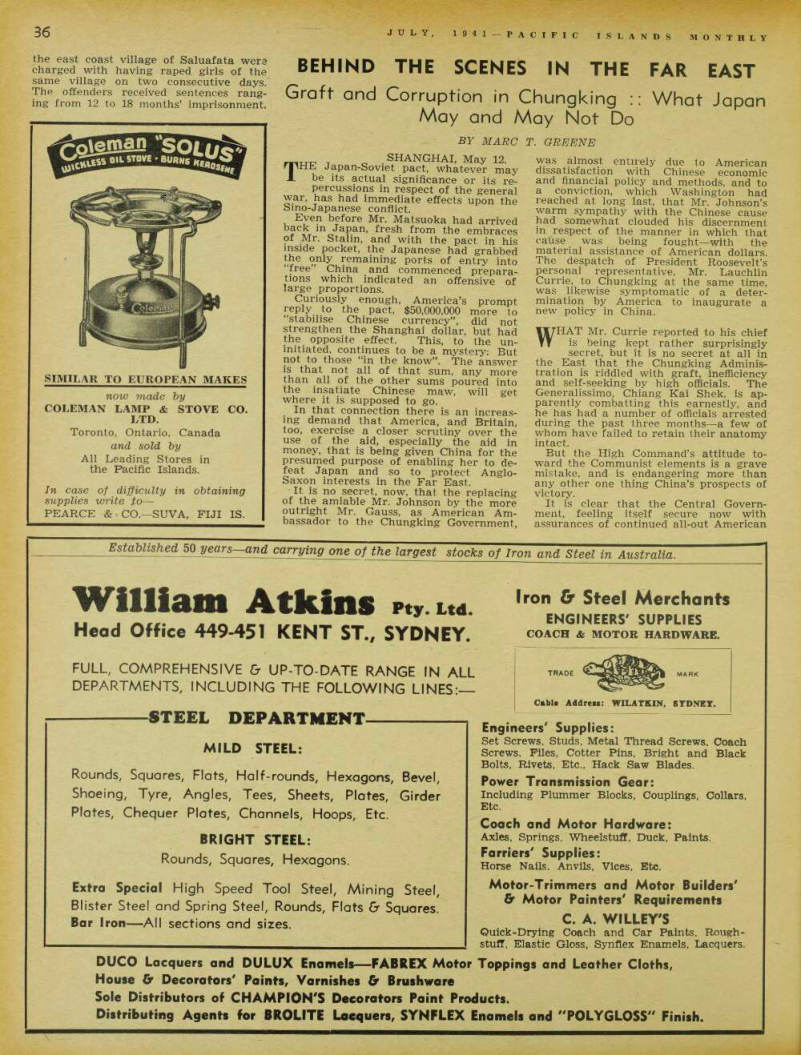

BEHIND THE SCENES IN THE FAR EAST Graft and Corruption in Chungking : What Japan May and May Not Do
By Marc T. Greene
THE Jaoan . May 12 * V, Japan-Soviet pact, whatever may oe its actual significance or its repercussions in respect of the general war, nas had immediate effects upon the b Wop P i?ii eSe .Sven before Mr, Matsuoka had arrived * iwr m c ?'! a F- an ’ fr f sh .from the embraces or Mr. Stalin, and with the pact in his inside pocket, the Japanese had grabbed S e ° nl £J emaimng Ports of entry into tree China and commenced preparations which indicated an offensive of large proportions.
Cunously enough, America’s prompt reply to the pact, $50,000,000 more to “stabilise Chinese currency”, did not strengthen the Shanghai dollar, but had fr® opposite effect. This, to the uninitiated, continues to be a mystery; But not to those in the know . The answer is that not all of that sum, any more than all of the other sums poured into the insatiate Chinese maw, will get where it is supposed to go. in that connection there is an increasmg demand that America, and Britain, too, exercise a closer scrutiny over the use of the aid, especially the aid in money, that is being given China for the presumed purpose of enabling her to defeat Japan and so to protect Anglobaxon interests in the Far East. it is no secret, now, that the replacing of the amiable Mr. Johnson by the more outnght Mr. Gauss, as American Ambassador to the Chungking Government,
was almost entirely due to American dissatisfaction with Chinese economic and financial policy and methods, and to a conviction, which Washington had reached at long last, that Mr. Johnson’s sympathy with the Chinese cause had somewhat clouded his discernment in respect of the manner in which that cause was being fought—with the material assistance of American dollars The despatch of President Roosevelt’s personal representative, Mr. Lauchlin Currie, to Chungking at the same time, was likewise symptomatic of a deter mination by America to inaugurate a new policy in China.
Ijl/HAT Mr. Currie reported to his chief W is being kept rather surprisingly secret, but it is no secret at all in the East that the Chungking Adminis tration is riddled with graft, inefficiency and self-seeking by high officials. The Generalissimo, Chiang Kai Shek, is ap parently combatting this earnestly, and he has had a number of officials arrested during the past three months—a few of whom have failed to retain their anatomy intact.
But the High Command’s attitude to ward the Communist elements is a grave mistake, and is endangering more than any other one thing China’s prospects of victory, It is clear that the Central Govern ment, feeling itself secure now with assurances of continued all-out American
aid, has made up its mind to end the armistice—which is all it ever was —with the Communists, to ignore them now, and as soon as victory is achieved to turn and rend them. The rending, of course, has already commenced, but the effect it is having is to bring about a uniting of all the Communist armies, half a million or so in the aggregate, against the Chungking regime. Thus, civil war on a wide scale is all but cer tain, when and if Japan is defeated by China —possibly before. In the light of that possibility the Japanese, encour aged, are redoubling their efforts to liquidate the “Incident”.
Furthermore, it is possible that among the secret clauses in the Soviet-Japan pact, which everybody knows are numer ous, are a promise by Stalin to discon tinue —gradually, of course, so as not to make it too obvious—assistance to Chungking.
However, the pact as a whole should by no means be taken too seriously. It is merely one more move in the game of chess (Russian style) that the black moustached fellow in the Kremlin is playing with exceeding cleverness —a move of pawns, really, which will be forgotten all about when it is time to shift larger pieces.
NO southward move will be made by Japan unless a major disaster comes in Europe—possibly not even then unless America enters the war.
But, in such an event, that entry is almost certain, even if not before.
Japanese action, both through adherence to the Axis pact and out of self-interest, is likely to be almost concurrent. It will take the form either of an attempt at Singapore or at the DEl—more likely the latter, but perhaps both.
No actual attack is probable upon Hong Kong, but rather a land and sea blockade, which would be hardly less disastrous after a month or so. No hostile Japanese move is considered likely in Shanghai, because this is too important a trading centre, and to turn it into a shambles would not avail Japan anything.
I HAVE lately returned from Thailand and I can say with certainty that the stories of Japanese bases and so forth in that country are entirely base less.
I came down the Peninsula by train and air to Penang, and then to Singa pore, Apart from the presence here and there of British troops, mainly Aus tralians, everything was perfectly tran quil.
The island of Singapore bristles with fortifications, as everybody knows, and no attempt at landing could possibly succeed. If Japan should grab Thailand, as might happen in the event of bad British set-backs in Europe, and an American entry into the conflict, an attempt to work down the Malay Penin sula, both inland and along the coast, might be made.
In sucn an undertaking the Germans might succeed. There isn’t a chance in twenty that the Japanese could—even with the aid of the German “advisors”, whose numbers are added to daily in Japan, and even here in Shanghai.
Singapore’s air-defences also are prob ably impregnable against a second-rate air-force like Japan’s. The attack, if any, is therefore far more likely to be made at some point or points in the DEI. These might conceivably be held, to the imminent danger of Australia. In the light of such a possibility, it would seem to be unwise for Australia to be denuded entirely of military units.
Mr. T. K. Stewart has taken up duties as headmaster of Ifi Ifi School at Apia, Western Samoa.