War-Time
p. 29 · Read in the full issue
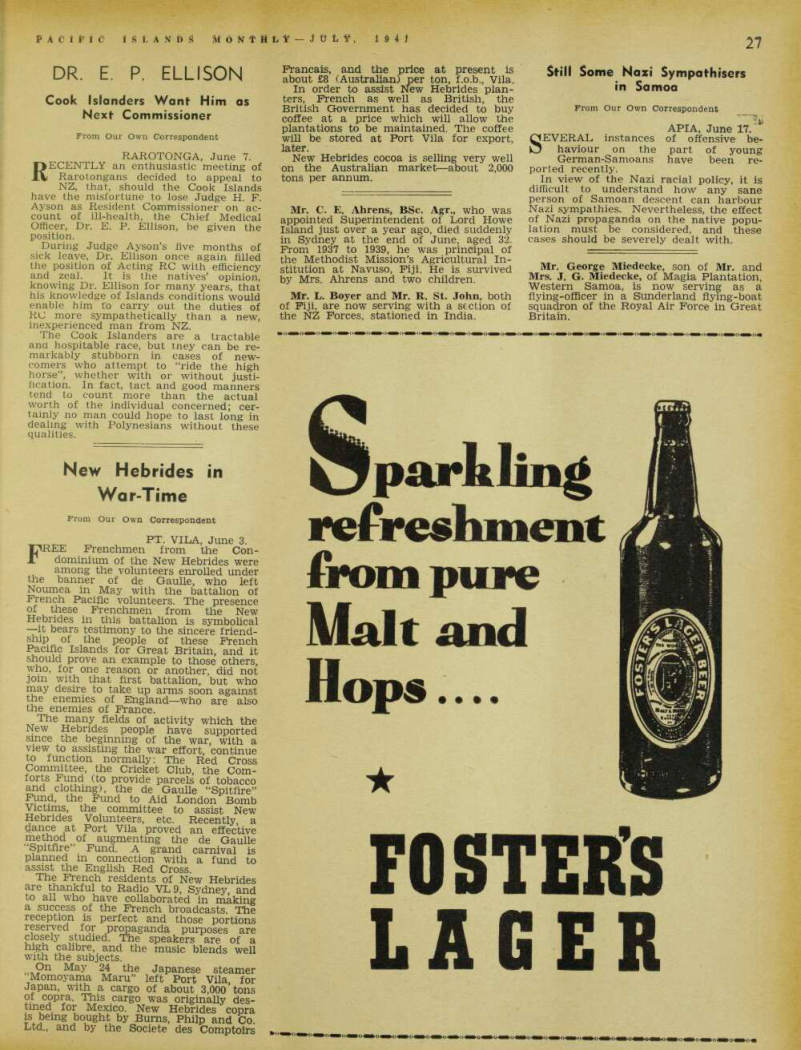
New Hebrides in War-Time
From Our Own Correspondent
F_ Pt. Vila, June 3.
REE Frenchmen from the Con dominium of the New Hebrides were among the volunteers enrolled under the banner of de Gaulle, who left Noumea in May with the battalion of French Pacific volunteers. The presence of these Frenchmen from the New Hebrides in this battalion is symbolical —it bears testimony to the sincere friend ship of the people of these French Pacific Islands for Great Britain, and it should prove an example to those others, who, for one reason or another, did not join with that first battalion, but who may desire to take up arms soon against the enemies of England—who are also the enemies of France.
The many fields of activity which the New Hebrides people have supported since the beginning of the war, with a view" to assisting the war effort, continue to function normally; The Red Cross Committee, the Cricket Club, the Com forts Fund (to provide parcels of tobacco and clothing), the de Gaulle “Spitfire”
Fund, the Fund to Aid London Bomb Victims, the committee to assist New Hebrides Volunteers, etc. Recently, a dance at Port Vila proved an effective method of augmenting the de Gaulle “Spitfire” Fund. A grand carnival is planned in connection with a fund to assist the English Red Cross.
The French residents of New Hebrides are thankful to Radio VL 9, Sydney, and to all who have collaborated in making a success of the French broadcasts. The reception is perfect and those portions reserved for propaganda purposes are closely studied. The speakers are of a high calibre, and the music blends well with the subjects. ~_P n M a y 24 the Japanese steamer Momoyama Maru” left Port Vila for Japan, with a cargo of about 3,000* tons of copra. This cargo was originally des tined for Mexico. New Hebrides copra is being bought by Burns, Philp and Co.
Ltd., and by the Societe des Comptoirs
Francais, and the price at present is about £8 (Australian) per ton, f.0.b., Vila.
In order to assist New Hebrides plan ters, French as well as British, the British Government has decided to buy coffee at a price which will allow the plantations to be maintained. The coffee will be stored at Port Vila for export, later.
New Hebrides cocoa is selling very well on the Australian market—about 2,000 tons per annum.
Mr. C. E. Ahrens, BSc. Agr., who was appointed Superintendent of Lord Howe Island just over a year ago, died suddenly in Sydney at the end of June, aged 32.
Prom 1937 to 1939, he was principal of the Methodist Mission's Agricultural In stitution at Navuso, Fiji. He is survived by Mrs. Ahrens and two children.
Mr. L. Boyer and Mr. R. St. John, both of Fiji, are now serving with a section of the NZ Forces, stationed in India.