Merchants Regain
p. 10 · Read in the full issue
Copra Is
Better
Pooling Plan Recedes as Merchants Regain Markets
IT was formally notified in the New Guinea Gazette on June 30 that a “copra control board” for the Man dated Territory of New Guinea has been appointed. The names are shown below.
We are officially informed that this territory committee, or board, will not begin to administer the regulations until the date of their commencement is fixed by notice in the Commonwealth Gazette.
There is no word yet of the appoint ment of a similar control board for Papua.
The whole South Pacific copra situa tion has improved considerably since the elaborate centralised plan was made, six months ago, for the purchase, pooling and marketing of South Pacific copra, by a Board formed by Australia, New Zea land and Fiji. It is possible, now, that the big firms will take care of the situa tion, and that the Governments will withdraw, giving the firms their blessing, and maintaining merely a “watching brief”.
The factors which caused the change are: The creation of an important new market (through crushing mills) in North America by Sir Walter Carpenter; the organisation and stabilisation of markets in Britain and Mexico, and of transport thereto; a marked decrease in production, especially of low grades. In other words, the gap between production and consumption has been almost closed.
All the present production of Papua, New Guinea and Solomons is apparently being sold and shipped, by Burns, Philp & Co., W. R. Carpenter & Co., and one or two smaller traders, at prices better than the £4 10 - per ton, on plantation, suggested by the Government.
Fiji is finding a market in Canada and Mexico. Fiji merchants are buying all good copra offering at £4 TO/- Fijian.
Most of Samoa’s copra is being bought by the NZ Government and distributed as stock-fodder. Tonga’s copra, being con sistently low-grade, is unsaleable.
It is believed that the three Govern ments concerned (Australia, NZ and Fiji) are reconsidering the position. Aus tralia, as announced, has been getting ready to pay £4 10/- per ton; but the Government could see plainly that it was heading towards very serious and expen sive problems of storage, marketing and shipping. Probably, it will be glad to leave matters in the hands of the big firms, under certain safeguards (to be operated by the Territories Committees) designed to protect the interests of the planters in these difficult times.
There is a distinct possibility, now that Russia is fighting Germany, that the copra market in Japan (which developed last January and was cut off by Britain because it was feared the oil was finding a way across to Germany) will be recov ered. •
New Guinea Committee
THE Copra Control Committee for the Mandated Territory of New Guinea will be as follows: — Hon. Gerald Hogan, chairman.
Mr. J. C. Archer, executive member.
Mr. F. J. MacKenzie, finance member.
These three men are well qualified for the task, and the arrangement generally
is approved by planters— except those very few who have contracts for better markets.
Hon. G. G. Hogan is New Guinea’s Crown Law Officer, and a member of the Executive and Legislative Councils. He is also Chairman of the New Guinea Patriotic Funds Board, Chairman of the Petroleum Advisory Board, Chairman of the Council of Legal Education, and a member of the Medical Board. For about twenty years he has been in touch with every branch of territory adminis tration. He was Chairman of the Mort gagors’ Relief Committee, which in 1938- 1939 investigated the position of Terri tory agriculturists and made a thorough examination of the copra industry.
Mr. J. C. Archer has been an officer of the Commonwealth Audit Department since 1916. Since about 1931, he has been the Delegate in New Guinea of the Custodian of Expropriated Property,
which has made him an authority on matters relating to the copra industry.
He knows nearly all the nlanters, and has a knowledge of practically every plantation in the Territory, He was a member of the Mortgagors’ Relief Com mittee.
Mr. F. J. MacKenzie is the manager of the Rabaul branch of the Common wealth Bank. He has been about three years in the Territory, and has taken a keen interest in its economic, agricul tural, and other problems. He is re garded in the Territory as a very sound man.
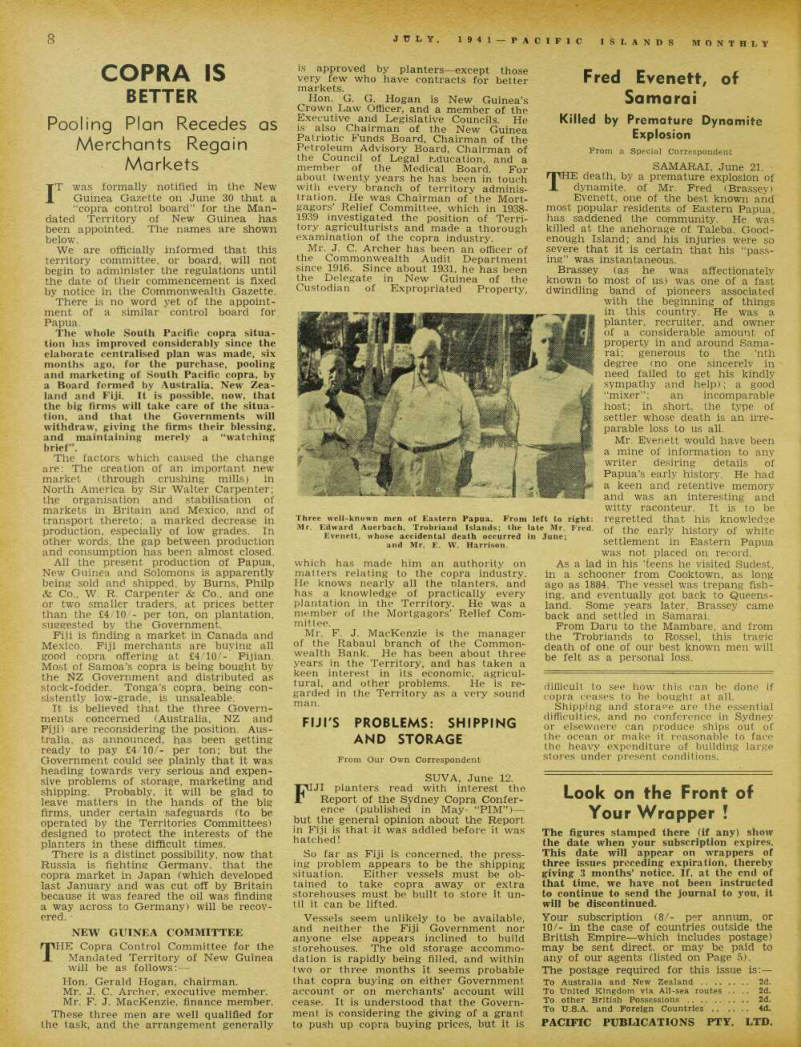
Three well-known men of Eastern Papua. From left to right: Mr. Edward Auerbach, Trobriand Islands; the late Mr. Fred.
Evenett, whose accidental death occurred in June; and Mr. E. W. Harrison.