New Books
p. 19 · Read in the full issue
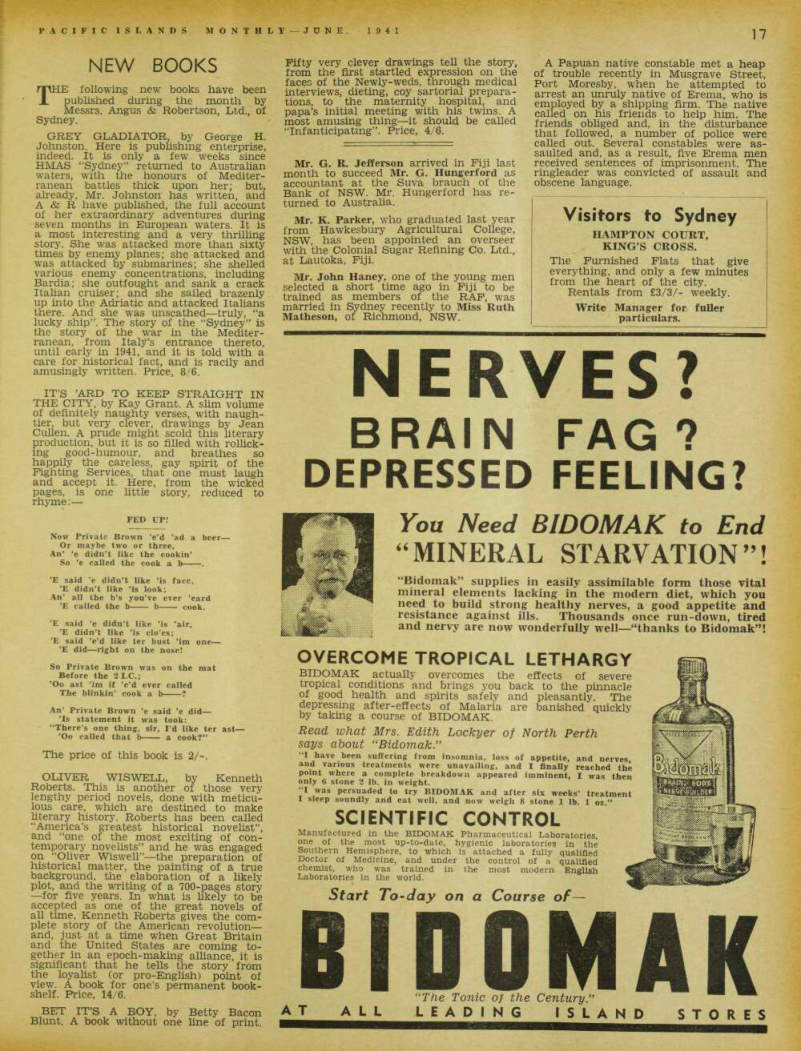
rE following new books have been published during the month by Messrs. Angus & Robertson, Ltd., of Sydney.
GREY GLADIATOR, by George H.
Johnston. Here is publishing enterprise, indeed. It is only a few weeks since HMAS “Sydney” returned to Australian waters, with the honours of Mediter ranean battles thick upon her; but, already, Mr. Johnston has written, and A & R have published, the full account of her extraordinary adventures during seven months in European waters. It is a most interesting and a very thrilling story. She was attacked more than sixty times by enemy planes; she attacked and was attacked by submarines; she shelled various enemy concentrations, including Bardia; she outfought and sank a crack Italian cruiser; and she sailed brazenly up into the Adriatic and attacked Italians there. And she was unscathed —truly, “a lucky ship”. The story of the “Sydney” is the story of the war in the Mediter ranean, from Italy's entrance thereto, until early in 1941, and it is told with a care for historical fact, and is racily and amusingly written. Price, 8/6.
It’S ’Ard To Keep Straight In
THE CITY, by Kay Grant. A slim volume of definitely naughty verses, with naugh tier, but very clever, drawings by Jean Cullen, A prude might scold this literary production, but it is so filled with rollick ing good-humour, and breathes so happily the careless, gay spirit of the Fighting Services, that one must laugh and accept it. Here, from the wicked pages, is one little story, reduced to rhyme:—
Fed Up!
Now Private Brown ’e’d ’ad a beer— Or maybe two or three, An’ ’e didn’t like the cookin’
So 'e called the cook a b . ’E said e didn’t like ’is face, ’E didn’t like ’is look; An’ all the b’s you’ve ever ’card ’E called the b b cook. ’E said ’e didn’t like ’is ’air, ’E didn’t like ’is clo’es; ’E said ’e’d like ter bust ’im one— ’E did—right on the nose!
So Private Brown was on the mat Before the 21. C.; ’Oo ast ’im if ’e’d ever called The blinkin’ cook a b ?
An’ Private Brown ’e said ’e did— ’ls statement it was took: “There’s one thing, sir, I’d like ter ast— ’Oo called that b a cook?”
The price of this book is 2/-.
OLIVER WISWELL, by Kenneth Roberts. This is another of those very lengthy period novels, done with meticu lous care, which are destined to make literary history. Roberts has been called “America’s greatest historical novelist”, and “one of the most exciting of con temporary novelists” and he was engaged on “Oliver Wiswell”—the preparation of historical matter, the painting of a true background, the elaboration of a likely plot, and the writing of a 700-pages story —for five years. In what is likely to be accepted as one of the great novels of all time, Kenneth Roberts gives the com plete story of the American revolution— and, just at a time when Great Britain and the United States are coming to gether in an epoch-making alliance, it is significant that he tells the story from the loyalist (or pro-English) point of view. A book for one’s permanent book shelf. Price, 14/6.
BET IT’S A BOY, by Betty Bacon Blunt. A book without one line of print.
Fifty very clever drawings tell the story, from the first startled expression on the faces of the Newly-weds, through medical interviews, dieting, coy sartorial prepara tions, to the maternity hospital, and papa’s initial meeting with his twins. A most amusing thing—it should be called “Infanticipating”. Price, 4/6.
Mr. G. R. Jefferson arrived in Fiji last month to succeed Mr. G. Hungerford as accountant at the Suva brauch of the Bank of NSW. Mr. Hungerford has re turned to Australia.
Mr. K. Parker, who graduated last year from Hawkesbury Agricultural College, NSW, has been appointed an overseer with the Colonial Sugar Refining Cos. Ltd., at Lautoka, Fiji.
Mr. John Haney, one of the young men selected a short time ago in Fiji to be trained as members of the RAF, was married in Sydney recently to Miss Ruth Matheson, of Richmond, NSW.
A Papuan native constable met a heap of trouble recently in Musgrave Street, Port Moresby, when he attempted to arrest an unruly native of Erema, who is employed by a shipping firm. The native called on his friends to help him. The friends obliged and, in the disturbance that followed, a number of police were called out. Several constables were as saulted and, as a result, five Erema men received sentences of imprisonment. The ringleader was convicted of assault and obscene language.