Japan Seeking
Copra
"Flutter" in Fiji and Tonga
S. Pacific Marketing Plan—See P. 8.
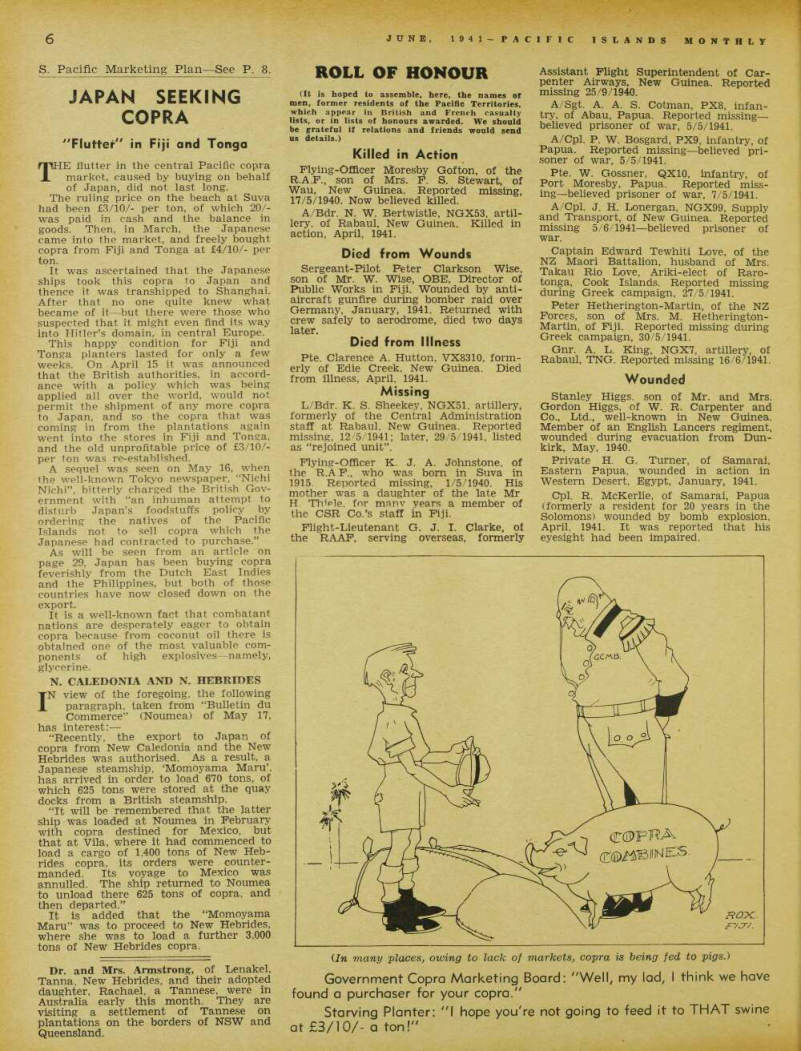
THE flutter in the central Pacific copra market, caused by buying on behalf of Japan, did not last long.
The ruling price on the beach at Suva had been £3/10/- per ton, of which 20/was paid in cash and the balance in goods. Then, in March, the Japanese came into the market, and freely bought copra from Fiji and Tonga at £4/10/- per ton.
It was ascertained that the Japanese ships took this copra to Japan and thence it was transhipped to Shanghai.
After that no one quite knew what became of it —but there were those who suspected that it might even find its way into Hitler’s domain, in central Europe.
This happy condition for Fiji and Tonga planters lasted for only a few weeks. On April 15 it was announced that the British authorities, in accord ance with a policy which was being applied all over the world, would not permit the shipment of any more copra to Japan, and so the copra that was coming in from the plantations again went into the stores in Fiji and Tonga, and the old unprofitable price of £3/10/per ton was re-established.
A sequel was seen on May 16, when the well-known Tokyo newspaper, “Nichi Nichi”, bitterly charged the British Gov ernment with “an inhuman attempt to disturb Japan’s foodstuffs policy by ordering the natives of the Pacific Islands not to sell copra which the Japanese had contracted to purchase.”
As will be seen from an article on page 29, Japan has been buying copra feverishly from the Dutch East Indies and the Philippines, but both of those countries have now closed down on the export.
It is a well-known fact that combatant nations are desperately eager to obtain copra because from coconut oil there is obtained one of the most valuable com ponents of high explosives—namely, glycerine.
N. Caledonia And N. Hebrides
IN view of the foregoing, the following paragraph, taken from “Bulletin du Commerce” (Noumea) of May 17, has interest:— “Recently, the export to Japan of copra from New Caledonia and the New Hebrides was authorised. As a result, a Japanese steamship, ‘Momoyama Maru’, has arrived in order to load 670 tons, of which 625 tons were stored at the quay docks from a British steamship.
“It will be remembered that the latter ship was loaded at Noumea in February with copra destined for Mexico, but that at Vila, where it had commenced to load a cargo of 1,400 tons of New Heb rides copra, its orders were counter manded. Its voyage to Mexico was annulled. The ship returned to Noumea to unload there 625 tons of copra, and then departed.”
It is added that the “Momoyama Maru” was to proceed to New Hebrides, where she was to load a further 3,000 tons of New Hebrides copra.
Dr. and Mrs. Armstrong, of Lenakel, Tanna, New Hebrides, and their adopted daughter, Rachael, a Tannese, were in Australia early this month. They are visiting a settlement of Tannese on plantations on the borders of NSW and
Queensland.
Roll Of Honour
(It is hoped to assemble, here, the names or men, former residents of the Pacific Territories, which appear in British and French casualty lists, or in lists of honours awarded. We should be grateful if relations and friends would send us details.)
Killed in Action
Flying-Officer Moresby Gofton, of the R.A.F., son of Mrs. F. S. Stewart, of Wan, New Guinea. Reported missing, 17/5/1940. Now believed killed.
A/Bdr. N. W. Bertwistle, NGXS3, artil lery, of Rabaul, New Guinea. Killed in action, April, 1941.
Died from Wounds
Sergeant-Pilot Peter Clarkson Wise, son of Mr. W. Wise, OBE, Director of Public Works in Fiji. Wounded by anti aircraft gunfire during bomber raid over Germany, January, 1941. Returned with crew safely to aerodrome, died two days later.
Died from Illness Pte. Clarence A. Hutton, VXB3IO, form erly of Edie Creek, New Guinea. Died from illness, April, 1941.
Missing
L/Bdr. K. S. Sheekey, NGXSI, artillery, formerly of the Central Administration staff at Rabaul. New Guinea. Reported missing, 12/5/1941; later, 29/5/1941, listed as “rejoined unit”.
Flying-Officer K. J. A. Johnstone, of the R.A F„ who was bom in Suva in 1915. Reported missing, 1/5/1940. His mother was a daughter of the late Mr H Thiple, for manv years a member of the CSR Co.’s staff in Fiji.
Flight-Lieutenant G. J. I. Clarke, of the RAAF, serving overseas, formerly
Assistant Flight Superintendent of Car penter Airways, New Guinea. Reported missing 25/9/1940.
A/Sgt. A. A. S. Cotman, PXB, infan try, of Abau, Papua. Reported missing believed prisoner of war, 5/5/1941.
A/Cpl. P. W. Bosgard, PX9, infantry, of Papua. Reported missing—believed pri soner of war, 5/5/1941.
Pte. W. Gossner, QXIO, infantry, of Port Moresby, Papua. Reported miss ing—believed prisoner of war, 7/5/1941.
A/Cpl. J. H. Lonergan, NGX99, Supply and Transport, of New Guinea. Reported missing 5/6/1941 —believed prisoner of war.
Captain Edward Tewhiti Love, of the NZ Maori Battalion, husband of Mrs.
Takau Rio Love, Ariki-elect of Raro tonga, Cook Islands. Reported missing during Greek campaign, 27/5/1941.
Peter Hetherington-Martin, of the NZ Forces, son of Mrs. M. Hetherington- Martin, of Fiji. Reported missing during Greek campaign, 30/5/1941.
Gnr. A. L. King, NGX7, artillery, of Rabaul, TNG. Reported missing 16/6/1941.
Wounded
Stanley Higgs, son of Mr. and Mrs.
Gordon Higgs, of W. R. Carpenter and Co., Ltd., well-known in New Guinea.
Member of an English Lancers regiment, wounded during evacuation from Dun kirk, May, 1940.
Private H. G. Turner, of Samarai, Eastern Papua, wounded in action in Western Desert, Egypt, January, 1941.
Cpl. R. McKerlie, of Samarai, Papua (formerly a resident for 20 years in the Solomons) wounded by bomb explosion, April, 1941. It was reported that his eyesight had been impaired.