Charles J. Bucknell
pp. 58-60 · Read in the full issue
A Pioneer of Fiji
By K. Vellacott Jones
NEARLY 70 years ago a party of can nibals swooped down on an outlying homestead in Fiji and carried off a little white boy as hostage, against the delivery of ammunition, which they demanded from the child’s mother.
To-day, that small boy is a grey-haired veteran of Fiji, and the whole record of his life is interwoven with the history of the Colony. He is Mr. Charles J. Buck nell, of Koro Levu, who arrived in Fiji from Sydney with his parents in 1870 as a child of 18 months, and whose des-
tiny for the ensuing 70 years has been closely linked with the varying fortunes of the islands.
Soon after reaching Fiji, the present Mr. Bucknell’s father negotiated a deal with the Fijians in the Koro Levu dis trict —to-day, a pleasant afternoon’s drive from Suva, but at that time a long way from any place resembling civilisation—and, taking possession of his newly-acquired 750 acres of tropical sea-coast and jungle, established his family in a grass hut and set to work to make his fortune.
Far up in the grim hill country behind them, cannibal tribes along the upper reaches of the Sigatoka River waged intermittent warfare with one another, and feasts of human flesh were still the common custom of the country.
LUCKILY for the Bucknells, they got along very well indeed with their rather unorthodox and alarming neighbours, and, from time to time the cannibal chiefs sent their white friends a tidbit, such as a cooked human hand, from the native ovens. Great diplomacy was needed in the rejection of such gifts; for how was a cannibal warrior to comprehend that such a delicacy was an object of abhorrence to the white man?
Not once, but many times, young Charles, in his wanderings through the bush, chanced upon native villages, when the bodies of fallen foes were being pre pared for the feast; but, in describing the scene, he hastened to add that on
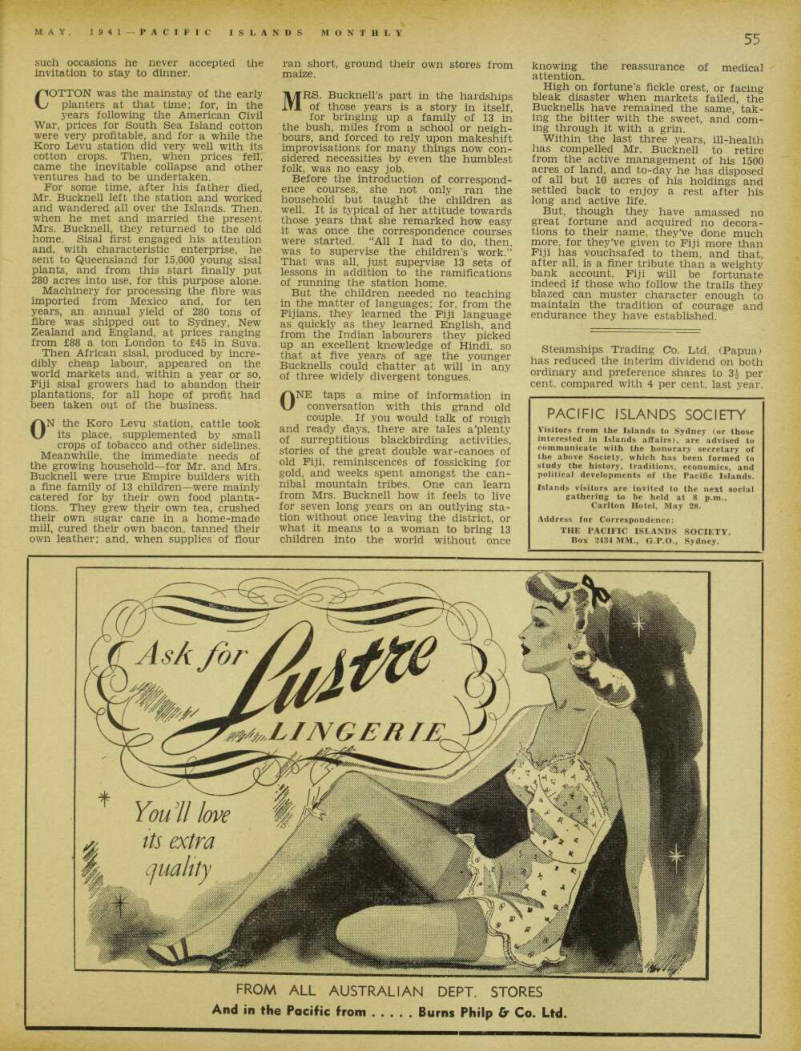
Mr. and Mrs. C. J. Bucknell.
such occasions he never accepted the invitation to stay to dinner.
COTTON was the mainstay of the early planters at that time; for, in the years following the American Civil War, prices for South Sea Island cotton were very profitable, and for a while the Koro Levu station did very well with its cotton crops. Then, when prices fell, came the inevitable collapse and other ventures had to be undertaken.
For some time, after his father died, Mr. Bucknell left the station and worked and wandered all over the Islands. Then, when he met and married the present Mrs. Bucknell, they returned to the old home. Sisal first engaged his attention and, with characteristic enterprise, he sent to Queensland for 15,000 young sisal plants, and from this start finally put 280 acres into use, for this purpose alone.
Machinery for processing the fibre was imported from Mexico and, for ten years, an annual yield of 280 tons of fibre was shipped out to Sydney, New Zealand and England, at prices ranging from £BB a ton London to £45 in Suva, Then African sisal, produced by incre dibly cheap labour, appeared on the world markets and, within a year or so, Fiji sisal growers had to abandon their plantations, for all hope of profit had been taken out of the business.
ON the Koro Levu station, cattle took its place, supplemented by small crops of tobacco and other sidelines.
Meanwhile, the immediate needs of the growing household —for Mr. and Mrs.
Bucknell were true Empire builders with a fine family of 13 children —were mainly catered for by their own food planta tions. They grew their own tea, crushed their own sugar cane in a home-made mill, cured their own bacon, tanned their own leather; and, when supplies of flour
ran short, ground their own stores from maize.
MRS. Bucknell’s part in the hardships of those years is a story in itself, for bringing up a family of 13 in the bush, miles from a school or neigh bours, and forced to rely upon makeshift improvisations for many things now con sidered necessities by even the humblest folk, was no easy job.
Before the introduction of correspond ence courses, she not only ran the household but taught the children as well. It is typical of her attitude towards those years that she remarked how easy it was once the correspondence courses were started. “All I had to do, then, was to supervise the children’s work.”
That was all, just supervise 13 sets of lessons in addition to the ramifications of running the station home.
But the children needed no teaching in the matter of languages; for, from the Fijians, they learned the Fiji language as quickly as they learned English, and from the Indian labourers they picked up an excellent knowledge of Hindi, so that at five years of age the younger Bucknells could chatter at will in any of three widely divergent tongues.
ONE taps a mine of information in conversation with this grand old couple. If you would talk of rough and ready days, there are tales a’plenty of surreptitious blackbirding activities, stories of the great double war-canoes of old Fiji, reminiscences of fossicking for gold, and weeks spent amongst the can nibal mountain tribes. One can learn from Mrs. Bucknell how it feels to live for seven long years on an outlying sta tion without once leaving the district, or what it means to a woman to bring 13 children into the world without once
knowing the reassurance of medical attention.
High on fortune’s fickle crest, or facing bleak disaster when markets failed, the Bucknells have remained the same, tak ing the bitter with the sweet, and com ing through it with a grin.
Within the last three years, ill-health has compelled Mr. Bucknell to retire from the active management of his 1500 acres of land, and to-day he has disposed of all but 10 acres of his holdings and settled back to enjoy a rest after his long and active life.
But, though they have amassed no great fortune and acquired no decora tions to their name, they’ve done much more, for they’ve given to Fiji more than Fiji has vouchsafed to them, and that, after all, is a finer tribute than a weighty bank account. Fiji will be fortunate indeed if those who follow the trails they blazed can muster character enough to maintain the tradition of courage and endurance they have established.
Steamships Trading Co. Ltd. (Papua) has reduced the interim dividend on both ordinary and preference shares to per cent, compared with 4 per cent, last year.
Mr. C. M. O’Loghlen, of Melbourne, has taken up residence in Wau, TNG, where he will practise as a barrister and solicitor.