Important Contingent Now Encamped in Australia
pp. 56-57 · Read in the full issue
Free France's Pacific Men March
To War
1T was announced in Sydney early in May that a considerable number of volunteers, anxious to fight under General de Gaulle for Free France, had arrived in Australia from New Caledonia, Tahiti and New Hebrides, and had gone into camp near Sydney for further train ing, before proceeding overseas. This first contingent comprises mostly Euro peans born in the French Colonies, Euro nesians and a few full-blooded Poly nesians.
Although their number is not large, it is emphasised that this is only the first
contingent and that they have not enlisted under compulsion—on the con trary, they have insisted that their ser vices, in some way, be made available to Free France.
The arrival of this contingent is a not able indication of the character and sen timent of the people of the Free French Colonies in the Pacific.
Story Behind The Contingent
From Our Own Correspondent NOUMEA, April 21. mHE women of New Caledonia have X presented a regimental flag to the Pacific Expeditionary Force of Free France, consisting of men from Tahiti and New Caledonia, the departure of which is imminent. In command of the force is Chef de Bataillon Felix Broche. who was a captain when he passed through New Zealand last November— coming from Tahiti, where he had been in charge of the local troops. On his arrival here he was made military com mander of French Oceania, in which capacity he has taken a leading part in reorganising the defences of the Colony.
He is an energetic officer, worthy of con fidence and respect, and has already done wonders with the native recruits— who, however, are not readv to join the first contingent. This contingent will be equipped and will undergo its final train ing outside New Caledonia. Command ant Broche’s successor will be Chef de Bataillon Jardin. from the Cameroons, who will arrive via the Dutch East Indies and Australia, with his wife and children.
M. Broche’s predecessor was ex-Gov ernor General Maurice Denis who, it is reported, now very much regrets having deserted this country, after three weeks of indecision, for Indo-China.
The allowance for the legitimate wives of European volunteers serving with the contingent has been fixed at 1,000 francs (about £A.7) monthly, with an additional 200 francs for each child. An advance of one million francs, from reserve funds, has been authorised to finance these allowances, which sum will be recuperated later from voluntary contributions and credits authorised by General de Gaulle.
The transport of this contingent was one of the matters discussed between General de Gaulle and Mr. Menzies, when they met in London on March 7.
Present defence measures have thrown extra burdens on that fine body of men, the New Caledonia Gendarmerie. These are the people who administer isolated settlements all over the French islands, and their services correspond with those undertaken by the “Mounties” in the Canadian North-West. They are spe-
cially qualified men, sent out from France before the war. In New Caledonia they have stuck to their posts and maintained law and order, although to some extent weakened by the Petainist exodus to Indo-China last November.
They are now to be increased by the re-enlistment of retired gendarmes living in the Colony, and by the creation of a New Caledonian-born auxiliary force of
men capable of riding and driving a car, reaching certain height and other physi cal standards, and possessing good army records and qualifications, the age limit being placed between 24 and 40. This local recruitment is a radical move, but it conforms both to the need of the hour and to the aspirations of the coun try towards a greater share in its own control.
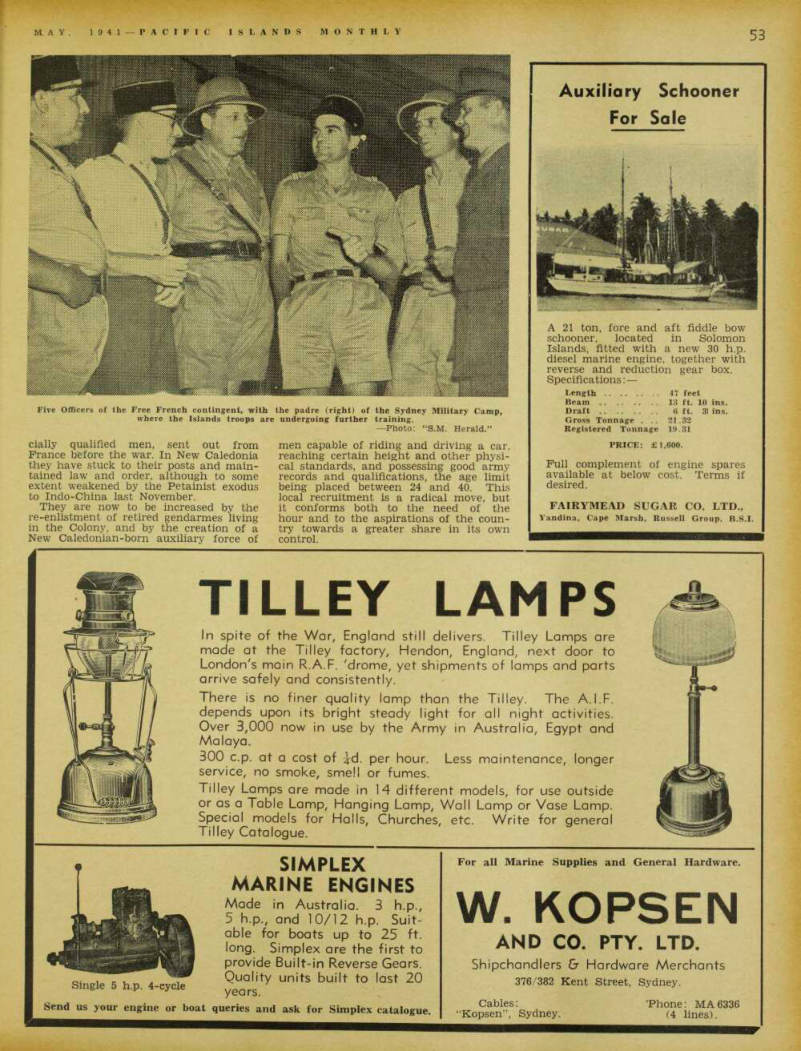
Five Officers of the Free French contingent, with the padre (right) of the Sydney Military Camp, where the Islands troops are undergoing further training.
Photo: “S.M. Herald.”