American Squadron's Call at Tahiti
pp. 24-25 · Read in the full issue
From Our Own Correspondent PAPEETE, March 29.
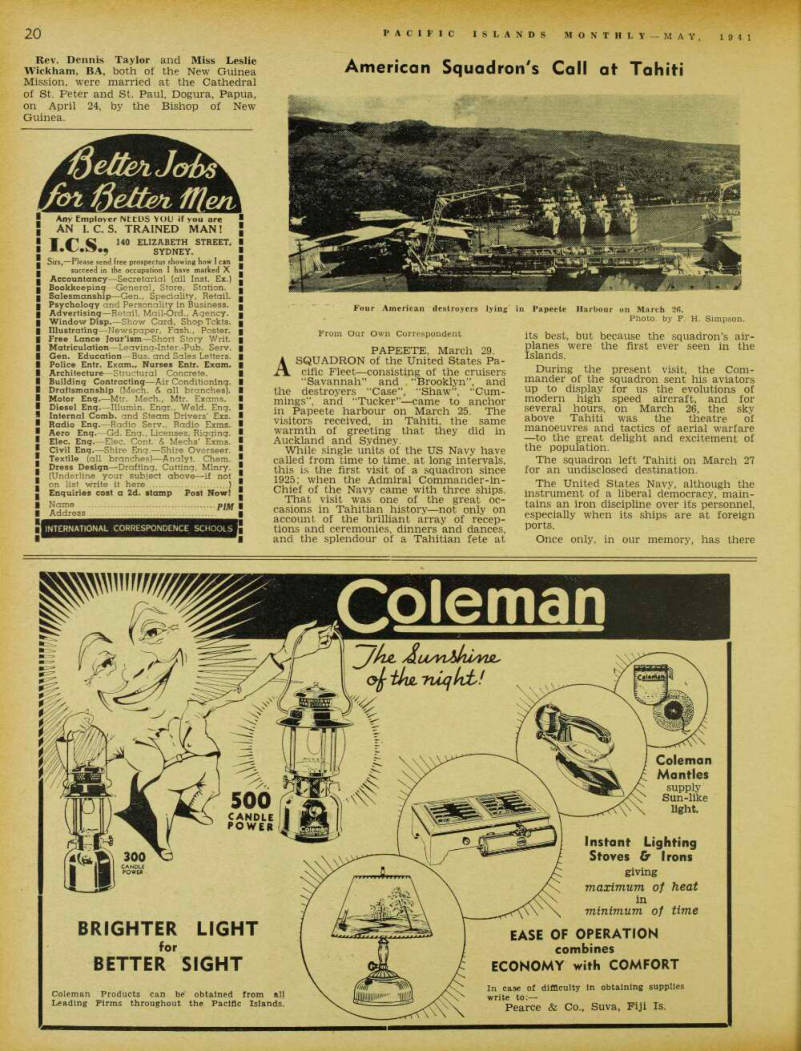
A SQUADRON of the United States Pa cific Fleet—consisting of the cruisers “Savannah” and “Brooklyn", and the destroyers “Case”, “Shaw”, “Cum mings”, and “Tucker” —came to anchor in Papeete harbour on March 25. The visitors received, in Tahiti, the same warmth of greeting that they did in Auckland and Sydney.
While single units of the US Navy have called from time to time, at long intervals, this is the first visit of a squadron since 1925; when the Admiral Commander-in - Chief of the Navy came with three ships.
That visit was one of the great oc casions in Tahitian history—not only on account of the brilliant array of recep tions and ceremonies, dinners and dances, and the splendour of a Tahitian fete at
its best, but because the squadron’s air planes were the first ever seen in the Islands.
During the present visit, the Com mander of the squadron sent his aviators up to display for us the evolutions of modern high speed aircraft, and for several hours, on March 26, the sky above Tahiti was the theatre of manoeuvres and tactics of aerial warfare —to the great delight and excitement of the population.
The squadron left Tahiti on March 27 for an undisclosed destination.
The United States Navy, although the instrument of a liberal democracy, main tains an iron discipline over its personnel, especially when its ships are at foreign ports.
Once only, in our memory, has there
Four American destroyers lying in Papeete Harbour on March 26.
Photo, by F. H. Simpson.
been any incident while a United States warship was at Papeete.
That was shortly after the end of the Great War. Were it not for the sequel, the incident would not be worth recording.
A few sailors, who had become unruly by too much alcohol, had started a brawl which resulted in the wrecking of some chairs and glassware in a couple of drinking places. As this had taken place on the night before the battleship departed, the commanding officer re quested the United States Consul at Papeete to appraise the damage and com pensate the proprietors. The Consul did so, and the incident was apparently closed.
Word had gone forth, however, that the Consul was dispensing funds from the United States’ Treasury. Sundry small merchants began to present belated claims at the Consulate for alleged damages wrought by United States sailors.
Among them came Monsieur X, at that time a photographer and purveyor of miscellaneous wares, who had a rather shadowy reputation in “ways that are dark and tricks that are vain’’. The Con sul knew Monsieur X. Indeed, when the procession of fresh claims began, the Consul expected to see him, sooner or later. He had, therefore, made some in quiries and discovered that the only “incident” was that Monsieur X had scandalously overcharged some perfectly sober and unsuspecting sailors for a num ber of pictures and souvenirs.
The Consul was a man of valour, and of peppery temper. He listened with mounting choler while Monsieur X re counted his damages until he presented a claim for a whole case of watches.
Whereupon the Consul arose, and Mon sieur X found himself executing the parabola of a flight from the entry of the Consulate that landed him literally on his ear in the middle of a very dusty highway.
Monsieur X had nothing more to say.
The dust and shock had extinguished his claims. He pulled himself to his feet, brushed the soil of the highwav from his garments and betook himself from the Consul’s menacing stare—comforted, no doubt, in the knowledge that he lived to plot and scheme another day.