Japan In The South Seas
pp. 29-30 · Read in the full issue
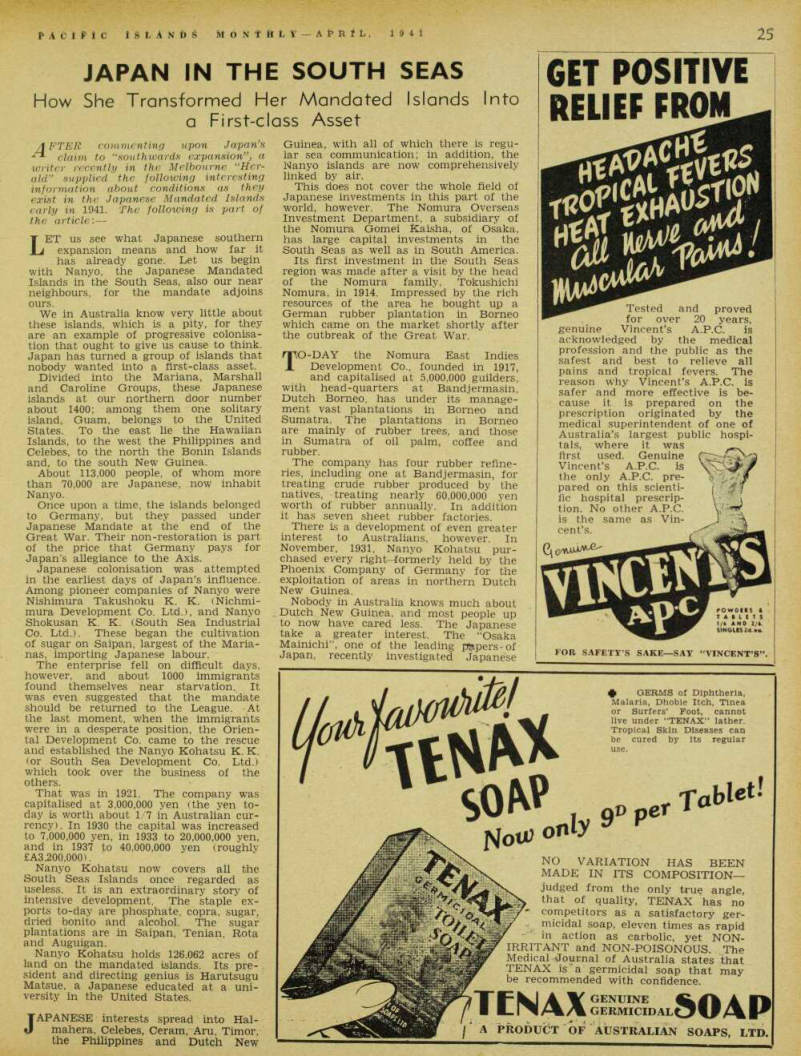

How She Transformed Her Mandated Islands Into a First-class Asset
/t FTER commenting upon Japan’s claim to “southwards expansion”, a writer recently in the Melbourne “Her ald” supplied the following interesting information about conditions as they exist in the Japanese Mandated Islands early in 1941. The following is part of the article :— LET us see what Japanese southern expansion means and how far it has already gone. Let us begin with Nanyo, the Japanese Mandated Islands in the South Seas, also our near neighbours, for the mandate adjoins ours.
We in Australia know very little about these islands, which is a pity, for they are an example of progressive colonisa tion that ought to give us cause to think.
Japan has turned a group of islands that nobody wanted into a first-class asset.
Divided into the Mariana, Marshall and Caroline Groups, these Japanese islands at our northern door number about 1400; among them one solitary island, Guam, belongs to the United States. To the east lie the Hawaiian Islands, to the west the Philippines and Celebes, to the north the Bonin Islands and, to the south New Guinea.
About 113,000 people, of whom more than 70,000 are Japanese, now inhabit Nanyo.
Once upon a time, the islands belonged to Germany, but they passed under Japanese Mandate at the end of the Great War. Their non-restoration is part of the price that Germany pays for Japan’s allegiance to the Axis, Japanese colonisation was attempted in the earliest days of Japan’s influence.
Among pioneer companies of Nanyo were Nishimura Takushoku K. K. (Nichmi mura Development Co. Ltd.), and Nanyo Shokusan K. K. (South Sea Industrial Co. Ltd.). These began the cultivation of sugar on Saipan, largest of the Maria nas, importing Japanese labour.
The enterprise fell on difficult days, however, and about 1000 immigrants found themselves near starvation. It was even suggested that the mandate should be returned to the League. At the last moment, when the immigrants were in a desperate position, the Orien tal Development Co. came to the rescue and established the Nanyo Kohatsu K. K. (or South Sea Development Co. Ltd.) which took over the business of the others.
That was in 1921. The company was capitalised at 3,000,000 yen (the yen to day is worth about 1/7 in Australian cur rency). In 1930 the capital was increased to 7,000,000 yen, in 1933 to 20,000,000 yen, and in 1937 to 40,000,000 yen (roughly £A3,200,000).
Nanyo Kohatsu now covers all the South Seas Islands once regarded as useless. It is an extraordinary story of intensive development. The staple ex ports to-day are phosphate, copra, sugar, dried bonito and alcohol. The sugar plantations are in Saipan, Tenian, Rota and Auguigan.
Nanyo Kohatsu holds 126,062 acres of land on the mandated islands. Its pre sident and directing genius is Harutsugu Matsue, a Japanese educated at a uni versity in the United States.
JAPANESE interests spread into Hal mahera. Celebes, Ceram, Aru. Timor, the Philippines and Dutch New
Guinea, with all of which there is regu lar sea communication: in addition, the Nanyo islands are now comprehensively linked by air.
This does not cover the whole field of Japanese investments in this part of the world, however. The Nomura Overseas Investment Department, a subsidiary of the Nomura Gomei Kaisha, of Osaka, has large capital investments in the South Seas as well as in South America.
Its first investment in the South Seas region was made after a visit by the head of the Nomura family, Tokushichi Nomura, in 1914. Impressed by the rich resources of the area he bought up a German rubber plantation in Borneo which came on the market shortly after the outbreak of the Great War.
TO-DAY the Nomura East Indies Development Co., founded in 1917, and capitalised at 5,000,000 guilders, with head-quarters at Bandjermasin.
Dutch Borneo, has under its manage ment vast plantations in Borneo and Sumatra. The plantations in Borneo are mainly of rubber trees, and those in Sumatra of oil palm, coffee and rubber.
The company has four rubber refine ries, including one at Bandjermasin, for treating crude rubber produced by the natives, treating nearly 60,000,000 yen worth of rubber annually. In addition it has seven sheet rubber factories.
There is a development of even greater interest to Australians, however. In November, 1931. Nanyo Kohatsu pur chased every right-formerly held by the Phoenix Company of Germany for the exploitation of areas in northern Dutch New Guinea.
Nobody in Australia knows much about Dutch New Guinea, and most people up to now have cared less. The Japanese take a greater interest. The “Osaka Mainichi”, one of the leading papers- of Japan, recently investigated Japanese
activities there, and its special correspondent, Shintaro Shimasaki, embodied his conclusions in four articles.
Mr. Shimasaki points out that an estimate puts the population of the whole of New Guinea Island at 200,000 the population of one small ward in TTokyo.
Roads, he says, seem to have been left out of thecolonia! scheme of New Guinea by the Dutch Such as exist at all are usually mere paths, and in many piaces there are none. In northern Dutch New Guinea he found not even a horse vehicle, much less a car.
Sea communication is bad, but a weekly air service has recently been opened Sf a es^i r ally" nS ptonlering in nnrfh Tuffimiit a Diitrh attpmot at colonisation bv half-castes failed Some work was done by individual Japanese, and in 1933 Nanyo Kohatsu purchased the land belonging to Jutaro Hosotani, a Japanese who had gone there in i9ii.
This was only 882 acres, and in 1937 the company leased an additional 2205 acres, employing 1500 workers to cultivate cotton and jute, with an interest also in tapioca, coconuts, fibrous plants and rubber.
A lease has been drawn up with the Dutch authorities for 2450 acres of as yet undeveloped land. In all the Nanyo Kohatsu interests in New Guinea are:— pinnfnHnn Momi Sarmi Nabire Resin Plantation. Momi.barmi.
Area loocaH 735 54 77 175 PinnnPrt S 2695 8575 ’
No coolies 1200 50 300 "
Tmfrf n rp about 30 Jananese at Momi toeeat
thS Elsewhere,
fold troubles” in the distressing conditions of the jungle.
Putting together the total amount of territory marked out for development by the Japanese and by the Dutch themselves, Mr. Shimasaki remarks, the total does no t exceed 24,500 acres, but territory with the possibility of development is unlimited.
“ W ell wate red by the inexhaustible waters that come out of the snow-capped mountains, with vast territories as yet uneX plored for their possible treasures> the resources of New Guinea present intriguing possibilities. Even the regions bordering on the sea coast alone are to take care of enormous numbers of immigrants.”
Shimasaki thinks that statements iri by prospectors that the chances of oil discovery are slight must be taken with a gram of salt.
The attitude of the authorities towards Japanese, he says, is one of “extreme nervousness”, and armed soldiers—under the guise of protection—follow the Japanese visitor about. The office of Nanyo Kohatsu was twice searched.
Mr shimasaki thinks the Dutch claim on New Guinea “vague and doubtful”, an d compares the Dutch administration unfavorably with that of the Australian parts of New Guinea.
“Question remains whether the Dutch are entitled to sovereignty over their land » he says . “Holland has too much land and even the development of Sumatra is just beginning.”
In any case, he considers, the Dutch have made a mess of New Guinea—and as Palau is only 500 miles away the Japanese are the people for the job.
Holland should be willing to turn over
the job of exploiting New Guinea to the Japanese—at least Mr. Shimasaki says so - Nor is Mr. Shimasaki alone in believ ing that Dutch New Guinea is unlikely to remain a blank on the map for ever, c A ..<.u c Development ot South Seas
Fishing Industry
Tttn ,
rivHE key to a solution of Japan s food A problem is stated by the ‘‘Chugai Shogyo” newspaper to lie in the development of the fishing industry in the South Seas, reported the “NZ Her aid” on February 18.
Experimental Ashing stations were set U P ln the Japanese mandated islands nine years ago and investigations re vealed that the shores of these islands are washed by a north equatorial cur knr}gmg rich schools of bomto, while another cross-current carries large numbers of tunny.
About 70 Japanese fishing boats, dis placing from 100 to 200 tons each, are a t present operating the year round in the waters near the Caroline Islands and the seas north of New Guinea. Each trip is said to net the boats about 60,000 yen, or about £3,750, and nine trips are normally made by each vessel per year, thus bringing ship earnings to 540,000 yen, or about £33,750.
The “Chugai Shogyo” suggests the establishment of advance bases in the mandated islands. Cold storage ships would be constructed to transport foiDd, drinking water, fuel and other necessities to the fishing vessels operating m the South Seas. Saipan and Ponape Islands are suggested as the best sites for such advance bases.