Memories Of "Queen Emma"
pp. 24-28 · Read in the full issue
Deaths of J. M. C. Forsayth and Mrs. Grace Schmidt
By R. W. Robson
A REMINDER of one of the most re markable and romantic personalities in last century’s history of the Pacific —namely, “Queen Emma of New Britain” —was contained in the brief announcement, in the Sydney news papers in mid-March, that the death had occurred, at a private hospital in Sydney on March 14, of Jonas Mynderse Coe Forsayth, aged 69.
Curiously enough, on the same date, March 14, there appeared in the “Rabaul Times” an announcement arousing the same set of memories—a report of the death on March 8 of Mrs. Grace Forsayth Schmidt, of Rainau Plantation, Kokopo, at the age of 74.
J. M. C. Forsayth, a rich man, long prominent in the Sydney social and sporting world, was a son of Queen Emma. Grace Schmidt was her sister.
For the following interesting story, I am indebted to Captain J. Lyng’s book, “Our New Possession”; to the diary of my old friend, Mr. J. T. Goedicke, of Haapai, Tonga; and to a variety of old newspaper cuttings. As far as I can tell from cross-checking, the story is true in outline, and substantially true in detail.
IN the ’fifties of last century, a hand some young American, Jonas Coe, was American Consul at what was then an important cross-roads station in the
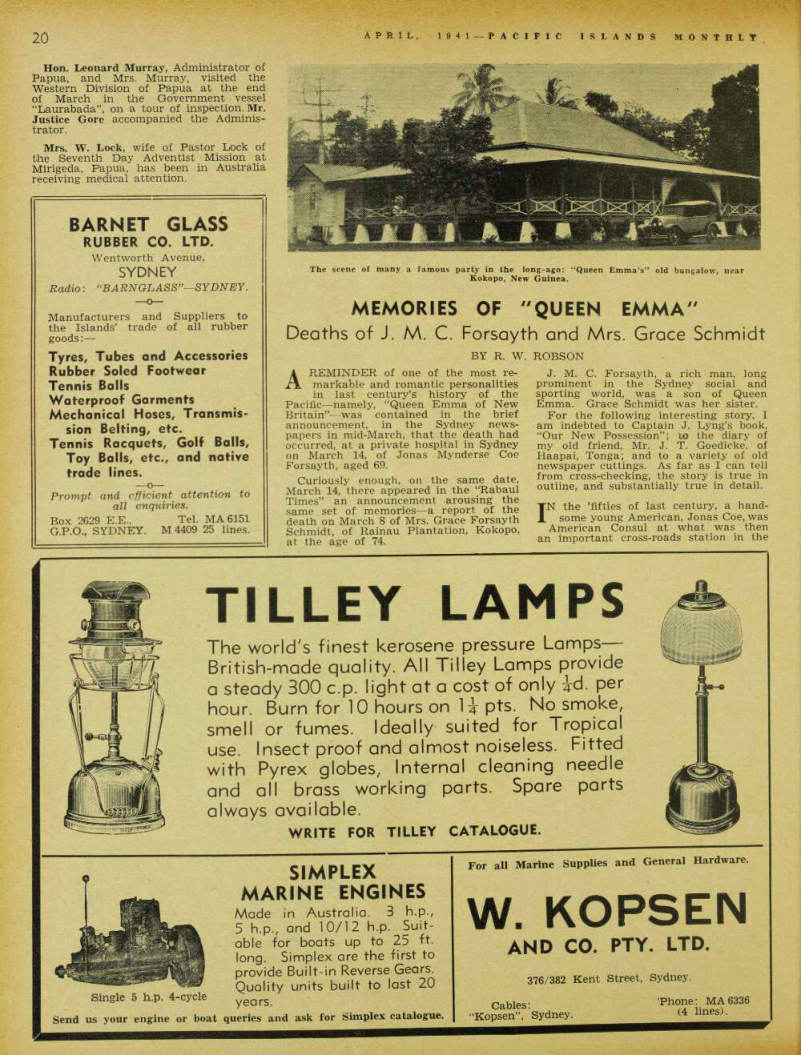
The scene of many a famous party in the long-ago: “Queen Emma’s” old bungalow, near Kokopo, New Guinea.
Pacific, Apia, in Western Samoa. It was “unspoiled Polynesia”—a rich and beau tiful country, wherein Europeans found a life of ease, and the most alluring women in the Pacific.
It is not surprising that Jonas Coe, soon after his arrival in Apia, married a beautiful Samoan girl. One report says that he married, in succession, two sisters, and another report says that, by his marriage, he had five children, of whom Emma was the eldest. It is sug gested, in one place, that Grace was older than Emma, and Grace’s name does not appear in the list of five children. Grace may have been a child of the first marriage: but as Grace was born in 1867, and Emma about 1855, it is likely she was the youngest (sixth) child of the second marriage. At any rate, we know that there were six Coe children, as follows: — Grace, born in 1867; educated in United States and Dubbo, NSW; joined Emma in New Britain in 1886; married Captain Rondahl in 1896 and settled at Kakabaul; married Walter Schmidt in 1912.
Emma, whose story follows. Born about 1855, married Forsayth 1871, married Kolbe about 1912, died 1912.
Phoebe, who later joined Emma in New Britain, and there married Mr.
Parkinson, who was manager for Queen Emma.
Essey, who married Captain Jobst.
Robert and William, both of whom were in New Britain with Queen Emma fifty years ago.
Emma grew up in Apia, and was des cribed by a contemporary writer as the cleverest and most beautiful girl in Samoa. She was sent to San Francisco for her education; and, when she re turned to Samoa, she “knocked ’em cold”. It appears that every eligible male in the South Seas scrambled for the hand of the beauty, and the prize went to a cultured Englishman, named Forsayth.
The marriage was not a success. One gets the impression of a jealous husband who was rather hedged around with a sense of the proprieties, and a beautiful and popular young wife, whose soaring and exalted spirit could not be held down.
They remained together long enough to have one son —the J. M. C. Forsayth, who died on March 14 —and (according to one not very reliable record) one daughter. Then they appear to have parted.
THE general belief is that Emma left Forsayth and ran away with Thomas Farrell, a miner from New Zealand, who was then a hotelkeeper in Apia.
But a New Guinea correspondent, who ought to know, assures me that that was not so. He says that Forsayth was drowned, while at sea; that Consul Coe tried hard to induce Emma then to marry a man in Samoa, of whom he thought highly; but that Emma rebelled, and ran away with Farrell.
It is clear, however, that Emma For sayth and Thomas Farrell, two people of notable quality and good looks, did come together at this time (somewhere be tween 1875 and 1880); that they were happy together; and that eventually they fitted out a trading schooner and went adventuring together into the north-west, far away from the probably disapproving people of Samoa.
Some records suggest that they never married. My incomplete data indicate that they did marry. She was known, for the next 30 years, as “Mrs. Farrell”.
There is here a wonderful story of romance and adventure —but we shall skip it —this is war-time, and paper is rationed. In due time Emma and Farrell arrived in the little Duke of York group (between the great islands of New Ire land and New Britain) and began trad
ing with the natives. Their enterprises flourished, and soon they had many trading stations and ships. They moved across to the mainland, near the entrance to what is now Rabaul Harbour, and, buying land from the natives for the proverbial song, they established cocnut plantations in what is now the Kokopo district.
THIS probably was about 1879 or 1880.
It was an interesting period. The Germans were thrusting into the South Seas, and displaying a lively interest in the New Guinea region, which afterwards became known as their colony of Bismarck Archipelago.
That singularly ill-fated colonising expedmon, led by the Marquis de Rays, arrived about this time (1880) and tried to establish a settlement in the feverridden district at the southern tip of New Ireland, near where Emma and Farrell had established their first trading station, in the Duke of York Islands.
They helped to rescue the wretched survivors of the Colony.
171R.0M 1880 to 1900, when she appar- I 1 ently was between 25 and 45 years of age, was the halcyon period of the life of Emma Forsayth (or Farrell) She now was a handsome, vital woman of immense personal charm and marked business ability. Farrell, her partner, was closely associated with her in the “eighties”, out it is reported that he died somewhere about 1890, and that she went on very successfully alone.
By this time, there was a considerable and growing German community in Rabaul district, and the Farrells and the Germans seemed to vie with each other in unrestricted hospitality. Emma was soon rich; her trading schooners ranged all over the north-western Pacific; and it was then that she ac quired the soubriquet of Queen Emma” —by which she was known until her death.
Queen Emma’s household grew rapidly, She brought from Samoa brothers, sisters and numerous other relations—handsome, high-spirited young people, who definitely
supplied the Kokopo district with social atmosphere. Queen Emma’s unstinted hospitality, her endless dinners, and her lavish champagne parties, are still talked about in that end of what is now the Mandated Territory of New Guinea.
WHEN the first decade of this century opened, Queen Emma was middle aged, but still handsome and clever.
She was immensely rich, and her gay spirit defied the oncoming years.
Between 1910 and 1912, she sold out all her interests in the then German colony to a German company, for £175,000; and, somewhere about that time, she married a handsome young German officer, Captain Kolbe, who was her junior by many years. Apparently, she lived in Berlin between 1912 and 1914. Then there came tragedy. This is taken from a book published in 1919: — “Before she left New Britain with her new' husband for a trip to Europe, the residents showed their respect for this remarkable woman by giving her almost a royal send-off. . . . Both of them died at Monte Carlo, in August, 1914, with but a day between them. The mystery surrounding their sudden death has never been cleared up. All we know is that a lady from Germany, who claimed a prior right to Captain Kolbe, had arrived at Monte Carlo, and that Emma
survived her husband by a day. . . . Her body was cremated and the ashes were interred at the same place in New Britain where she, then a young and charming woman, had landed, 33 years earlier.”
Sic transit gloria mundi!
NOW, here are some interesting ex tracts from the diary of Mr.
Goedicke: “February 16, 1884.—1 took over the Tolelevo Plantation, next to Farrell’s, at Ralun (near Kokopo).
“August 20, 1885.—Entertainment at Ralun by Mrs. Farrell (Emma Coe). I
there meet a young Mr. Forsayth, who is visiting Mrs. Farrell.” (Note. —This, apparently, was Queen Emma’s son, J.
M. C. Forsayth, who then was about 13 years old. It was said of him when he died, in March, 1941, that “few men possessed such intimate knowledge of the Melanesian and Polynesian races, and successfully studied the psychology of the former savage inhabitants of the Pacific Islands. For a number of years he owned extensive plantations in New Britain, New Ireland, the Solomon Islands, and many of the outlying groups, extending as far eastward as Tahiti. He also controlled a number of trading stations. His fleet of schooners and smaller vessels was a source of much pride to him, but he relinquished most of his interests to settle in Sydney.” It is indicated, therefore, that young For savth joined his mother in her remark ably successful trading operations in the Islands.) “February 2, 1886. —A native woman who had been selling taro to Mrs. Farrell stole a piece of linen from the clothes line. They sent 15 Buka boys in pursuit, to bring the thief back. They boys re turned without the thief, reporting ‘He woman no good—all same he dead’.” (They thus delicately intimated that the woman had been raped by all the 15 Buka boys, and left for dead.) “February 4, 1886. —Mr. Parkinson ar rived at Ralun to-day just in time to save Mrs. Farrell (Queen Emma) from being carried off into the bush by a lot of excited kanakas. They already had
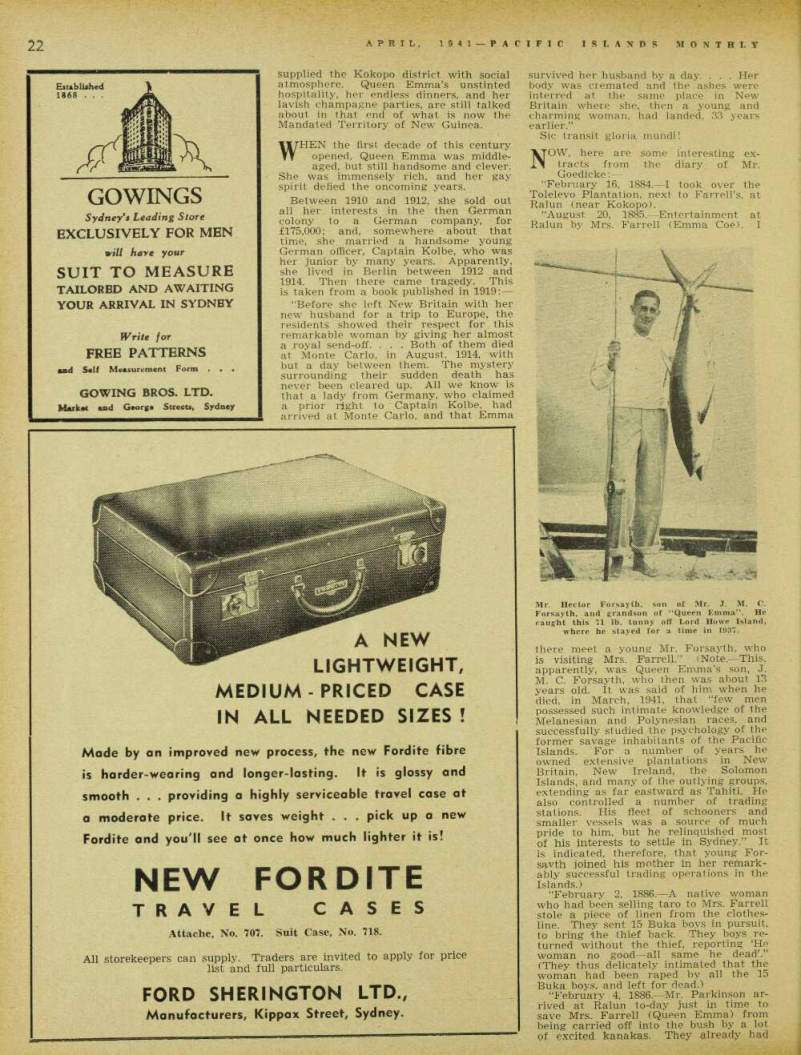
Mr. Hector Forsayth, son of Mr. J. M. C.
Forsayth, and grandson of “Queen Emma". He caught this 71 Ib. tunny off Lord Howe Island, where he stayed for a time in 1937.
tied Mrs. Farrell, pig-fashion, to a pole, to be carried off, as a revenge for the rape committed by the Buka boys.”
In his diary, during 1886, Mr. Goedicke refers to “Farrell, Junior”, on a number of occasions; and says that in Sydney on May 16, 1886, he called on Mr. Thomas Farrell, at Petersham. * * * The story of Queen Emma—her glori ous youth, her adventurous and romantic life, and her tragic, mysterious death— should be well worth telling, if only someone will get busy now, and inter view in New Guinea, and elsewhere, a number of ageing people, who are the last surviving links with that colourful period of the 'eighties.