Pacific News-Review
pp. 3-4 · Read in the full issue
Notes And Comment On
The Progress Of The War
From March 12 To April 15
Mar. 12; Unofficial reports indicate that the British are transporting at least 10 divisions, with full equipment, from North Africa to Greece, to support the Greek Army against the expected Ger man thrust from Bulgaria.
Mar. 14: Official quarters in London learn that the Germans have somehow established three divisions in Tripoli, including a modem mechanised division.
This is regarded as a dangerous threat against the light British forces now occupying Eastern Libya.
Mar. 14: US Congress has been asked by the President for an immediate appro priation of seven billion dollars, to assist the rapid production of every possible gun and plane for the assistance of the Hpmnprfi pjpq Mar. 14: The Italian counter-offensive in Albania, against the Greeks, has failed completely.
Mar. 15: To an increasing degree, as the weather improves, widespread raids are being carried out by the RAF over Germany and by the Germans over Britain. Many German towns in Cen tral and Western Germany, including Berlin, have been heavily bombed, while, in Britain, Glasgow, Liverpool and Hull have suffered severe attacks.
Mar. 15: German mechanised units are in contact with Australian advanced troops in Central Libya.
Mar. 15; British troops in Eritrea and Abyssinia are making steady and, in places, rapid progress, and the Italian armies are in retreat everywhere.
Mar. 17; In a notable speech, President Roosevelt stated that the republic was now completely united in an all-out effort to help the democracies win the war. He promised ships, planes, food, tanks, guns, ammunition and supplies of all kinds.
Mar. 17: Germany continues pressure upon Yugoslavia, but the Belgrade radio says Yugoslavia is determined to be a non-belligerent, and will use her troops only to retain her integrity.
Mar. 17: The Italian losses in the offensive against the Greeks in Albania are estimated at over 50,000.
Mar. 17: The final phase of the Abys sinian campaign has begun. The capital, Addis Ababa, is threatened by British columns from the east and west.
Mar 18: It is reported that the United States will not permit the Nazi blockade in the North Atlantic to keep American aid from Britain and America is pre pared to resort to convoys if necessary.
Mar. 18: United States Secretary for the Navy said the United States in the Pacific has the most hard-hitting and powerful fleet afloat, and it is ready for any eventuality. . , Mar. 18; The British have recaptured Berbera, capital of British Somaliland, and are now re-occupying British Soma liland, which was abandoned to the Ita lians some months ago.
Mar. 20; A Presidential order for the convoying of United States ships to Britain is expected in May; but other American experts advise abandonment of a convoy system and, instead, the crea tion of a lane of American destroyers between the United States and Britain.
Mar. 20; Reports are circulating that Yugoslav ministers will sign the Axis pact on Wednesday, in Berlin, in the presence of Japanese Foreign Minister Matsuoka.
Mar. 20: An extraordinarily cordial re ception was given by Sydney to an American naval squadron. At least half a million people cheered the American bluejackets as they marched through the
main streets of the city.
Mar. 21: It is understood that Yugo slavia has agreed to economic co-opera tion with the Axis in return for territorial integrity and independence.
Mar. 21: There are widespread, uncon firmed reports that Japan intends to move 100,000 troops through Indo-China, to Thailand, to be used, if necessary, against Malaya or Burma.
Mar. 24: Heavy British naval forces chased a German battle-squadron, be lieved to have been the “Scharnhorst” and “Gneisenau”, in the Atlantic, for two days.
Mar. 24: Three British columns are now racing towards Addis Ababa, capital of Abyssinia, and the Italians continue everywhere their retreat into the moun tain fastnesses of the country.
Mar. 25: The Premier of Yugoslavia, at Vienna, to-day, formally signed a protocol whereby Yugoslavia joins the Axis Pact.
This coincides with the arrival of Japan ese Minister Matsuoka in Berlin, and it is being widely hailed by the Axis as a great victory for German diplomacy.
Mar. 25: The defence appropriation of seven billion dollars was passed through the United States Congress in record time. Preparations are being hastened for the transfer to Britain of large quantities of naval and mercantile shipping.
Mar. 26: Now that Yugoslavia has joined the Axis an attack by Germany against the Greeks in Macedonia is hourly expected. A British Army is being moved into position to protect the Greek right flank.
Mar. 26: It is announced that an armoured German detachment has ap peared on the borders of Tripoli, south west of Benghazi, and that the British light forces there have been withdrawn towards Benghazi. There is renewed speculation regarding the strength of the German detachments in Libya.
Mar. 27: By a sensational military coup, in Belgrade, the Yugoslav Government, which signed the pact with Germany, has been thrown out, a new anti-Axis Govern ment has been appointed, and King Peter 11, 18 years old, has been brought forward to displace the three members of the Regency Council. Prince Paul, senior Regent, has fled the country and the former premier has been placed under arrest.
This sudden, unexpected and forth right defiance of the Axis is the most notable political development of recent months. Germany’s so-called diplomatic triumph has turned to sawdust in her mouth; and Germany now must fight Yugoslavia, to get at Greece, instead of quietly walking over the country. On the other hand, is feared that Germany will attack quickly, and the Yugoslavs will not have an opportunity to prepare an effective defence against the encircling German armies.
Mar. 27: There is increasing anxiety, owing to the rapid advance of the Ger man mechanised forces in Central Libya.
It is indicated that the appearance of these forces in such strength has taken the British High Command by surprise.
Is Germany carrying out her “pincers movement” (through Libya and through the Balkans) against the Suez Canal and the Iraq oilfield?
Mar. 28: Germany, while demanding from Yugoslavia an immediate indication of her attitude towards the Axis Pact, which Germany claims Yugoslavia has signed, is rapidly moving armies towards the northern and eastern borders of Yugoslavia. Britain and United States
have promised the new Yugoslav Govern ment all the aid in their power.
Mar. 28: Keren, the fortified town which is the key to Asmara (capital of Eritrea), and Harar (second largest town in Abyssinia), were captured to-day by the British. The retreating Italians are being heavily shelled and bombed.
Mar. 30: The naval battle of Cape Matapan was fought between the British and Italians in the Eastern Mediterranean on Mar. 28. The Italian fleet had moved out to attack a British convoy, between Alexandria and Greece, and was trapped by the British Fleet. The British sank three 10,000-ton cruisers; two (probably three) destroyers; and severely damaged several other vessels, including one 35,000ton Italian battleship. The British suf fered no casualties or damage.
This is regarded as the outstanding naval success of the war. It completely alters the balance of naval power in the Mediterranean, and cripples the Italian navy as an effective unit. The notable feature of the battle, which lasted the better part of two days, was the effective use and destructive power of large fleets of British planes—bombers from Egypt and Libya, co-operating with machines of the Fleet Air Arm.
Mar. 31: United States Government has seized 28 Italian ships, tied up in Ameri can ports, which were being sabotaged by their crews; has placed guards on a num ber of German freighters; and has taken 35 Danish ships into “protective custody”.
Apl. 1; Great destructive raids by Ger man ’planes upon Britain, and by RAF planes upon Germany, are carried out al most every night—too frequently to per mit enumeration.
Apl. 1: Germany continues to concen trate divisions upon the frontiers of Yugoslavia and a general mobilisation has been ordered in Bulgaria.
Apl. 1: The two German battleships, “Scharnhorst” and “Gneisenau”, which were hunted in from the Atlantic by British warships, are now sheltering in the French port of Brest, and RAF ’planes are maintaining a constant patrol there, night and day. The ships are being bombed frequently and it is unlikely they can escape.
The British Admiralty has been re markably silent concerning this incident.
It is evident that the two German war ships, busily raiding commerce in the Atlantic, were suddenly rounded up by the British fleet, and they must have been hard-pressed, otherwise they would not have gone into Brest, where they obviously are trapped.
Apl. 2: Germany and Italy have de manded that the United States release the seized Axis ships. Their demands are being rejected. Central and South Ameri can nations have followed the United States, and seized German and Italian ships in their ports, in order to prevent sabotage.
Apl. 2: Italy, on April 1, declared As mara (capital of Eritrea) an open town, and Asmara was formally surrendered to the British. A British column is already half-way to Massawa, the Red Sea port and naval base, where considerable Italian forces are gathered.
Apl. 2: The British, in last night’s raid on Emden, where terrific damage was done, used a new and powerful bomb of a secret type.
Apl. 3: Count Teleki, Premier of Hun gary, committed suicide rather than obey Hitler’s command that Hungary, under her pact with the Axis, should make war
upon Yugoslavia. Yugoslavia and Hun gary, some time ago, signed a mutual friendship pact and the Premier pre ferred to die rather than break his word.
Apl. 3: The British conquest of Eritrea is now practically complete, and the various British columns are racing to complete the conquest of Abyssinia be fore the rainy season commences.
Apl. 4: After so many successes, British opinion was given a sharp shock by the announcement that the British forces in Libya have retired hurriedly from Ben ghazi eastwards into Cyrenaica owing to heavy pressure by large German forces coming eastward from Tripoli, with large numbers of tanks. No one had taken much notice of American press warnings that a very large German mechanised force had somehow been transferred from Italy to Tripoli.
Apl. 5: The RAF continues to hammer with heavy bombs at the naval base at Brest, where the two German battleships have sought shelter.
Apl. 6: Early to-day Germany declared war on Yugoslavia and Greece, and the waiting German armies marched imme diately against both countries. Ignoring a Yugoslav declaration that Belgrade was an open town, German bombers attacked and seriously damaged the city. It is es timated that the Germans are employing at least one million men, with masses of tanks.
Apl. 6; The British approach to Mas sawa, the Italian port on the Red Sea, compelled five Italian destroyers to put to sea. Three were destroyed by ’planes of the Fleet Air Arm, and two were scuttled by their crews.
Apl. 6: President Roosevelt has ordered the construction of 212 merchant ships for Britain, which will be built in 60 new shipyards and will be ready early in 1942.
Apl. 6: A few hours before Germany declared war on Yugoslavia, Moscow of ficially announced that Russia and Yugo slavia had signed a pact of friendship and non-aggression.
Apl. 7: German columns, led by tanks and dive-bombers, have already pene trated across the Yugoslavian and Greek frontiers, to a depth of 20 to 25 miles.
A British army, comprising British, Aus tralian and New Zealand troops, is in position between Mount Olympus (in Greece, west of Salonika) and Koritza (on the border, between Greece and Albania).
Apl. 7: South African forces reached and occupied Addis Ababa, the capital of Abyssinia, after an extremely rapid march over 700 miles of bad country.
Apl. 8; Under intense German pressure, Yugoslav troops in Southern Serbia with drew, thus uncovering the Greek left flank. This caused a hurried withdrawal of the Greek Army protecting Salonika,
and the way now is apparently open for the Germans to march into Salonika. The Germans, owing to the collapse of the Yugoslav defence, entered the upper parts of the Struma and Varda Valleys, down which they are marching towards the Aegean Sea.
Apl. 8: RAP heavily attacked the Ger man naval base at Kiel. The raid lasted five hours, and enormous destruction was done.
Apl. 8: The British in Libya are still falling back, and German and Italian forces have occupied Derna.
The British, however, have practically finished their task of cleaning up the Italian forces in Eritrea and Abyssinia and probably 100,000 men will be released for the defence of the western frontier of Egypt, if necessary.
Apl. 9: The Germans to-day occupied the Greek port of Salonika. Most of the Greek forces in Salonika and Eastern Thrace, together with most of their war materials, were successfully withdrawn behind the Greek and British front, westward of Salonika.
Apl. 9: The Italian Red Sea port of Massawa was occupied by the British to-day.
Apl. 9: President Roosevelt announces that plans are afoot to take perman ent possession of 69 Italian, German and Danish ships, recently seized in United States ports. This will make additional shipping available to Britain.
Apl. 9: A British Admiralty announce ment indicates that an intense battle is proceeding in the Northern Atlantic between German U-boats and dive bombers, on the one side, and British warships on the other. The Prime Minis ter (Mr. Churchill) has stated that on the outcome of this battle, which may last for months, really depends the out come of the war.
Apl. 10: German forces are thrusting eastward from Bulgaria towards the Adriatic in an effort to divide the Yugo slav armies in the north from the Greeks and British, in the south. Generally speaking, Yugoslav armies, totalling per haps 700,000 men, have put up a very brave and courageous, but scattered and disorganised, resistance to the Germans.
Apl. 10: British tanks and reinforce ments, which were sent by .sea, have been established in strong force at Tobruk, in Libya. Otherwise, the British forces are still falling back upon the Egyptian frontier. Over 2,000 British have been captured, including three British generals.
Apl. 10: The Japanese Foreign Minis ter, Matsuoka, is now in Moscow, con ferring with the Soviet authorities and seeking a pact with Russia.
Apl. 10; The British Commander in Chief in the Far East is visiting Manila
and Hong Kong, where he is holding conferences with American and British commanders.
Apl. 11: The Germans have occupied most of northern Yugoslavia, including Zagreb (capital of Croatia). Croatia has been proclaimed an independent state under Nazi protection.
Apl. 11; Hungarian armies are march ing against Yugoslavia, in obedience to Nazi demands under the Axis-Hungarian pact.
Apl. 13: The German and Italian troops in Libya have surrounded the British troops in Tobruk, and have advanced and occupied Bardia. The British are still falling back to western frontier of Egypt.
Apl. 13: Russia and Japan signed a pact of neutrality and friendship to-day.
Matsuoka, the Japanese Foreign Minis ter, has departed for Tokyo, He was farewelled at the railway station by Sta lin—an unprecedented gesture by the Russian dictator.
Apl. 14: The defeated and retreating Italian forces are now cooped up in all sorts of valleys in Abyssinia, and are being mopped up by the British Imperial Forces.
Apl. 14: British and Empire forces have repulsed many German tank attacks in Greece; but it is officially announced that the British have withdrawn to pre pared positions, further back. The Ger mans are re-organising for a fresh push, for which they have accumulated huge supplies at Monastir, but they are being hampered by bad weather and incessant attacks by the RAF.
Apl. 14: Further reports say that the Serbs, thrusting southwards along the coast into Albania, have occupied Dur azzo and are attacking the Italians in the rear.
Apl. 14: The German Libyan columns have now reached the western frontier of Egypt and have occupied Solium and Fort Capuzzo.
Apl. 14: The RAF is still hammering away at the two German battleships in the French port of Brest.
Apl. 15: The Greek armies have been withdrawn from Koritza (on the border between Greece, Bulgaria and Albania).
Apl. 15: The British Army has been instructed to withdraw from the west ern border of Egypt to the line of Mersa Matruh, 150 miles inside the Egyptian border, where it will meet the advancing German forces on the strong defensive lines which were built to meet the Italian invasion last year.
Apl. 15: The British forces, encircled by the Germans at Tobruk (on the coast of Libya) are still defending themselves.
Presumably, they are being supplied by the British from the sea.
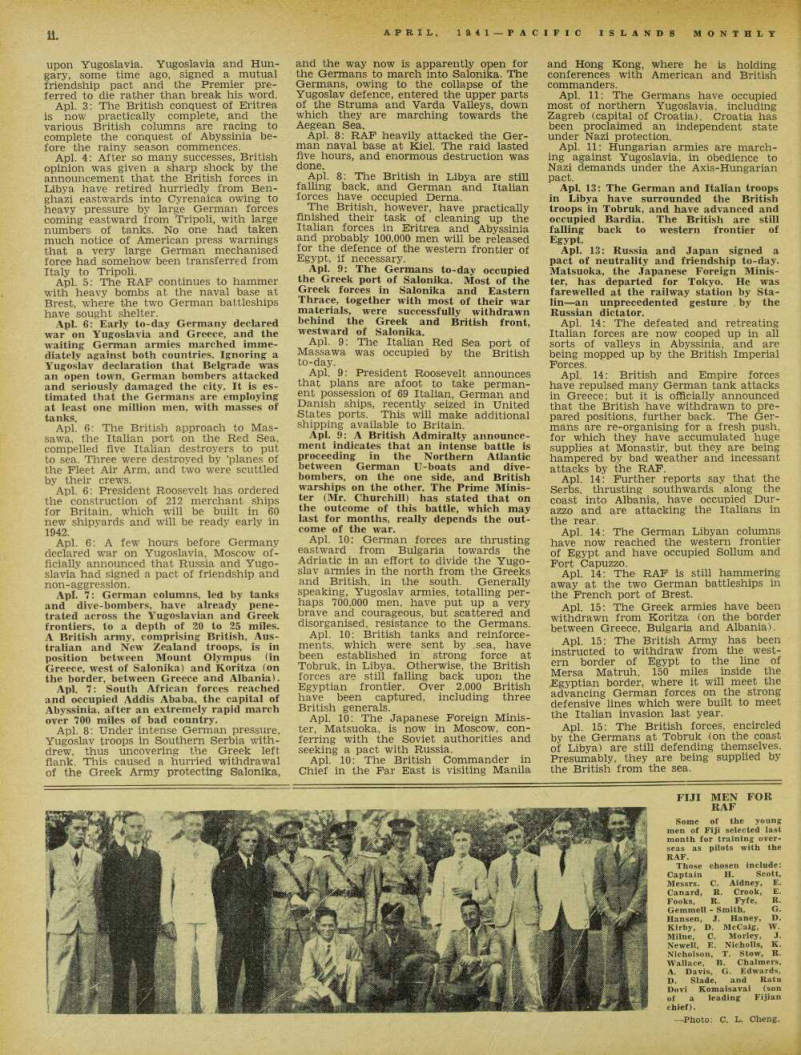
Fiji Men For
Raf
Some of the young men of Fiji selected last month for training over seas as pilots with the
Raf.
Those chosen include: Captain H. Scott, Messrs. C. Aidney, E.
Canard, R. Crook, E.
Fooks, R. Fyfe, R.
Gemmell - Smith, G.
Hansen, J. Haney, D.
Kirby, D. McCaig, W.
Milne, C. Morley, J.
Newell, E. Nicholls, K.
Nicholson, T. Stow, R.
Wallace, B. Chalmers, A. Davis, G. Edwards, D. Slade, and Ratu Dovi Komaisavai (son of a leading Fijian chief).
Photo; C. L. Cheng.