Training Polynesians To Save Their
pp. 33-35 · Read in the full issue
People
Invaluable Work of Suva's Famous Central Medical School
AUGMENTING the band of Native Medical Practitioners, whose devoted work among Pacific Islanders has earned deserved praise from medical authorities everywhere, another 12 Poly nesians graduated from the famous Central Medical School at Suva on December 23 and received their diplomas from the Governor of Fiji (Sir Harry Luke) at an impressive ceremony in the Fiji Legislative Council Chamber.
The new NMP’s are:— Ropati Bakata Cula, Fiji.
Francis Saula Tadu, Fiji.
Aseri Koroi Manulevu, Fiji.
Wilisoni Fakamanoa Tigarea, Rotuma.
Ualesi Toelupe, Western Samoa.
Siaosi Tuioti, Western Samoa.
John Wesley Kere, British Solomon Is.
Arobati Kicking, Gilbert and Ellice Is.
Tentau lotama, Gilbert and Ellice Is.
Morde Eria, Nauru.
Sateki Tubou, Tonga.
Uiliami Fehoko Tufui, Tonga.
Address by Sir Harry Luke
IN a notable address to the students and graduates, Sir Harry Luke said: — I think I first realised how colossal were the opportunities of the Native — and Indian—Medical Practitioner on behalf of his fellowmen when, a year and a half ago, I paid my first visit to the New Hebrides and beheld, in the
northern islands of that group, the heaviest incidence of crippling and dis figuring disease that I have had the misfortune to encounter in any popula tion. The missionaries there are putting up a magnificent fight, with the Bible in one hand and the needle for n.a.b. injections in the other; but I have never ceased to regret that funds are not avail able to multiply by 50 the two former students of the Central Medical School, now battling against sickness in the New Hebrides. Something similar in the way of opportunity still remains for the NMP’s working in Rotuma.
I first realised something of the achievement of those who have gone forth from this School as healers and as apostles of health when I came to visit Nauru, the Solomons and, later, the Gilbert and the Ellice Islands. Those territories cannot afford a large staff of European doctors; and it is to the NMP's that they have to look to carry the pre cepts and practices of modern Western medical science to their people. In the Gilbert and Ellice Islands, in particular, with its highly developed system of native government, European supervision is reduced to a minimum; but the NMP has risen to the occasion. After inspecting the native hospital in the remote island of Little Makin, northern most of the Gilberts, I noted in my diary:—
“The NMP’s are doing wonderful work in these islands and so are the dressers who, in places where there is no Medical Practitioner, are the sole repositories of medical science.”
Two weeks later, I wrote at Funafuti, head-quarters of the Ellice Islands:— “In the afternoon went over the really excellent hospital which, started some years ago by Macpherson, has managed since his departure to maintain the high standard set by him under the super vision of such admirable NMP’s as Tutu and Tatoa.”
What Nmp’S Are Doing
IT was on account of experiences of this sort, showing that those who have gone out from this School are not content to work only under the supervision of others, but are willing, and able, to take the initiative, that I felt justified in declaring, at the Graduation Ceremony last year, that .the Central Medical School is, in my opinion, one of the most beneficent gifts which British rule has conferred upon the native races of the Pacific.
Since the completion last year of the “Viti” has enabled me once more to visit adjoining territories, I have been able to repeat some of these experiences.
Exactly 40 days ago my party and I spent some hours in Niuafoou, the most outlying part of the Kingdom of Tonga, an island literally as well as metaphoric ally off the map in that it is seldom shown on charts. Yet, even in this remote place, we were pleased to see the position which the Tongan Medical Practitioner had won for himself, and the way in which he and his wife, in their little house in which the Central Medical School Diploma is prominently
displayed, live up to the dignity of one of the world's most honourable professlons ' A few days later, at the fine Apia hospital, I saw some of our graduates who are working in the island of Upolu; on the following day in Savaii, one of the cultural cradles of the Polynesian race, we watched the NMP injecting children for yaws; two days later Dr. Macpherson, who was accompanying me, was able to see for himself in Pago Pago the good account the School is giving of itself in American Samoa. And in Southern Lau, where we spent a little time on our return journey to Suva, the two NMP’s whom we had taken on the cruise from Fiji were able to make themselves useful in assisting Dr. Macpherson and the Travelling Native Medical Practitioner of Lau in carrying out village inspections of children.
Need For Expansion
IT was my hope to have seen in 1940 the beginnings of a new, better and permanent Central Medical School, but the exigencies and stringencies of war have unhappily deferred the fulfil ment of this hope. It should be realised by all that the conditions under which our medical students are now housed and taught are no longer satisfactory.
Classroom space has become cramped.
The laboratories for the teaching of chemistry, physics, biology and physio logy are inadequate in both space and equipment.
A generous credit from the Rockefeller Foundation for a health centre is “frozen” until the site of the health centre to be can be freed by the removal of the antiquated and no longer credit able hostel of the School. Museum faci lities are wholly lacking, and such facili
ties are essential for medical teaching.
Many valuable specimens collected over a period of years await proper space for display. I should like to see a section of such a museum devoted to specimens illustrative of the various special condi tions found in the Western Pacific and contiguous territories.
There is also much need for improve ment in library facilities for up-to-date text-books form part of the tools with which the doctor practises his art The Central* Medical School, made possible in part through the munificent aid of the Rockefeller Foundation, began as the extension of an experiment in medical education which had proved suc cessful in Fiji. It has now outgrown that stage, and I should like to see its usefulness expanded to the extent where it may become the recognised medical training-centre for most if not all the natives of Polynesia, Micronesia and Melanesia, and a place where systematic research into the peculiar medical prob lems of the Pacific Islands can be con ducted. All great medical schools have had similar small beginnings, and to each of them has come a time when their consolidation, improvement and, if pos sible, permanent endowment have become matters of concern to those responsible.
Wanted: A Benefactor
IDO not think I was wrong in refer ring to this School in a foreword I wrote some months ago to a num ber of “The Native Medical Practitioner” —the School’s very excellent journal founded by Dr. Clunie—as “a microcosm of the Pacific”. After all, the students at present in the School represent many territories: Fiji (including Fiji-born Indians and Rotuma), Tonga, Gilbert and Ellice Islands, British Solomon Islands, Anglo-French Condominium of the New Hebrides, NZ Mandated Terri tory of Western Samoa, the Cook Islands and Niue, Nauru (which is under Australian administration), and Ameri can Samoa; and we hope before long to be able to bring that most distant of the territories which come within my juris diction as High Commissioner for the Western Pacific, namely, Pitcairn Island, within the scope of the School’s opera tions. Thus you will see that the School flings the net of its valuable activities extremely wide.
I am, therefore, not without hope that some generous potential benefactor or benefactors may become interested in the future of this comprehensive institu tion to the extent of making it possible to provide the new buildings and equip ment which are so badly required. Such benefactors would in this way not only nobly commemorate their generosity in perpetuity, but would help to extend the benefits of medicine and public health over an immense area, populated by some of the most attractive races in the world.
Prize-Winning Students
PRIZES won during the year were presented to the following students: First Year: Mahesh Prasad (Indian), chemistry, 98 per cent.; Mahesh Prasad (Indian), biology, 94 per cent.; Peni S.
Vuiyale (Fiji), physics, 93 per cent.; Filipi Vulaono (Fiji), anatomy, 89 per cent.; Semisi Fonua (Tonga), physiology, 89 per cent.
Second Year: Ngacikura Tou (Cook Is.), anatomy, 89 per cent.; Jale W.
Masi (Fiji), physiology, 82 per cent.; Jale W. Masi (Fiji), bacteriology, 93 per cent.; Jale W. Masi (Fiji), surgery, 89 per cent.; Ganga Ram (Indian), medicine, 83 per-
cent.; Ganga Ram (Indian), Materia Medica, 94 per cent.
Fourth Year: Ropati B. Cula (Fiji), medicine, 78 per cent.; John Wesley Kere (Solomon Is.), surgery, 79 per cent.; Arobati Kicking (Gilbert Is.), obstetrics, 84 per cent.; Arobati Kicking (Gilbert Is), forensic medicine, 81 per cent.; Siaosi Tuioti (W. Samoa), diseases of children, 90 per cent.; Ualesi Toelupe (W. Samoa), public health, 77 par cent.
Special prizes were awarded as follow: Fiji Governor’s prize in Practical Medicine and Surgery; Siaosi Tuioti (W Samoa).
Bishop Nicolas’ special prize for best Fijian student; Francis S. Tadu (Fiji).
Pacific Islands Society’s special prize for proficiency in final year studies, com bined with a high standard in athletics: John Wesley Kere (Solomon Is.).
Gold medals were awarded as follow: Sir Henry Scott’s medal in Anatomy • Ngacikura Tou (Cook Is.).
Hon. Alport Barker’s medal in Medi cine: Ropati B. Cula (Fiji).
Sir Maynard Hedstrom’s medal in Public Health: Ualesi Toelupe (W.
Samoa).
BMA (Fiji Branch) medal in Surgery: John Wesley Kere (Solomon Is.).
“NMP lelu” medal in Diseases of Children; A. K. Manulevu (Fiji).
Dr. Pearce’s medal in Obstetrics: F.
S. Tadu (Fiji).
Mr. and Mrs. Charles Cleveland re cently returned to Thursday Island after an extended visit to Australia.
Rev. and Mrs. Godfrey Gilbert have returned to their work at St. Paul’s Mission on Moa Island, Torres Strait, after furlough in Australia.
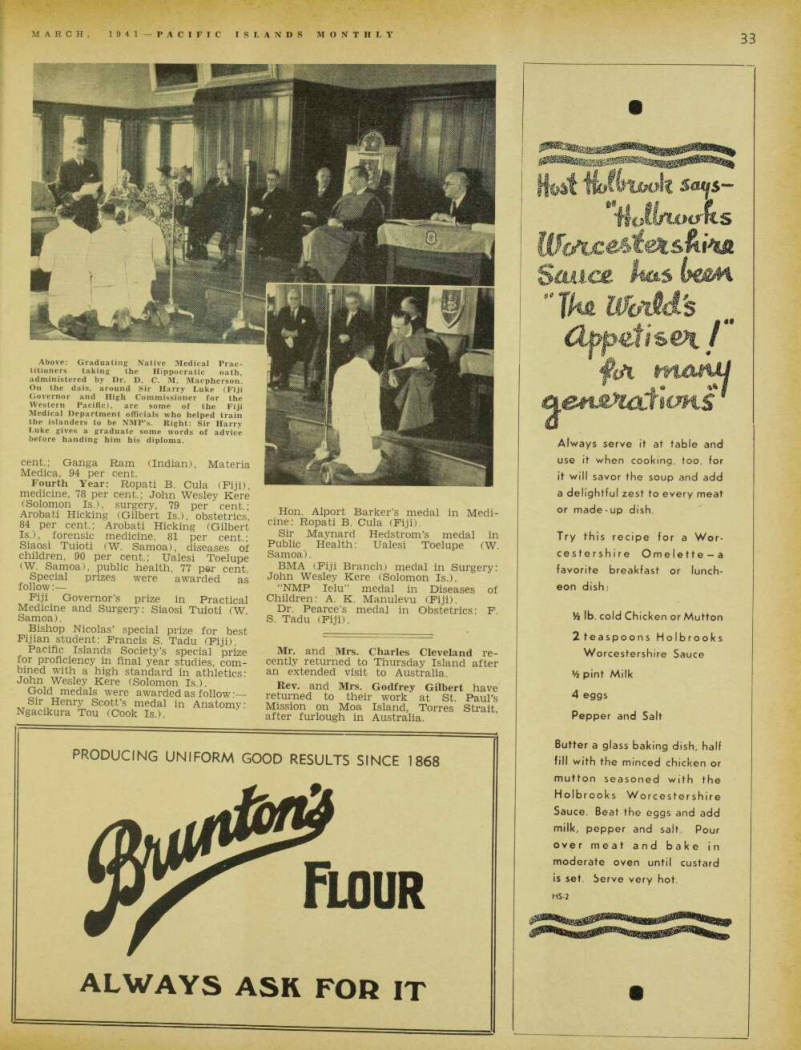
Above: Graduating Native Medical Prac titioners taking the Hippocratic oath, administered by Dr. D. C. M. Macpherson.
On the dais, around Sir Harry Luke (Fiji Governor and High Commissioner for the Western Pacific), are some of the Fiji Medical Department officials who helped train the islanders to be NMP’s. Right: Sir Harry Luke gives a graduate some words of advice before handing him his diploma.