Litigation
p. 27 · Read in the full issue
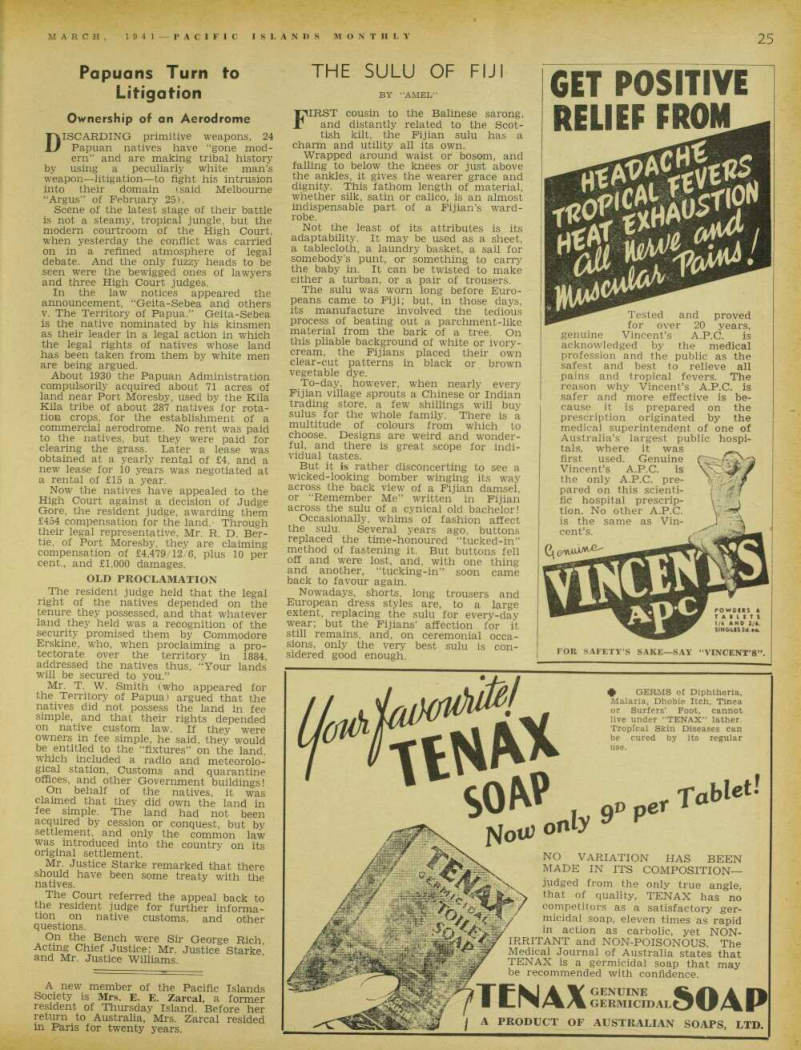
Papuans Turn to Litigation Ownership of an Aerodrome
DISCARDING primitive weapons, 24 Papuan natives have “gone mod ern” and are making tribal history by using a peculiarly white man’s weapon—litigation—to fight his intrusion into their domain (said Melbourne “Argus” of February 25).
Scene of the latest stage of their battle is not a steamy, tropical jungle, but the modern courtroom of the High Court, when yesterday the conflict was carried on in a refined atmosphere of legal debate. And the only fuzzy heads to be seen were the bewigged ones of lawyers and three High Court judges.
In the law notices appeared the announcement, “Geita-Sebea and others v. The Territory of Papua.” Geita-Sebea is the native nominated by his kinsmen as their leader in a legal action in which the legal rights of natives whose land has been taken from them by white men are being argued.
About 1930 the Papuan Administration compulsorily acquired about 71 acres of land near Port Moresby, used by the Kila Kila tribe of about 287 natives for rota tion crops, for the establishment of a commercial aerodrome. No rent was paid to the natives, but they were paid for clearing the grass. Later a lease was obtained at a yearly rental of £4, and a new lease for 10 years was negotiated at a rental of £l5 a year.
Now the natives have appealed to the High Court against a decision of Judge Gore, the resident judge, awarding them £454 compensation for the land. Through their legal representative, Mr. R. D. Ber tie, of Port Moresby, they are claiming compensation of £4,479/12 6, plus 10 per cent., and £l,OOO damages.
Old Proclamation
The resident judge held that the legal right of the natives depended on the tenure they possessed, and that whatever land they held was a recognition of the security promised them by Commodore Erskine, who, when proclaiming a pro tectorate over the territory in 1884, addressed the natives thus, “Your lands will be secured to you.”
Mr. T. W. Smith (who appeared for the Territory of Papua) argued that the natives did not possess the land in fee simple, and that their rights depended on native custom law. If they were owners in fee simple, he said, they would be entitled to the “fixtures” on the land, which included a radio and meteorolo gical station, Customs and quarantine offices, and other Government buildings!
On behalf of the natives, it was claimed that they did own the land in fee simple. The land had not been acquired by cession or conquest, but by settlement, and only the common law was introduced into the country on its original settlement.
Mr Justice Starke remarked that there should have been some treaty with the natives.
The Court referred the appeal back to the resident judge for further informa tion on native customs, and other questions.
On the Bench were Sir George Rich Acting Chief Justice: Mr. Justice Starke! and Mr. Justice Williams.
A new member of the Pacific Islands Society is Mrs. E. E. Zarcal, a former resident of Thursday Island. Before her return to Australia, Mrs. Zarcal resided in Paris for twenty years.