Pacific News-Review
pp. 3-4 · Read in the full issue
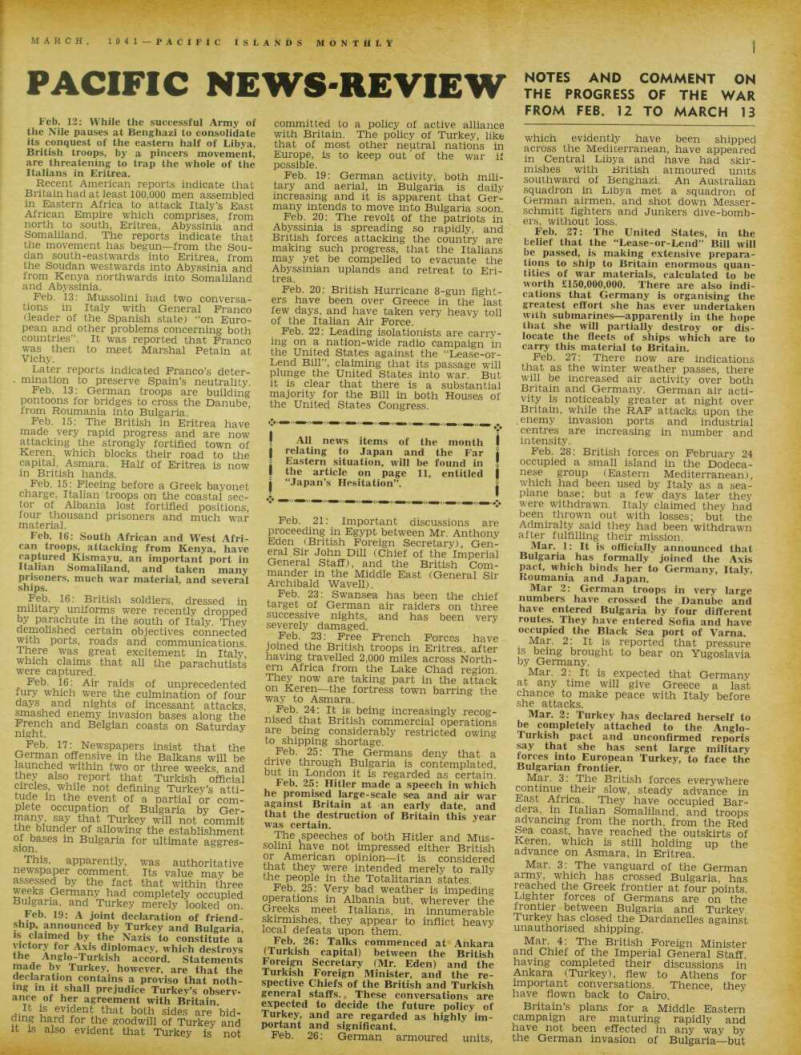
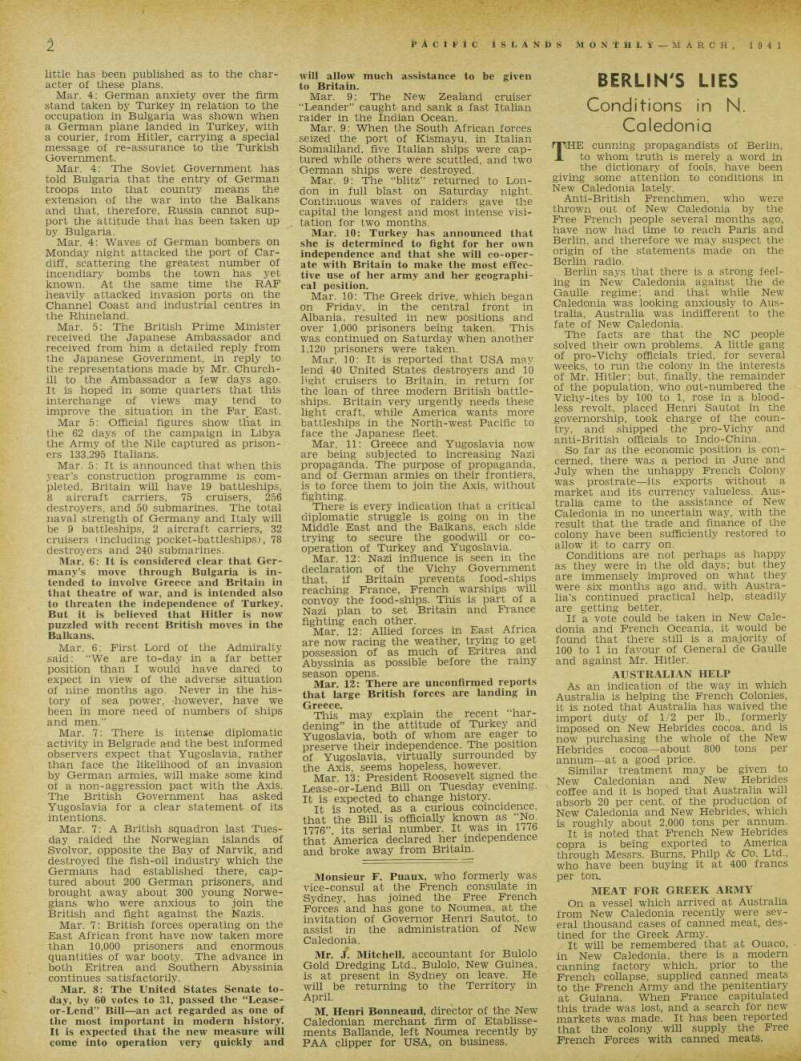
Feb. 12: While the successful Army of the Nile pauses at Benghazi to consolidate its conquest of the eastern half of Libya, British troops, by a pincers movement, are threatening to trap the whole of the Italians in Eritrea.
Recent American reports indicate that Britain had at least 100,000 men assembled in Eastern Africa to attack Italy’s East African Empire which comprises, from north to south, Eritrea, Abyssinia and Somaliland. The reports indicate that the movement has begun—from the Sou dan south-eastwards into Eritrea, from the Soudan westwards into Abyssinia and from Kenya northwards into Somaliland and Abyssinia.
Feb. 13: Mussolini had two conversa tions in Italy with General Franco (leader of the Spanish state) “on Euro pean and other problems concerning both countries’’. It was reported that Franco was then to meet Marshal Retain at Vichy.
Later reports indicated Franco’s deter mination to preserve Spain’s neutrality.
Feb. 13: German troops are building pontoons for bridges to cross the Danube from Roumania into Bulgaria.
Feb. 15: The British in Eritrea have made very rapid progress and are now attacking the strongly fortified town of Keren, which blocks their road to the capital, Asmara. Half of Eritrea is now in British hands.
Feb. 15: Fleeing before a Greek bayonet charge, Italian troops on the coastal sec tor of Albania lost fortified positions, four thousand prisoners and much war material.
Feb. 16: South African and West Afri can troops, attacking from Kenya, have captured Kismayu, an important port in Italian Somaliland, and taken many prisoners, much war material, and several ships.
Feb. 16: British soldiers, dressed in military uniforms were recently dropped by parachute in the south of Italy. They demolished certain objectives connected with ports, roads and communications There was great excitement in Italy, which claims that all the parachutists were captured.
Feb. 16: Air raids of unprecedented fury which were the culmination of four days and nights of incessant attacks, smashed enemy invasion bases along the French and Belgian coasts on Saturday night. J Feb. 17: Newspapers insist that the German offensive in the Balkans will be launched within two or three weeks, and they also report that Turkish official circles, while not defining Turkey’s atti tude in the event of a partial or com plete occupation of Bulgaria by Ger many say that Turkey will not commit the blunder of allowing the establishment of bases in Bulgaria for ultimate aggres sion. && This, apparently, was authoritative newspaper comment. Its value may be assessed by the fact that within three weeks Germany had completely occupied Bulgaria, and Turkey merely looked on.
Feb. 19: A joint declaration of friend ship announced by Turkey and Bulgaria, is claimed by the Nazis to constitute a victory for Axis diplomacy, which destroys the Anglo-Turkish accord. Statements made by Turkey, however, are that the declaration contains a proviso that noth ing m it shall prejudice Turkey’s observ ance of her agreement with Britain.
“ “ evident that both sides are bid ding hard for the goodwill of Turkey and it is also evident that Turkey is not
committed to a policy of active alliance with Britain. The policy of Turkey, like that of most other neutral nations in Europe, is to keep out ’of the war if possible.
Feb. 19: German activity, both mili tary and aerial, in Bulgaria is daily increasing and it is apparent that Ger many intends to move into Bulgaria soon.
Feb. 20: The revolt of the patriots in Abyssinia is spreading so rapidly, and British forces attacking the country are making such progress, that the Italians may yet be compelled to evacuate the Abyssinian uplands and retreat to Eri trea.
Feb. 20: British Hurricane 8-gun fight ers have been over Greece in the last few days, and have taken very heavy toll of the Italian Air Force.
Feb. 22: Leading isolationists are carry ing on a nation-wide radio campaign in the United States against the “Lease-or- Lend Bill”, claiming that its passage will plunge the United States into war. But it is clear that there is a substantial majority for the Bill in both Houses of the United States Congress.
All news items of the month relating to Japan and the Far Eastern situation, will be found in the article on page 11, entitled “Japan’s Hesitation’’.
Feb. 21: Important discussions are proceeding in Egypt between Mr. Anthony Eden (British Foreign Secretary), Gen eral Sir John Dill (Chief of the Imperial General Staff), and the British Com mander in the Middle East (General Sir Archibald Wavell).
Feb. 23: Swansea has been the chief target of German air raiders on three successive nights, and has been very severely damaged.
Feb. 23: Free French Forces have joined the British troops in Eritrea, after having travelled 2,000 miles across North ern Africa from the Lake Chad region.
They now are taking part in the attack on Keren—the fortress town barring the way to Asmara.
Feb. 24: It is being increasingly recog nised that British commercial operations are being considerably restricted owing to shipping shortage.
Feb. 25: The Germans deny that a drive through Bulgaria is contemplated, but in London it is regarded as certain.
Feb. 25: Hitler made a speech in which he promised large-scale sea and air war against Britain at an early date, and that the destruction of Britain this year was certain.
The speeches of both Hitler and Mus solini have not impressed either British or American opinion—it is considered that they were intended merely to rally the people in the Totalitarian states.
Feb. 25: Very bad weather is impeding operations in Albania but, wherever the Greeks meet Italians, in innumerable skirmishes, they appear to inflict heavy local defeats upon them.
Feb. 26: Talks commenced at Ankara (Turkish capital) between the British Foreign Secretary (Mr. Eden) and the Turkish Foreign Minister, and the re spective Chiefs of the British and Turkish general staffs.. These conversations are expected to decide the future policy of Turkey, and are regarded as highly im portant and significant.
Feb. 26: German armoured units,
Notes And Comment On
The Progress Of The War
From Feb. 12 To March 13
which evidently have been shipped across the Mediterranean, have appeared in Central Libya and have had skir mishes with British aimoured umts southward of Benghazi. An Australian squadron in Libya met a squadron of German airmen, and shot down Messer schmitt fighters and Junkers dive-bomb ers, without loss.
Feb. 27: The United States, in the belief that the “Lease-or-Lend” Bill will be passed, is making extensive prepara tions to ship to Britain enormous quan tities of war materials, calculated to be worth £150,000,000. There are also indi cations that Germany is organising the greatest effort she has ever undertaken with submarines—apparently in the hope that she will partially destroy or dis locate the fleets of ships which are to carry this material to Britain.
Feb. 27: There now are indications that as the winter weather passes, there will be increased air activity over both Britain and Germany. German air acti vity is noticeably greater at night over Britain, while the RAF attacks upon the . enemy invasion ports and industrial centres are increasing in number and intensity.
Feb. 28: British forces on February 24 occupied a small island in the Dodeca nese group (Eastern Mediterranean), which had been used by Italy as a sea plane base; but a few days later they were withdrawn. Italy claimed they had been thrown out with losses; but the Admiralty said they had been withdrawn after fulfilling their mission.
Mar. 1: It is officially announced that Bulgaria has formally joined the Axis pact, which binds her to Germany, Italy, Roumania and Japan.
Mar 2: German troops in very large numbers have crossed the Danube and have entered Bulgaria by four different routes. They have entered Sofia and have occupied the Black Sea port of Varna.
Mar. 2: It is reported that pressure is being brought to bear on Yugoslavia by Germany.
Mar. 2: It is expected that Germany at any time will give Greece a last chance to make peace with Italy before she attacks.
Mar. 2: Turkey has declared herself to be completely attached to the Anglo- Turkish pact and unconfirmed reports say that she has sent large military forces into European Turkey, to face the Bulgarian frontier.
Mar. 3: The British forces everywhere continue their slow, steady advance in East Africa. They have occupied Bar dera, in Italian Somaliland, and troops advancing from the north, from the Red Sea coast, have reached the outskirts of Keren, which is still holding up the advance on Asmara, in Eritrea.
Mar. 3: The vanguard of the German army, which has crossed Bulgaria, has reached the Greek frontier at four points.
Lighter forces of Germans are on the frontier between Bulgaria and Turkey.
Turkey has closed the Dardanelles against unauthorised shipping.
Mar. 4; The British Foreign Minister and Chief of the Imperial General Staff having completed their discussions in Ankara (Turkey), flew to Athens for important conversations. Thence, they have flown back to Cairo.
Britain’s plans for a Middle Eastern campaign are maturing rapidly and have not been effected in any way by the German invasion of Bulgaria—but
little has been published as to the char acter of these plans.
Mar. 4; German anxiety over the firm stand taken by Turkey in relation to the occupation in Bulgaria was shown when a German plane landed in Turkey, with a courier, from Hitler, carrying a special message of re-assurance to the Turkish Government.
Mar. 4: The Soviet Government has told Bulgaria that the entry of German troops into that country means the extension of the war into the Balkans and that, therefore, Russia cannot sup port the attitude that has been taken up by Bulgaria.
Mar. 4: Waves of German bombers on Monday night attacked the port of Car diff, scattering the greatest number of incendiary bombs the town has yet known. At the same time the RAF heavily attacked invasion ports on the Channel Coast and industrial centres in the Rhineland.
Mar. 5: The British Prime Minister received the Japanese Ambassador and received from him a detailed reply from the Japanese Government, in reply to the representations made by Mr. Church ill to the Ambassador a few days ago.
It is hoped in some quarters that this interchange of views may tend to improve the situation in the East.
Mar 5: Official figures show that in the 62 days of the campaign in Libya the Army of the Nile captured as prison ers 133.295 Italians.
Mar. 5: It is announced that when this year’s construction programme is com pleted, Britain will have 19 battleships, 8 aircraft carriers, 75 cruisers, 256 destroyers, and 50 submarines. The total naval strength of Germany and Italy will be 9 battleships, 2 aircraft carriers, 32 cruisers (including pocket-battleships), 78 destroyers and 240 submarines.
Mar. 6: It is considered clear that Ger many’s move through Bulgaria is in tended to involve Greece and Britain in that theatre of war, and is intended also to threaten the independence of Turkey.
But it is believed that Hitler is now puzzled with recent British moves in the Balkans.
Mar. 6; First Lord of the Admiralty said: “We are to-day in a far better position than I would have dared to expect in view of the adverse situation of nine months ago. Never in the his tory of sea power, -however, have we been in more need of numbers of ships and men.”
Mar. 7; There is intense diplomatic activity in Belgrade and the best informed observers expect that Yugoslavia, rather than face the likelihood of an invasion by German armies, will make some kind of a non-aggression pact with the Axis.
The British Government has asked Yugoslavia for a clear statement of its intentions.
Mar. 7: A British squadron last Tues day raided the Norwegian islands of Svolvor, opposite the Bay of Narvik, and destroyed the fish-oil industry which the Germans had established there, cap tured about 200 German prisoners, and brought away about 300 young Norwe gians who were anxious to join the British and fight against the Nazis.
Mar. 7: British forces operating on the East African front have now taken more than 10,000 prisoners and enormous quantities of war booty. The advance in both Eritrea and Southern Abyssinia continues satisfactorily.
Mar. 8: The United States Senate to day, by 60 votes to 31, passed the “Lease or-Lend” Bill —an act regarded as one of the most important in modern history.
It is expected that the new measure will come into operation very quickly and
will allow much assistance to be given to Britain.
Mar. 9; The New Zealand cruiser “Leander” caught and sank a fast Italian raider in the Indian Ocean.
Mar. 9: When the South African forces seized .the port of Kismayu, in Italian Somaliland, five Italian ships were cap tured while others were scuttled, and two German ships were destroyed.
Mar. 9: The “blitz” returned to Lon don in full blast on Saturday night.
Continuous waves of raiders gave the capital the longest and most intense visi tation for two months.
Mar. 10: Turkey has announced that she is determined to fight for her own independence and that she will co-oper ate with Britain to make the most effec tive use of her army and her geographi cal position.
Mar. 10: The Greek drive, which began on Friday, in the central front in Albania, resulted in new positions and over 1,000 prisoners being taken. This was continued on Saturday when another 1,120 prisoners were taken.
Mar. 10: It is reported that USA may lend 40 United States destroyers and 10 light cruisers to Britain, in return for the loan of three modern British battle ships. Britain very urgently needs these light craft, while America wants more battleships in the North-west Pacific to face the Japanese fleet.
Mar. 11: Greece and Yugoslavia now are being subjected to increasing Nazi propaganda. The purpose of propaganda, and of German armies on their frontiers, is to force them to join the Axis, without fighting.
There is every indication that a critical diplomatic struggle is going on in the Middle East and the Balkans, each side trying to secure the goodwill or co operation of Turkey and Yugoslavia.
Mar. 12: Nazi influence is seen in the declaration of the Vichy Government that, if Britain prevents food-ships reaching France, French warships will convoy the food-ships. This is part of a Nazi plan to set Britain and France fighting each other.
Mar. 12: Allied forces in East Africa are now racing the weather, trying to get possession of as much of Eritrea and Abyssinia as possible before the rainy season opens.
Mar. 12: There are unconfirmed reports that large British forces are landing in Greece. .
This may explain the recent har dening” in the attitude of Turkey and Yugoslavia, both of whom are eager to preserve their independence. The position of Yugoslavia, virtually surrounded by the Axis, seems hopeless, however.
Mar. 13: President Roosevelt signed the Lease-or-Lend Bill on Tuesday evening.
It is expected to change history.
It is noted, as a curious coincidence, that the Bill is officially known as “No 1776”, its serial number. It was in 1776 that America declared her independence and broke away from Britain.
Monsieur F. Puaux, who formerly was vice-consul at the French consulate in Sydney, has joined the Free French Forces and has gone to Noumea, at the invitation of Governor Henri Sautot, to assist in the administration of New Caledonia.
Mr. J. Mitchell, accountant for Bulolo Gold Dredging Ltd., Bulolo, New Guinea, is at present in Sydney on leave. He will be returning to the Territory in April.
M. Henri Bonneaud, director of the New Caledonian merchant firm of Etablisse ments Ballande, left Noumea recently by PAA clipper for USA, on business.