When Noumea Was In A Fever
pp. 48-53 · Read in the full issue
How the Loss of on Admiralty Message Brought in Sir Harry Luke as Peacemaker
By R. W. Robson
WHEN France capitulated in June, 1940, and found herself subject to the Nazis, the French Colonies in the Pacific -were isolated. They were not entirely cut off from the mother country, insofar that they were in- radio communication with the Petain Govern ment at Vichy; but everyone knew that the Vichy Government was acting under the. direction of the Huns. Anything done by the Administrators of the French Pacific Colonies was suspect by the British Territories in the Pacific, which were still fighting Germany, and which adjoined the French Colonies on every side.
For a time, the situation in the New Hebrides was simply chaotic. Here there is a Condominium—that is, France and Britain have exercised joint control of the territory, and French and British public servants work side by side in the administration. Naturally, the British were not very happy in such close asso ciation with men who were taking their orders from Vichy, which, in turn, was
accepting instructions from Mr. Hitler.
On the part of some of the French (cer tainly they were very few) a hatred of the British was suddenly and surpris ingly manifested.
But, apart from politics, the position of the New Hebrides was deplorable.
There was no market anywhere for the principal products of the New Hebrides —copra, coffee, cocoa, cotton—and the French currency, which hitherto had been interchangeable with the British and Australian currency, and which was in general use throughout the New Heb rides, suddenly became valueless. Every one who owned francs made it his busi ness quickly to get rid of them, and to obtain British money, instead.
It is said that Messrs. Burns, Philp & Co.’s Vila branch found itself, in no time at all, with about 500,000 francs on its hands, which no one wanted. The posi tion was aggravated by certain bold economic adventurers who brought in francs from all over the place—especially New Caledonia and the Loyalty Islands —and got them changed for British money.
THE economic confusion in New Hebrides became a matter of serious concern to the British High Commissioner for the Western Pacific (Sir Harry Luke). Opportunely, his new patrol boat, “Viti”, arrived in Suva from Hong Kong, and Sir Harry decided imme diately to visit the New Hebrides.
When the “Viti” arrived in Port Vila Sir Harry found that he had a real job of work on hand. British officials, under Sir Harry’s direction, set to work to straighten things out, but progress was slow and difficult. A silent war was going on in the ranks of French officialdom.
The position then was that the French Resident Commissioner (M. Henri Sau tot) had declared himself, outspokenly and courageously, on July 18, for General de Gaulle —the first French colonial administrator to do so—while other French officials, to whom he might naturally have looked for support, were cunningly and savagely pro-Vichy. A high French judicial officer set to work, by underground and devious means, to unseat M. Sautot, so that he might himself become Resident Commissioner.
A couple of minor, but none the less important officials, assisted him, and, for a time, it looked as if the gallant M.
Sautot was going to be destroyed by the forces of Vichy. But he fought on courageously.
One of the officials whom Sautot sus pected of strong pro-Vichy sentiments was in charge of the French native police, which force was much stronger numerically than the British native force. So M. Sautot, with the connivance of good friends, in the quiet and dark ness of one night, contrived to remove all the ammunition supplies of the police. It was then pointed out to the Resident Commissioner that the police still had bayonets. The night operation was repeated, and a couple of mornings later the police found that, while they had most excellent rifles, they had neither bayonets nor bullets.
Meanwhile, the Governor of Noumea (who is also French High Commissioner for the Western Pacific, with jurisdiction over the French section of the New Hebrides) had curtly “sacked” M. Sautot, for his act in allying himself with
General de Gaulle. The doughty M.
Sautot refused to take the sack, and car ried on as Resident Commissioner in the New Hebrides —with, of course, the hearty moral and material support of the British community.
This was the highly delicate and com plex situation found by Sir Harry Luke.
It soon became apparent to him that, while the pro-Vichy authority was being exercised in Noumea, it was rather diffi cult to arrange a new establishment in the New Hebrides. Confused reports reached Sir Harry Luke about conditions in New Caledonia. It was indicated that, although Vichy ruled New Caledonia, de Gaulle sympathisers were much in the majority there.
AFTER radio consultation with Lon don, Sir Harry Luke decided that, if he were to visit Noumea, he might be of assistance in arranging a peaceful settlement there. He was joined by a couple of important officials from the New Hebrides establishment, and set off. It is understood that he received an assurance from the British Admiralty that the “Viti” might proceed in safety.
Now comes an interesting develop ment, which only goes to show how a little event may have a highly important sequel.
While the “Viti” was at sea, proceed ing over the few hundred miles between
Port Vila and Noumea, the British Admiralty received certain information and, as a result, sent an urgent radio
message to the “Viti”, requesting her to discontinue her voyage and not to visit Noumea. That message was not received aboard the “Viti”, and the little patrol ship proceeded happily on her way.
When the “Viti” arrived off Noumea, early on August 30, she was met by a taciturn old French pilot, and conducted into the harbour. Sir Harry Luke then discovered, to his astonishment and per turbation, that the small French war ship “Dumond d’Urville”, which he understood was safely at anchor away over in Tahiti, was actually in Noumea Harbour, where she had arrived within the last couple of days. It was known that the commander of the little war ship, Captain Toussaint de Quievrecourt, was a strong pro-Vichy man, and bitterly anti-British.
The party of British officials on the “Viti” wondered uneasily how they were going to be received. They had come in a spirit of helpfulness; but if the anti-British element ashore should assume from their arrival that British officialdom was trying to interfere im properly in the unhappy affairs of the French colony, there might be ugly developments.
The silent and unimaginative French pilot did not help matters. He took the “Viti” right up alongside the grim and silent little French warship, and moored
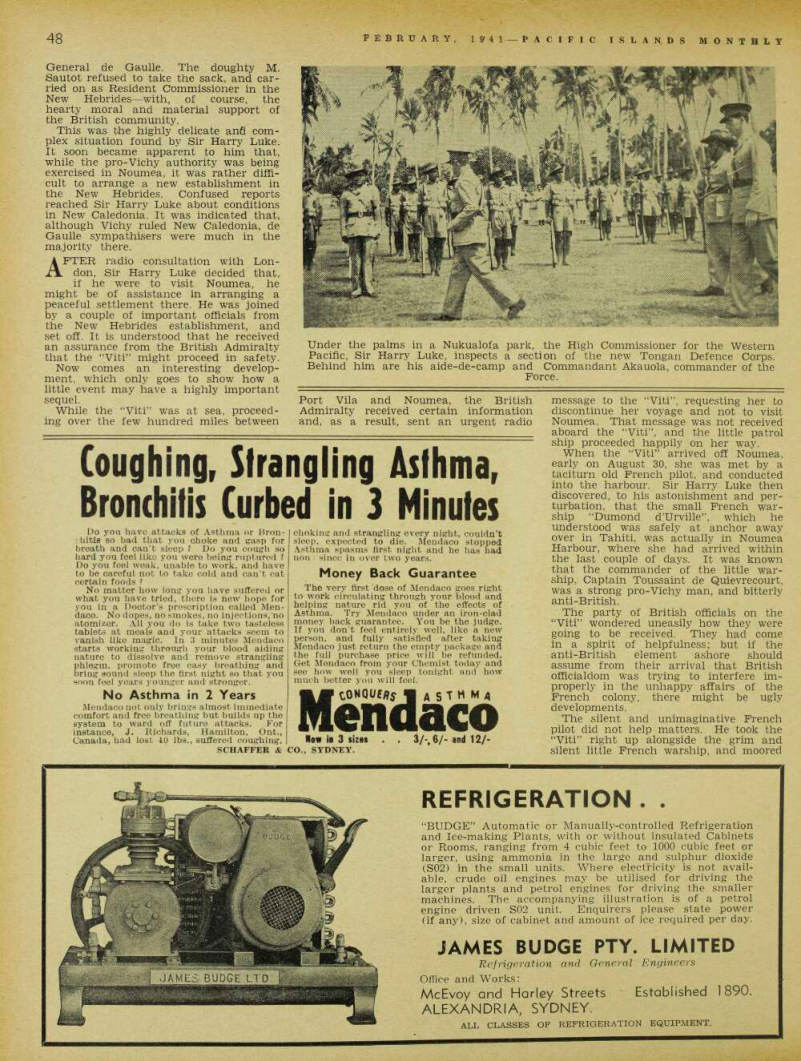
Under the palms in a Nukualofa park, the High Commissioner for the Western Pacific, Sir Harry Luke, inspects a section of the new Tongan Defence Corps.
Behind him are his aide-de-camp and Commandant Akauola, commander of the Force.
her at the quay, only 20 feet away from the warship’s bow.
THEN a general situation of extra ordinary confusion developed. The pre-capitulation Governor, M. Peli cier, was still in charge, and he sent a formal welcome to Sir Harry Luke, and invited him to luncheon. A little later Sir Harry Luke was invited to dinner by the Governor, who, it appeared, was Colonel Denis.
When the puzzled Englishmen asked the meaning of it all, they were informed that Noumea that day was in process of changing governors—M. Pelicier, finding the position untenable in view of the very strong pro-de Gaulle sentiment in the Colony, had decided to leave, and he was handing on the governorship, under instructions from Vichy, to Colonel Denis, who was in charge of the military detachments in Noumea.
Colonel Denis, it appeared, was even more pro-Vichy than M. Pelicier.
Meanwhile, a formal call on Sir Harry Luke, aboard the “Viti”, was made by Captain de Quievrecourt, commander of the “Dumond d’Urville”. Sir Harry Luke speaks French very fluently, and he Quickly learned that the warship’s com mander. while frigidly polite and cour teous, was intensely anti-British—in fact, he made a number of remarks which the British officials were bound to resent.
We do not know exactly what occurred —officials naturally are reticent about these matters—but we do know that the commander of the sloop departed from the “Viti” in high dudgeon, with all his naval feathers bristling.
What with a hostile warship com mander right alongside, and two embar rassed governors trving to observe pro per official formalities ashore, and an excited civil populace on the wharf beside the “Viti” roaring for de Gaulle, and for Britain. Sir Harrv Luke found the general situation “definitely sticky”.
IT was suggested officially to Sir Harry, at an early stage of his visit, that perhaps it would be better if the “Viti” withdrew from Noumea. It is probable that he himself felt that it would have been better had he not come; but, since he was there, he felt also that it would create a very bad impression in the minds of the over whelming majority of the civil popu lation (obviouslv pro-de Gaulle) if he. the leading British official in that part of the world, were to withdraw too quickly.
So he told the French Governor— which one, history sayeth not!—that he had come to discuss economic affairs with Australia’s official representative in New Caledonia, Mr. B. C. Ballard, and that, in any event, he wanted to have a clear understanding with French head ouarters in Noumea in regard to the difficult economic and administrative situation existing in the New Hebrides; and so the “Viti” stayed alongside the wharf, and discussions went on.
It was noon on August 30 before offi cial formalities were over. During Fri dav afternoon and Saturday the British officials were kept extremely busy—the little ship was packed out with parties of pro-de Gaulle and pro-Vichy adher ents. The people of Noumea insisted on assembling on the wharf alongside the “Viti”, and cheering for de Gaulle and Great Britain. The blue-jackets from the “Dumont d’Urville” joined the civi lians in cheering for de Gaulle; but their officers on the warship were quite defin itelv hostile.
Sir Harry Luke and his officials attended a series of official functions,
where traditional French hospitality was extended to them. They found it a little difficult to decide to whom they should address themselves as head of the French Colony—so they got over it by calling both M. Pelicier and Colonel Denis “Your Excellency”.
During the following day (Saturday, August 31) the pro-de Gaulle sentiments of the Noumea population bubbled up perceptibly, and demonstrations became more frequent and marked. It was clear that the high officials adhering to the Vichy Government —especially the de parting and the new Governor, and the warship’s captain—were alarmed, and that the growing tenseness might lead to an explosion. It was evident, too, that the temper of Colonel Denis, commander of the garrison, and Captain de Quievre court, commander of the warship, was such that they were quite prepared to use the forces at their command to sup press a pro-de Gaulle revolt by force, if necessary.
When he found that he could do noth ing more to straighten out the tangle, Sir Harry Luke decided quickly to con clude his formal conversations with the French Government, and depart; and the “Viti” accordingly left Noumea before dusk on Saturday, August 31.
I have reason to believe that as the little Fijian patrol-ship departed, more than one pair of official British binocu lars were focussed anxiously on the unfriendly French warship still lying beside the Noumea wharf.
IT will be remembered that it was only a few days later that the people of New Caledonia took matters into their own hands, deposed Colonel Denis from the Governorship, and installed in his place the staunch Henri Sautot, who suddenly appeared in Noumea Har bour. I should very much like to tell the story of how Henri Sautot actually came from Port Vila—but that story will have to wait until war precautions in relation to maritime information are not necessary.
Had the admiralty message reached Sir Harry Luke between Port Vila and Noumea, the “Viti”, of course, would not have entered Noumea. I believe that its non-receipt was a very good thing.
The little, unarmed, harmless “Viti”, carrying the highest British official in the Pacific, entered Noumea Harbour at a most critical moment. If the “Viti” had been a British warship, almost cer tainly there would have been an explo sion ashore, and probably there would have been serious fighting and bloodshed between British and French forces. As it was, the arrival of the British party, and the tactful behaviour of the pleasant and charming Sir Harry Luke, disarmed the excited French factions. The pro- Vichy officials could do nothing, except snarl; while the arrival and confident bearing of the British official party gave great heart, encouragement and impetus to the de Gaulle adherents, who, shortly afterwards, bloodlessly took command of the situation.
The Admiralty message missed the “Viti”—but it was a lucky miss.