The Curse!
pp. 30-31 · Read in the full issue
Last, Final Insult From the Tuamotus
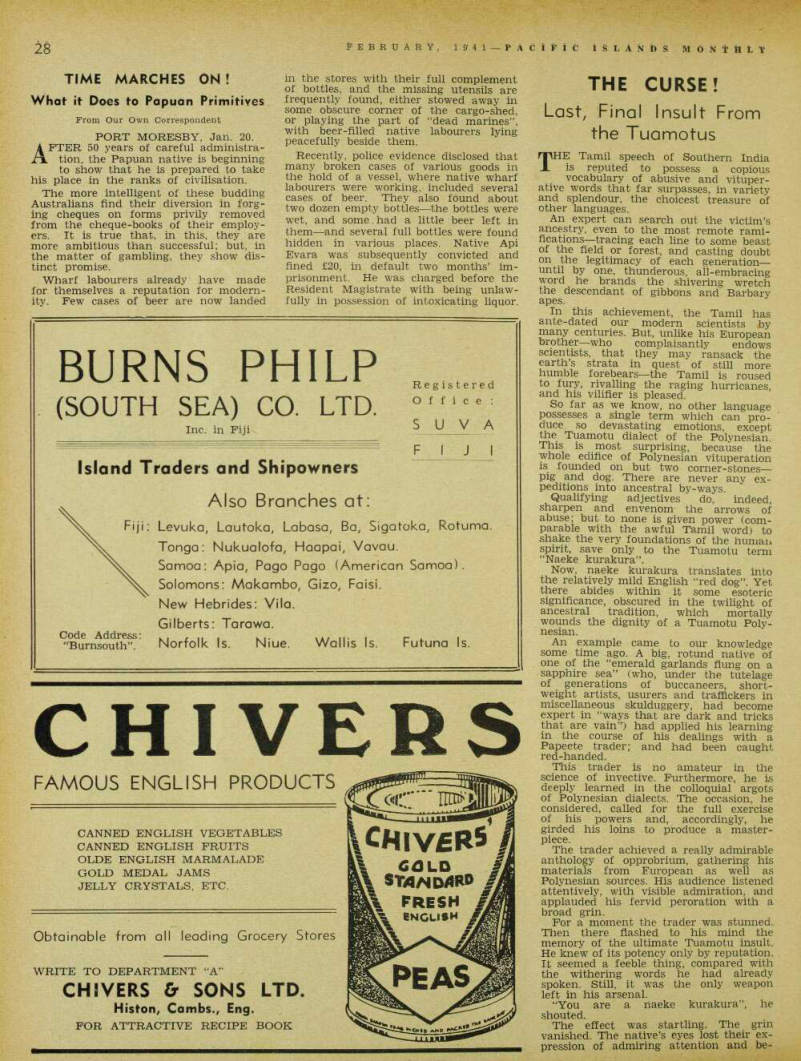
THE Tamil speech of Southern India is reputed to possess a copious vocabulary of abusive and vituper ative words that far surpasses, in variety and splendour, the choicest treasure of other languages.
An expert can search out the victim’s ancestry, even to the most remote rami fications—tracing each line to some beast of the field or forest, and casting doubt on the legitimacy of each generation— until by one, thunderous, all-embracing word he brands the shivering wretch the descendant of gibbons and Barbary apes.
In this achievement, the Tamil has ante-dated our modern scientists by many centuries. But, unlike his European brother—who complaisantly endows scientists, that they may ransack the earth’s strata in quest of still more humble forebears—the Tamil is roused to fury, rivalling the raging hurricanes, and his vilifier is pleased.
So far as we know, no other language possesses a single term which can pro duce, so devastating emotions, except the Tuamotu dialect of the Polynesian This is most surprising, because the whole edifice of Polynesian vituperation is founded on but two corner-stones — pig and dog. There are never any ex peditions into ancestral by-ways.
Qualifying adjectives do, indeed, sharpen and envenom the arrows of abuse; but to none is given power (com parable with the awful Tamil word) to shake the very foundations of the human spirit, save only to the Tuamotu term “Naeke kurakura”.
Now, naeke kurakura translates into the relatively mild English “red dog”. Yet there abides within it some esoteric significance, obscured in the twilight of ancestral tradition, which mortally wounds the dignity of a Tuamotu Poly nesian.
An example came to our knowledge some time ago. A big, rotund native of one of the “emerald garlands flung on a sapphire sea” (who, under the tutelage of generations of buccaneers, short weight artists, usurers and traffickers in miscellaneous skulduggery, had become expert in “ways that are dark and tricks that are vain”) had applied his learning in the course of his dealings with a Papeete trader; and had been caught red-handed.
This trader is no amateur in the science of invective. Furthermore, he is deeply learned in the colloquial argots of Polynesian dialects. The occasion, he considered, called for the full exercise of his powers and, accordingly, he girded his loins to produce a master piece.
The trader achieved a really admirable anthology of opprobrium, gathering his materials from European as well as Polynesian sources. His audience listened attentively, with visible admiration, and applauded his fervid peroration with a broad grin.
For a moment the trader was stunned.
Then there flashed to his mind the memory of the ultimate Tuamotu insult.
He knew of its potency only by reputation.
It seemed a feeble thing, compared with the withering words he had already spoken. Still, it was the only weapon left in his arsenal.
“You are a naeke kurakura”, he shouted.
The effect was startling. The grin vanished. The native’s eyes lost their ex pression of admiring attention and be
came baleful, feral. His whole body trembled from the storm of anger and humiliation which raged within him.
The trader drew a deep sigh of relief.
His forlorn hope had brought him vic
tory.-