Campaign
p. 26 · Read in the full issue
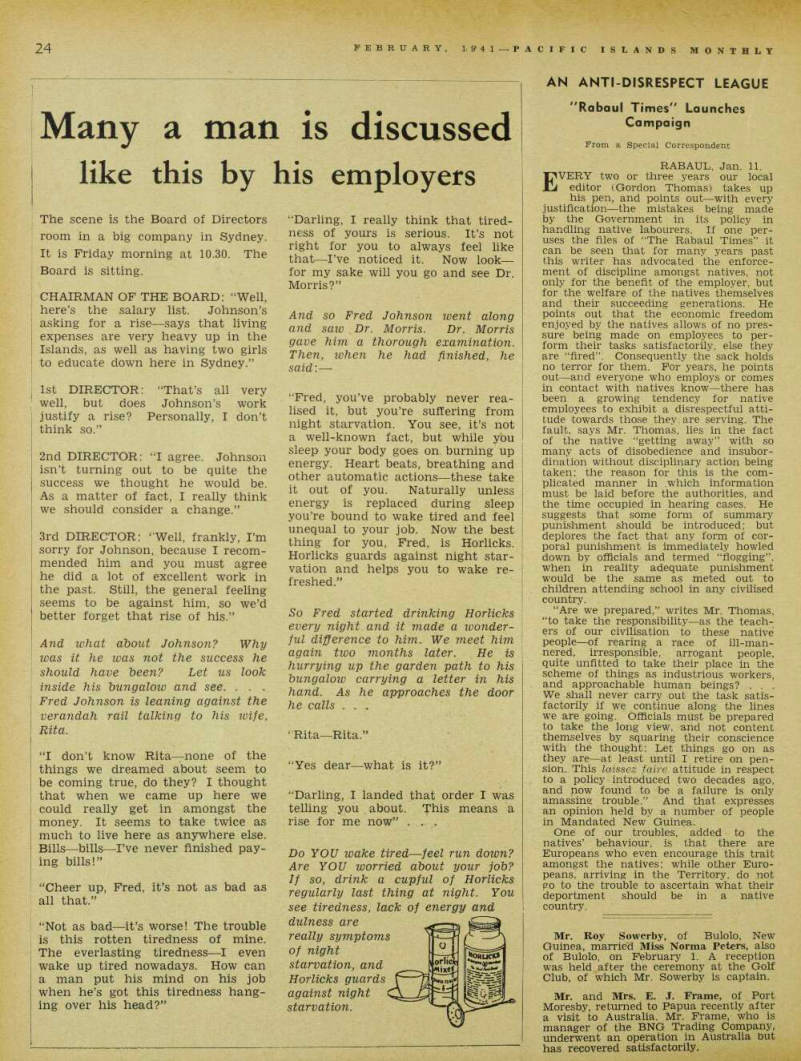
An Anti-Disrespect League
"Rabaul Times" Launches Campaign
From a Special Correspondent
Rabaul, Jan. 11.
EVERY two or three years our local editor (Gordon Thomas) takes up his pen, and points out—with every justification—the mistakes being made by the Government in its policy in handling native labourers. If one per uses the files of “The Rabaul Times” it can be seen that for many years past this writer has advocated the enforce ment of discipline amongst natives, not only for the benefit of the employer, but for the welfare of the natives themselves and their succeeding generations. He points out that the economic freedom enjoyed by the natives allows of no pres sure being made on employees to per form their tasks satisfactorily, else they are “fired”. Consequently the sack holds no terror for them. For years, he points out —and everyone who employs or comes in contact with natives know —there has been a growing tendency for native employees to exhibit a disrespectful atti tude towards those they are serving. The fault, says Mr. Thomas, lies in the fact of the native “getting away” with so many acts of disobedience and insubor dination without disciplinary action being taken; the reason for this is the com plicated manner in which information must be laid before the authorities, and the time occupied in hearing cases. He suggests that some form of summary punishment should be introduced; but deplores the fact that any form of cor poral punishment is immediately howled down by officials and termed “flogging”, when in reality adequate punishment would be the same as meted out to children attending school in any civilised country.
“Are we prepared,” writes Mr. Thomas, “to take the responsibility—as the teach ers of our civilisation to these native people—of rearing a race of ill-man nered, irresponsible, arrogant people, quite unfitted to take their place in the scheme of things as industrious workers, and approachable human beings? . . .
We shall never carry out the task satis factorily if we continue along the lines we are going. Officials must be prepared to take the long view, and not content themselves by squaring their conscience with the thought: Let things go on as they are—at least until I retire on pen sion. This laissez faire attitude in respect to a policy introduced two decades ago, and now found to be a failure is only amassing trouble.” And that expresses an opinion held by a number of people in Mandated New Guinea.
One of our troubles, added to the natives’ behaviour, is that there are Europeans who even encourage this trait amongst the natives: while other Euro peans, arriving in the Territory, do not go to the trouble to ascertain what their deportment should be in a native country.
Mr. Roy Sowerby, of Bulolo, New Guinea, married Miss Norma Peters, also of Bulolo, on February 1. A reception was held after the ceremony at the Golf Club, of which Mr. Sowerby is captain.
Mr. and Mrs. E. J. Frame, of Port Moresby, returned to Papua recently after a visit to Australia. Mr. Frame, who is manager of the BNG Trading Company, underwent an operation in Australia but has recovered satisfactorily.