The Real War Is About To Begin
pp. 7-8 · Read in the full issue
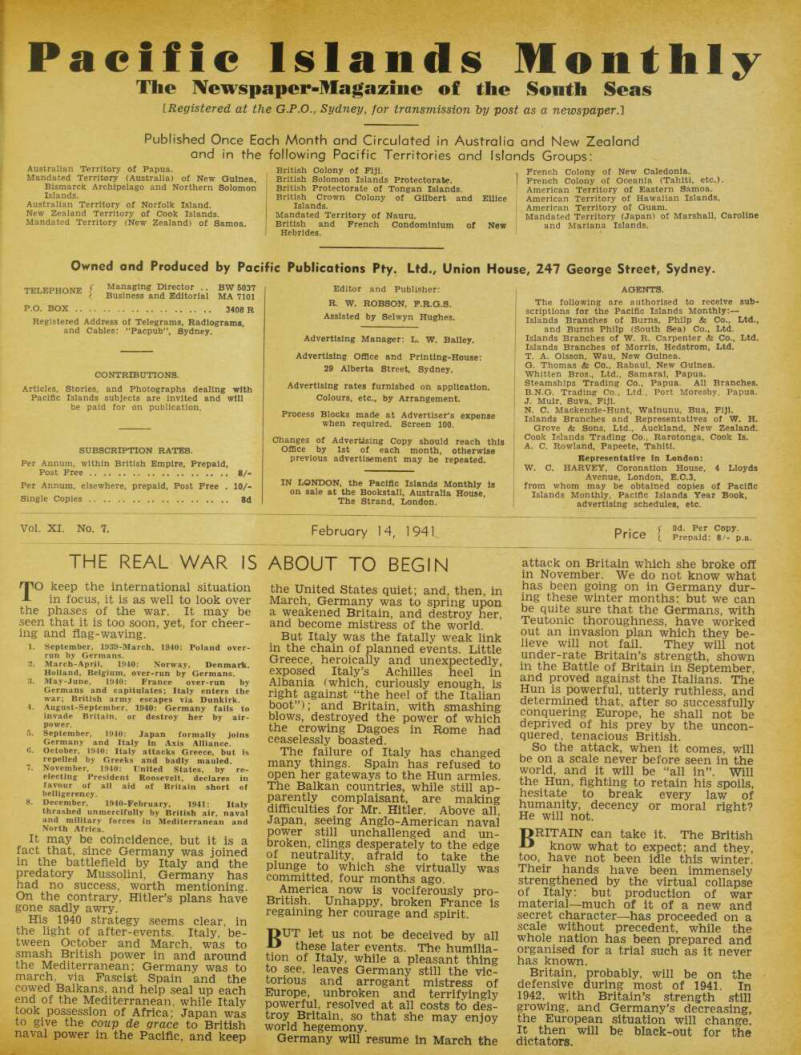
TO keep the international situation in focus, it is as well to look over the phases of the war. It may be seen that it is too soon, yet, for cheer
ing and flag-waving.
1. September, 1939-March, 1940: Poland over run by Germans.
March-Aprjl, 1940: Norway, Denmark, Holland, Belgium, over-run by Germans. 3. May-June, 1940: France over-run by Germans and capitulates; Italy enters the war; British army escapes via Dunkirk. 4. August-September, 1940: Germany fails to invade Britain, or destroy her by air power. 5. September, 1940: Japan formally joins Germany and Italy in Axis Alliance. 6. October, 1940; Italy attacks Greece, but is repelled by Greeks and badly mauled. 7. November, 1940: United States, by re electing President Roosevelt, declares in favour of all aid of Britain short of belligerency. 8. December, 1940-February, 1941: Italy thrashed unmercifully by British air, naval and military forces in Mediterranean and North Africa.
It may be coincidence, but it is a
fact that, since Germany was joined
in the battlefield by Italy and the
predatory Mussolini, Germany has
had no success, worth mentioning.
On the contrary, Hitler’s plans have gone sadly awry.
His 1940 strategy seems clear, in the light of after-events. Italy, be tween October and March, was to smash British power in and around the Mediterranean; Germany was to march, via Fascist Spain and the cowed Balkans, and help seal up each end of the Mediterranean, while Italy took possession of Africa; Japan was to give the coup de grace to British naval power in the Pacific, and keep
the United States quiet; and, then, in March, Germany was to spring upon a weakened Britain, and destroy her, and become mistress of the world.
But Italy was the fatally weak link in the chain of planned events. Little Greece, heroically and unexpectedly, exposed Italy’s Achilles heel in Albania fwhich, curiously enough, is right against “the heel of the Italian boot”); and Britain, with smashing blows, destroyed the power of which the crowing Dagoes in Rome had ceaselessly boasted.
The failure of Italy has changed many things. Spain has refused to open her gateways to the Hun armies.
The Balkan countries, while still ap parently complaisant, are making difficulties for Mr. Hitler. Above all, Japan, seeing Anglo-American naval power still unchallenged and un broken, clings desperately to the edge of neutrality, afraid to take the plunge to which she virtually was committed, four months ago.
America now is vociferously pro- British. Unhappy, broken France is regaining her courage and spirit.
OUT let us not be deceived by all these later events. The humilia tion of Italy, while a pleasant thing to see, leaves Germany still the vic torious and arrogant mistress of Europe, unbroken and terrifyingly powerful, resolved at all costs to des troy Britain, so that she may enjoy world hegemony.
Germany will resume in March the
attack on Britain which she broke off in November. We do not know what has been going on in Germany dur ing these winter months: but we can be quite sure that the Germans, with Teutonic thoroughness, have worked out an invasion plan which they be lieve will not fail. They will not under-rate Britain’s strength, shown in the Battle of Britain in September, and proved against the Italians. The Hun is powerful, utterly ruthless, and determined that, after so successfully conquering Europe, he shall not be deprived of his prey by the uncon quered, tenacious British.
So the attack, when it comes, will be on a scale never before seen in the world, and it will be “all in”. Will the Hun, fighting to retain his spoils, hesitate to break every law of humanity, decency or moral right?
He will not.
BRITAIN can take it. The British -Lf know what to expect; and they, too, have not been idle this winter.
Their hands have been immensely strengthened by the virtual collapse of Italy: but production of war material—much of it of a new and secret character—has proceeded on a scale without precedent, while the whole nation has been prepared and organised for a trial such as it never has known.
Britain, probably, will be on the defensive during most of 1941. In 1942, with Britain’s strength still growing, and Germany’s decreasing, the European situation will change.
It then will be black-out for the dictators.
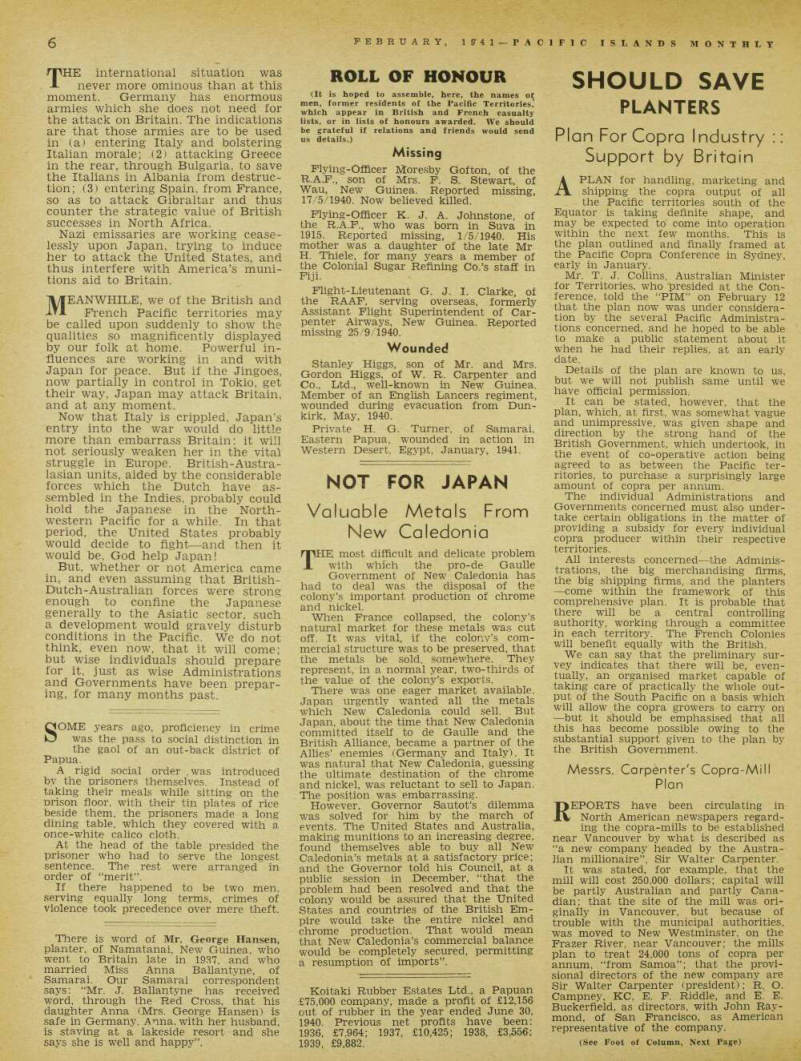
THE international situation was never more ominous than at this moment. Germany has enormous armies which she does not need for the attack on Britain. The indications are that those armies are to be used in (a) entering Italy and bolstering Italian morale; (2) attacking Greece in the rear, through Bulgaria, to save the Italians in Albania from destruc tion; (3) entering Spain, from France, so as to attack Gibraltar and thus counter the strategic value of British successes in North Africa.
Nazi emissaries are working cease lessly upon Japan, trying to induce her to attack the United States, and thus interfere with America’s muni tions aid to Britain.
MEANWHILE, we of the British and French Pacific territories may be called upon suddenly to show the qualities so magnificently displayed by our folk at home. Powerful in fluences are working in and with Japan for peace. But if the Jingoes, now partially in control in Tokio, get their way, Japan may attack Britain, and at any moment.
Now that Italy is crippled, Japan’s entry into the war would do little more than embarrass Britain: it will not seriously weaken her in the vital struggle in Europe. British-Austra lasian units, aided by the considerable forces which the Dutch have as sembled in the Indies, probably could hold the Japanese in the North western Pacific for a while. In that period, the United States probably would decide to fight—and then it would be, God help Japan!
But, whether or not America came in, and even assuming that British- Dutch-Australian forces were strong enough to confine the Japanese generally to the Asiatic sector, such a development would gravely disturb conditions in the Pacific. We do not think, even now, that it will come; but wise individuals should prepare for it, just as wise Administrations and Governments have been prepar ing, for many months past.
SOME years ago, proficiency in crime was the pass to social distinction in the gaol of an out-back district of Papua.
A rigid social order ,was introduced by the prisoners themselves. Instead of taking their meals while sitting on the orison floor, with their tin plates of rice beside them, the prisoners made a long dining table, which they covered with a once-white calico cloth.
At the head of the table presided the prisoner who had to serve the longest sentence. The rest were arranged in order of “merit”.
If there happened to be two men. serving equally long terms, crimes of violence took precedence over mere theft.
There is word of Mr. George Hansen, planter, of Namatanai, New Guinea, who went to Britain late in 1937, and who married Miss Anna Ballantyne, of Samarai. Our Samarai correspondent says; “Mr. J. Ballantyne has received word, through the Red Cross, that his daughter Anna (Mrs. George Hansen) is safe in Germany. Anna, with her husband, is staving at a lakeside resort and she says she is well and happy”.