When War Loomed On Palmerston Is
pp. 59-60 · Read in the full issue
Palmerston Is.
Forgotten Incident of the Marsters Family
By Eric Ramsden
WHEN old William Marsters, the patriarch of Palmerston Island, died fn 1899, he left his family hope lessly divided.
Marsters, an Englishman, settled this island with the assistance of three native women. The latter are referred to as Tahitians. But, as the Marsters them selves say they came from Penrhyn, they should know. From 1862, the year that he arrived with his women, he set out to populate the previously uninhabited island.
Sara was regarded as his legitimate wife. Te Pou was her sister. The third member of the party was their cousin Matavei.
The story of this Englishman on his lonely island, one of the outposts of Poly nesia, is as remarkable as any in the Pacific. Some day it will be considered worthy of a book. The descendants of Marsters have always been wanderers: to-day they are found in many parts of the Pacific.
BUT when the old man died these English-speaking Euronesians did what many another family has done—they fought among themselves.
How the Palmerston islanders received their first Magistrate and Council is related in a forgotten despatch which Colonel W. E. Gudgeon, then British Commissioner at Rarotonga, prepared for the edification of the New Zealand Par liament in the early part of this century.
At that time, New Zealand’s adminis tration in the Cook Group was in the experimental stage. Considerable trouble was occasioned by French schooners dumping guns and liquor at certain islands.
“It will not be possible to prevent the demoralisation of the islands in the British Pacific so long as these Tahitian traders are allowed to visit any of our islands without entering at Rarotonga and clearing therefrom,” Colonel Gud geon informed Lord Ranfurly, then Gov ernor of New Zealand. “As things are at present, any schooner may land arms and spirits unchecked.”
The New Zealand Parliament acted on his advice and approved of the necessary legislation.
It so happened that when a German cruiser called at Rarotonga in August, 1901, John Marsters (a son of old Wil liam) was visiting that island. The Ger man commander, who had been at Palmerston Island earlier in the month, carried a letter (apparently to the Com missioner at Rarotonga) from John’s brother. William. For reasons which Wil liam explained, he did not want John to return.
THIS letter of William Marsters (which was an appeal to the Governor of Fiji for help) is of definite historic importance and is worthy of recording in detail. Authentic material relating to this family does not often come to light.
“I am living on this island, together with two brothers of my own, and four teen half-brothers of two other mothers,”
William wrote on August 17, 1901. “We three brothers are in a quarrel with the fourteen half-brothers. The latter want to take possession of the island and to send us three away, though we think ourselves the real and first owners from
my father, who took possession of the island. He died two years ago.
“About three months ago, there came a schooner and brought a lot of guns for these people. I told the skipper not to bring these guns ashore, as there was no need for guns at all on the island.
About one week later there arrived another schooner, who stayed here for one day to get copra.”
It appeared that half-brother John embarked on this vessel for Tahiti, the supposition being that he proposed to get more guns. At any rate, William thought he had no business there, and was not anxious for his return—unless he was of peaceful mind. Therefore, he urged the Governor to send help and, at the same time, settle the vexed question of the Marsters “heritage”.
COLONEL Gudgeon (Commissioner at Rarotonga) sent for John Marsters and warned him of the conse
quences of disturbing the peace at Palmerston Island. In the previous May, a missionary had found the people there
suffering from the effects of spirits landed from a Tahitian schooner.
The Commissioner then took the earliest opportunity of visiting the island.
In 1901, he says, there were 60 members of the Marsters family residing there “in apparent peace, but anxious that one of them should be appointed to govern the island and act as magistrate”.
After some discussion the will of old William Marsters was produced. It was found that the patriarch desired that Joel, his eldest son, should be “chief of the family”. Accordingly, Gudgeon gave his decision in favour of Joel, who was
appointed magistrate and agent for the Resident and answerable to the adminis trative head-quarters in Rarotonga. “This decision seemed to please all parties,” he says. “They evidently feared that the second son, William Marstersr might be appointed.”
Despite his eloquent appeal for help, it seems that William received short shrift. When Gudgeon, again visited the island on his way to Niue on April 6, 1902, he confirmed Joel in his post, and appointed John, Thomas, Andrew, and Turu Marsters to the council. William was not given even a seat.
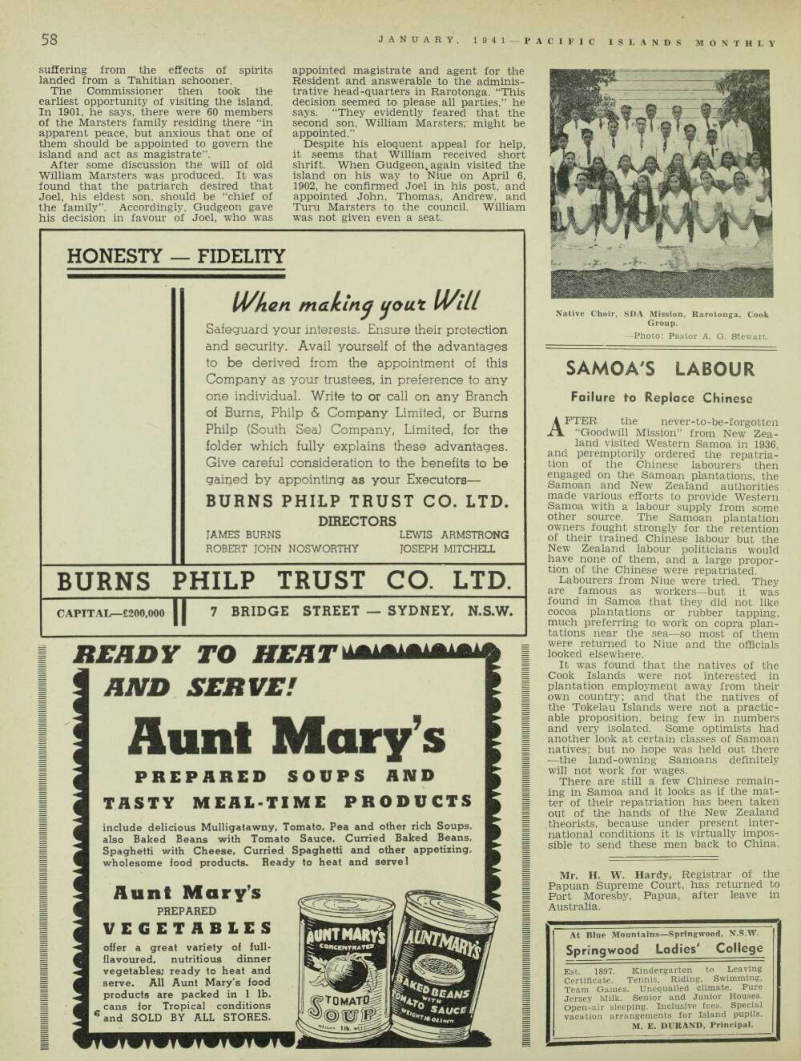
Native Choir, SDA Mission, Rarotonga, Cook Group. —Photo: Pastor A. G. Stewart.