Sir Harry Luke On Tour
pp. 51-52 · Read in the full issue
Colls at Fijian, Samoan and Tongan Islands
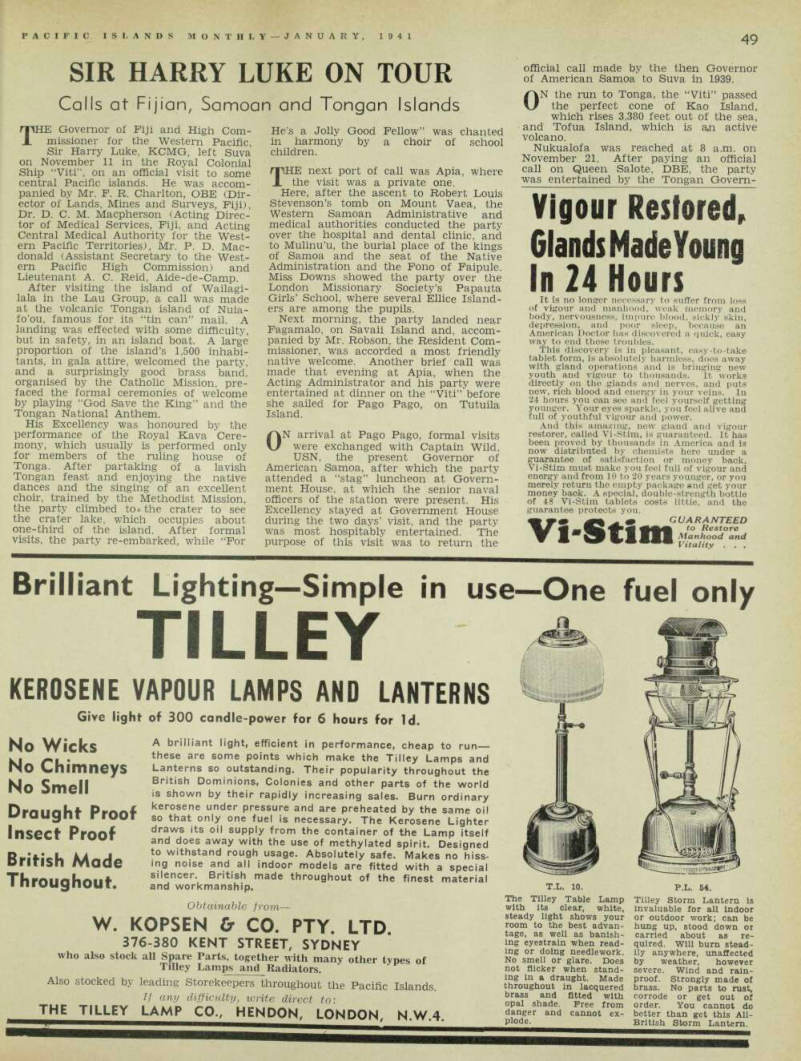
rE Governor of Fiji and High Com missioner for the Western Pacific, Sir Harry Luke, KCMG, left Suva on November 11 in the Royal Colonial Ship “Viti”, on an official visit to some central Pacific islands. He was accom panied by Mr. F. R. Charlton, OBE (Dir ector of Lands, Mines and Surveys, Fiji), Dr. D. C. M. Macpherson (Acting Direc tor of Medical Services, Fiji, and Acting Central Medical Authority for the West ern Pacific Territories), Mr. P. D. Mac donald (Assistant Secretary to the West ern Pacific High Commission) and Lieutenant A. C. Reid, Aide-de-Camp.
After visiting the island of Wailagi lala in the Lau Group, a call was made at the volcanic Tongan island of Nuia fo’ou, famous for its “tin can” mail. A landing was effected with some difficulty, but in safety, in an island boat. A large proportion of the island’s 1.500 inhabi tants, in gala attire, welcomed the party, and a surprisingly good brass band, organised by the Catholic Mission, pre faced the formal ceremonies of welcome by playing “God Save the King” and the Tongan National Anthem, His Excellency was honoured by the performance of the Royal Kava Cere mony, which usually is performed only for members of the ruling house of Tonga. After partaking of a lavish Tongan feast and enjoying the native dances and the singing of an excellent choir, trained by the Methodist Mission, the party climbed to* the crater to see the crater lake, which occupies about one-third of the island. After formal visits, the party re-embarked, while “For
He’s a Jolly Good Fellow” was chanted in harmony by a choir of school children.
THE next port of call was Apia, where the visit was a private one.
Here, after the ascent to Robert Louis Stevenson’s tomb on Mount Vaea, the Western Samoan Administrative and medical authorities conducted the party over the hospital and dental clinic, and to Mulinu’u, the burial place of the kings of Samoa and the seat of the Native Administration and the Fono of Faipule.
Miss Downs showed the party over the London Missionary Society’s Papauta Girls’ School, where several Ellice Island ers are among the pupils.
Next morning, the party landed near Fagamalo, on Savaii Island and, accom panied by Mr. Robson, the Resident Com missioner, was accorded a most friendly native welcome. Another brief call was made that evening at Apia, when the Acting Administrator and his party were entertained at dinner on the “Viti” before she sailed for Pago Pago, on Tutuila Island.
ON arrival at Pago Pago, formal visits were exchanged with Captain Wild, USN, the present Governor of American Samoa, after which the party attended a “stag” luncheon at Govern ment House, at which the senior naval officers of the station were present. His Excellency stayed at Government House during the two days’ visit, and the party was most hospitably entertained. The purpose of this visit was to return the
official call made by the then Governor of American Samoa to Suva in 1939.
ON the run to Tonga, the “Viti” passed the perfect cone of Kao Island, which rises 3,380 feet out of the sea, and Tofua Island, which is aoi active volcano.
Nukualofa was reached at 8 a.m. on November 21. After paying an official call on Queen Salote, DBE, the party was entertained by the Tongan Govem
ment at an open-air picnic at Hufaga lube, on the south coast of Tongatabu.
The afternoon was devoted to official inspections, and in the evening Sir Harry entertained the Queen, the Premier, the Agent and Consul, and Mrs. Armstrong, the Minister of Police and Mrs. Akaoulu, the heads of the churches and other prominent people at dinner on the “Viti”, His Excellency, in his capacity as High Commissioner, discussed official matters at some length with the Queen and her
Prime Minister, and the British Agent and Consul. He also visited the Defence Force camp and inspected and addressed the Force, which gave a very smart account of itself.
Other members of the party visited the hospital and the Lands and Survey Department, and were taken to see such remarkable objects of interest as the “Lagi” (Tomb of the Kings) and the Ha-amoga.
NUKUALOFA was left at dawn on November 23, and at about 11 a.m. the “Viti” was off the periodically disappearing Falcon Island (in Tongan, Fonuafo’ou).
Making a difficult and somewhat dan gerous landing through the heavy surf breaking on the steep black beach, the party spent half an hour on shore. The island was found to be composed of black scoria and ash. The scene was exceed ingly grim and sinister, relieved only by one small coconut palm, about 3 feet high.
RETURNING to Fijian waters, calls were made at the Southern Lau Islands of Vatoa (which was dis covered by Captain Cook during his second voyage in 1774), Ogea, Fulaga, Kabara and Totoya, at all of which His Excellency was ceremonially received by the chiefs and people.
The principal village of each island was inspected and at Tovu village, in Totoya, Dr. Macpherson and two native medical practitioners carried out a medical inspection of the children.
Suva was reached on Wednesday morn ing, November 27.
Mr. J. B. McAdam. of the NG Forestry Department, arrived in Australia recently on leave. He was accompanied by Mrs.
McAdam.