Lively Controversy About
p. 39 · Read in the full issue
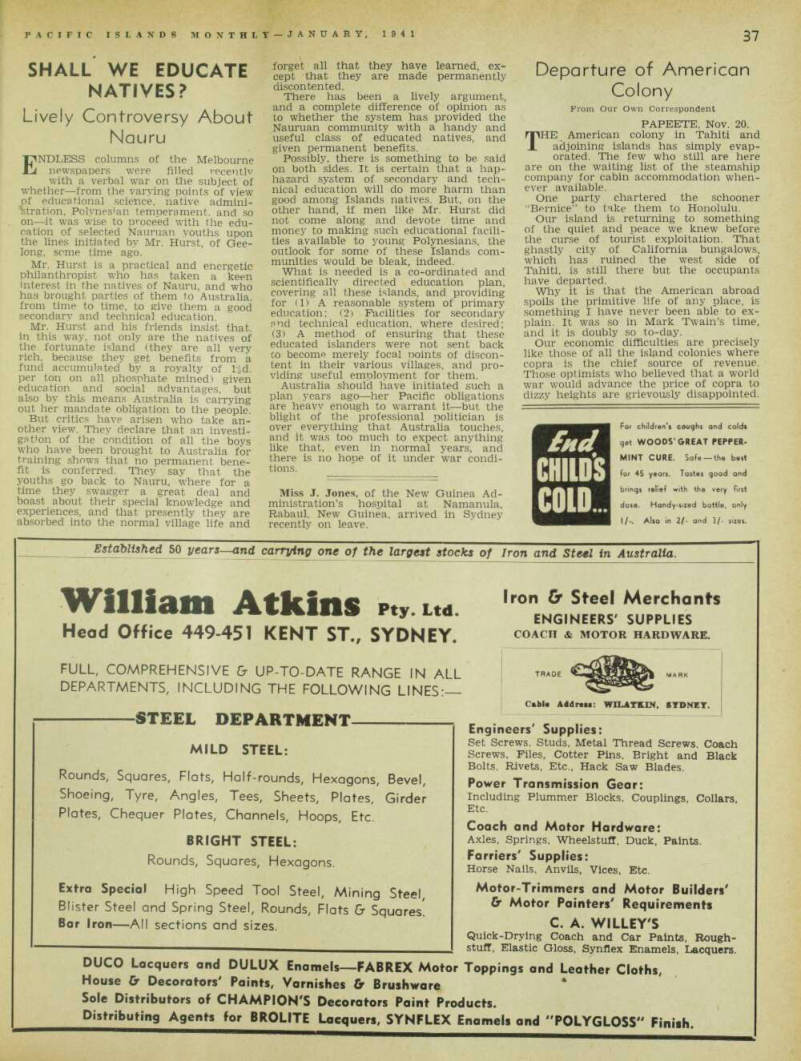
Shall We Educate
Natives?
Lively Controversy About Nauru
ENDLESS columns of the Melbourne newspapers were filled recentlv with a verbal war on the subject of whether —from the varying noints of view of educational science, native admini stration, Polynesian temperament, and so on—it was wise to proceed with the edu cation of selected Nauruan youths upon the lines initiated by Mr. Hurst, of Gee long, some time ago.
Mr. Hurst is a practical and energetic philanthropist who has taken a keen interest in the natives of Nauru, and who has brought parties of them to Australia, from time to time, to give them a good secondary and technical education.
Mr. Hurst and his friends insist that, in this way, not only are the natives of the fortunate island (they are all very rich, because they get benefits from a fund accumulated by a royalty of rid. per ton on all phosphate mined) given education and social advantages, but also by this means Australia is carrying out her mandate obligation to the people.
But critics have arisen who take an other view. They declare that an investi gation of the condition of all the boys who have been brought to Australia for training shows that no permanent bene fit is conferred. They say that the youths go back to Nauru, where for a time they swagger a great deal and boast about their special knowledge and experiences, and that presently they are absorbed into the normal village life and
forget all that they have learned, ex cept that they are made permanently discontented.
There has been a lively argument, and a complete difference of opinion as to whether the system has provided the Nauruan community with a handy and useful class of educated natives, and given permanent benefits.
Possibly, there is something to be said on both sides. It is certain that a hap hazard system of secondary and tech nical education will do more harm than good among Islands natives. But, on the other hand, if men like Mr. Hurst did not come along and devote time and money to making such educational facili ties available to young Polynesians, the outlook for some of these Islands com munities would be bleak, indeed.
What is needed is a co-ordinated and scientifically directed education plan, covering all these islands, and providing for (1) A reasonable system of primary education; (2) Facilities for secondary pnd technical education, where desired; (3) A method of ensuring that these educated islanders were not sent back to become merely focal points of discon tent in their various villages, and pro viding useful employment for them.
Australia should have initiated such a plan years ago—her Pacific obligations are heavy enough to warrant it—but the blight of the professional politician is over everything that Australia touches, and it was too much to expect anything like that, even in normal years, and there is no hope of it under war condi tions.
Miss J. Jones, of the New Guinea Ad ministration’s hospital at Namanula, Rabaul, New Guinea, arrived in Sydney recently on leave.