Historic Medals
pp. 37-38 · Read in the full issue
Specimens of Cook Medal Traced in Pacific
By A. C. Rowland
A MEDAL known as the “Cook com memorative medal, 1772” was sup plied in some numbers to Captain Cook early in that year, when he was about to sail on his second voyage, “to be given to the natives of new-discovered countries”.
At page 151 of his narrative, Captain Cook records that on August 23, 1773, he had an interview at “Oaiti-Piha Bay” with the prince “Waheatoua” and that “the present I made him consisted of a shirt, a sheet, a broad axe, soike nails, knives, looking-glasses, medals, beads, &c”.
From Vehiatua’s possession, two medals came into the hands of Maximo Rodriguez, the Spanish padres’ inter preter, while the frigate was away at El Callao, in 1775; and on her return to Tautira he delivered them to Commanacr de Langara. De Langara presented them to Viceroy Amat, who sent them forward to the Secretary of State at Madrid.
Doctor B. G. Corny—from whose work on the Spanish voyages these notes are taken—made a search at Madrid for the purpose of ascertaining whether the sub sequent history of one or both of these medals could be traced: but found that “neither in the National Museum nor in H.M. Alfonso’s collection is any example of the Cook medal to be met with”.
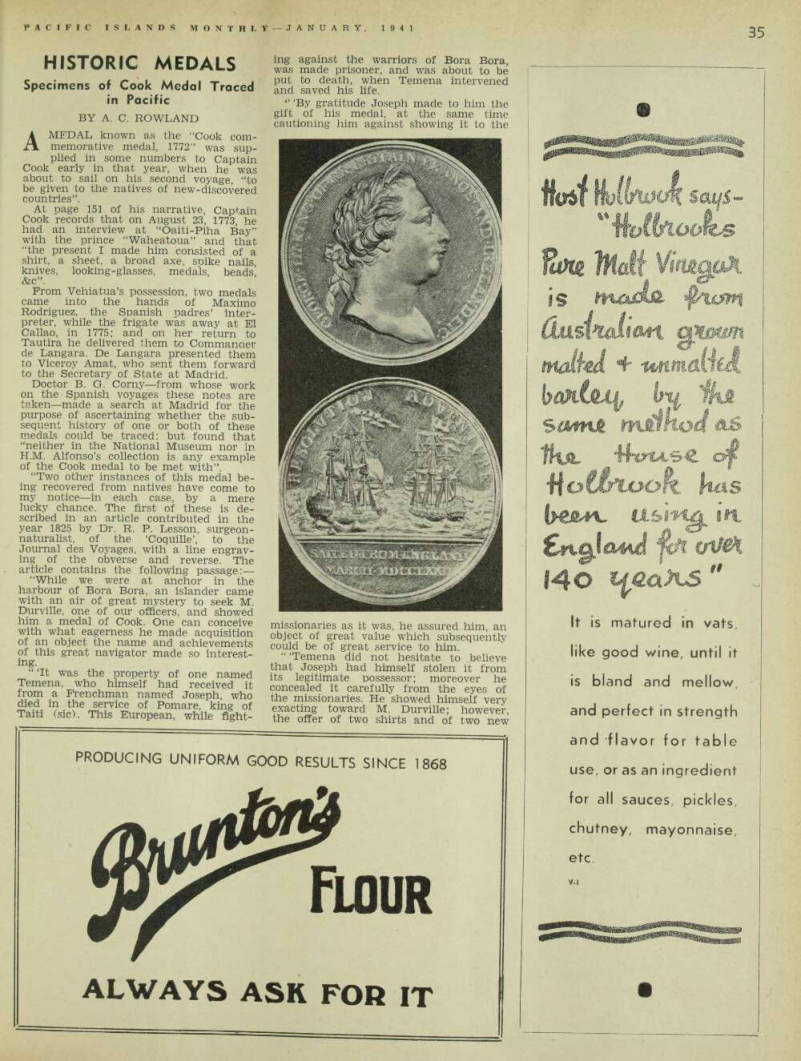
“Two other instances of this medal be ing recovered from natives have come to my notice —in each case, by a mere lucky chance. The first of these is de scribed in an article contributed in the year 1825 by Dr. R. P. Lesson, surgeon naturalist, of the ‘Coquille’, to the Journal des Voyages, with a line engrav ing of the obverse and reverse. The article contains the following passage:— “While we were at anchor in the harbour of Bora Bora, an islander came with an air of great mystery to seek M.
Durville, one of our officers, and showed him a medal of Cook. One can conceive with what eagerness he made acquisition of an object the name and achievements of this great navigator made so interest ing.
“Tt was the nronerty of one named Temena, who himself had received it from a Frenchman named Joseph, who died in the service of Pomare, king of Taiti (sic). This European, while fight
ing against the warriors of Bora Bora, was made prisoner, and was about to be put to death, when Temena intervened and saved his life.
“ ‘By gratitude Joseph made to him the gift of his medal, at the same time cautioning him against showing it to the
missionaries as it was, he assured him, an object of great value which subsequently could be of great service to him.
“ ‘Temena did not hesitate to believe that Joseph had himself stolen it from its legitimate possessor; moreover he concealed it carefully from the eyes of the missionaries. He showed himself very exacting toward M. Durville; however, the offer of two shirts and of two new
handkerchiefs finally seduced him, and he parted with his medal.
“ ‘The missionaries, charged by the London Missionary Society to collect all such objects for the purpose of envoying them to the Museum in England, were much surprised to learn this affair: de claring that, since their arrival, notwith standing their care and requests, they had never been able to procure one of these medals.’
“The other instance is recorded in a letter addressed by Peter Dillon to the editor of the Bengal Hurkaru, which was printed in the Calcutta Government Gazette of October 16, 1826, and contains the following laconic passage:—T got one of Captain Cook’s medals at Port Reso lution.' “Dillon was at that time master of the brig ‘Calder’, and Port Resolution (in Tanna, New Hebrides) had been but rarely visited since Cook called there in August, 1774. This Dillon was the same who discovered the first genuine clues of
La Perouse’s two lost ships, at Vanikoro.
“The illustration represents the obverse and reverse of the gold specimen of the Cook medal in the British Museum, where are also silver and a bronze or bronzed brass one.”
THE, Captain Cook medal was not the only metallic memorial left in the islands by early navigators.
A long letter written by Monsieur Commerson, docteur en medecine and medecin botaniste with Bougainville’s expedition, and dated February 25, 1769, contains the following paragraph:—“l am including here a duplicate of the in scription engraved on medallions of lead which I have left in this island of Taiti” (sic).
This inscrintion is in Latin and is
Dated: “Idibus Aprilis Mdcclxviii”.
No mention of these lead medallions has ever been made (so far as the pre sent writer is aware) by subsequent navi gators. Perhaps the lead was melted and cast into bullets when firearms came
into use among Tahitian natives or, as is quite probable, the medallions repose in some secret cave far inland in the dis trict of Hitiaa, with the bones of the ancient chiefs of that part of Tahiti.