New Caledonia—II.
pp. 29-35 · Read in the full issue
From Notes Mode in New Caledonia—II.
By Brian Stein
OF all the goods rationed in New Caledonia perhaps the one missed most is cooking oil. Ordinarily, a French family uses about 3k pints a month, but all it is allowed to-day is Ik pints. This oil came from France, and now comes from North Ainca; but the possibilities of crushing peanuts and bancoule nuts (both of which grow wild in the Colony) and purifying the oil for table use, are being investigated. Copra, also, has been mentioned as a possible source of cooking oil. * * * MR. B. C. Ballard has quietly and effi ciently taken over his duties as offi cial representative in Noumea of the Australian Government. One of his first difficulties, on his arrival in August, was the scarcity of suitable offices; but he now has secured a dignified suite in a modern new building. Mr. Ballard, who spent about six years in the New Hebrides presenting claims to the Joint Court of the Condominium Govern ment on behalf of the Commonwealth, speaks French fluently, and has a thor ough knowledge of the French legal system. * * * IN 1939 New Caledonia exported 9,300 tons of nickel mattes (68 per cent.) to France and Belgium. When Hit ler over-ran both these countries, the Societe le Nickel, which controls the large, smelting works at Noumea, had to look for a new market for this nickel, and following the visit of Mr. Paul Vois to Australia in July, Australia agreed to take 450 tons a month (5400 tons per annum). To-day, only two of the three furnaces at the smelting works are working, but a representative of the Societe is expected to visit Australia shortly to try and build exports up to their former level.
The Societe’s small fleet of colliers take coal from Australia to Noumea for the smelting works, and then return mostly empty. Referring to this recently a well known mining man said it was a pity these boats could not carry cargoes of nickel ore (3-4 per cent.) back to New castle. He said the Colony easily could supply 60,000 tons of this ore each year. ♦ ♦ ♦ A SIGHT that should never be missed by a visitor to Noumea can be seen after a short walk to the top of one of the hills at the back of the town.
Across Bulari Bay rises a high moun tain, its summit at times wreathed in clouds. The earth of this particular part of the country is highly mineralised and is dark red in colour; and as the rays of the setting sun reach the side of the mountain it glows as though afire — hence its name, Mont D’Or or Mount of Gold. This glowing mountain in the foreground and the winding coastline in the background, give a colour picture so unusual and fantastic as to seem unreal. ♦ * * LACK of French newspapers and the restricted shipping connections have made Caledonians more dependent than ever on the radio for news. In the streets of Noumea, any night between 7.30 and 8 p.m., one sees large groups intently listening to the French programme of news and music broadcast from Australia.
There are about 2,000 radio sets in the Colony, and most of these came from France and America. With France cut off, and a lack of dollar exchange, Australia now will play an important
part in supplying the Colony’s radio requirements. Many people have diffi culty in getting service for their sets, and one Englishman, after waiting many weeks to get his wireless repaired locally, decided that the quickest way would be to send it to Australia. * * * rREE types of coffee are produced in New Caledonia—namely, Arabica, Robusta and Excelsior. The first two are exported but the latter is not a very high quality coffee and is grown mainly by natives. Owing to cyclonic weather, production in 1939 was smaller than usual—l,223 tons, against 1,767 in 1938, and 1,894 in 1937. Formerly France took all of this coffee; but, since the capitulation, production has been stored.
Algeria (French North Africa) has offered to take 1,200 tons a year at good prices; but, owing to shipping difficulties and blockade conditions, New Caledonia can not accept this offer. Shipments are beginning to come to Australia, and efforts are being made to interest America —one of the largest coffee drinking countries in the world—and samples of the best New Caledonian coffees have been sent to the United States. * * * DESPITE the fact that most of New Caledonia resembles the country districts of Australia, the Colony has not the rabbit pest. In fact, rabbits are regarded as a delicacy and most people breed them; and it is quite com monplace to hear one gentleman inquire of another how his rabbits are doing.
Experiments have shown that if rabbits are turned loose to breed of their own accord, they usually die or are killed by rats. • * ♦ ALONG the road to Col d’Amieu, on the west coast, many little water falls run down the mountainside.
Travellers pause at these rivulets now and again for a refreshing drink of icy water; but to the visitor, the prospect of leaning on a precarious footing and the risk of getting a free shower hardly looks worth a drink of water. A closer inspection of these falls, however, reveals a number of little spouts of water issu ing from hollow sticks. Natives build
small clay dams in the ledges of the waterfall and in the bottom of these are placed hollow banana-leaf stems. The water shoots out of these stems like fountains, so that the thirsty traveller can have his drink in reasonable comfort.
PEOPLE visiting Noumea often mis take the policemen they see around the town for ‘ gendarmes ’. Actually these men are Police Agents, and are selected locally for police work in the Municipality of Noumea. The rest of the Colony is divided up into districts and to each a Gendarme is appointed.
These men are sent out from France and hold the rank of a sergeant in the French Army and must be saluted by sol diers in the local forces. Each has a motor bicycle, and makes regular visits to all parts of his district, and one of his most important duties is to look after the welfare of the native and indentured labourers.
Once a month he visits the various plantations and cattle stations to see that the labourers are paid. The em ployer pays their wages, and settles any accounts they may have incurred, before the gendarme: and any complaints are usually aired in his presence. * * ♦ AT Paagoumene, at the north end of the 250 miles long island, is the most important nickel mine in the world, belonging to the Societe Tiebaghi.
This company is British-owned and last year produced 28,000 tons of 58 per cent, ore. In addition, there is an American mine at Fantoche; a French-Australian mine at Koumac; and 18 other small
mines throughout the Colony. The ore is shipped away unsmelted; but some companies have installed a mechanical process which raises its chrome content.
Japan did not import any chrome in the year before the war, but Germany took 13,000 tons, almost double its pre vious year’s import. To-day, America and the British Empire are taking the bulk of chrome exports. * * * A STRIKING feature of town life in New Caledonia is the large number of bicycles used by Europeans, natives, Tonkinese and Javanese. Even business people with motor cars find it necessary to have a bicycle for short trips around the town and in Noumea it is not unusual to see about 100 bicycles of all descriptions leaning against the wall of a big store. Some are equipped with patent gears, electric lamp generators and gleaming mudguards. Others are just ordinary “bikes”, while others appear
to be held together with bits of wire and string. * * * SO that a permanent record may be kept of the momentous events which took place in the Colony following the capitulation of France. Mr. Charles Schmidt, formerly assistant editor of the “France-Austral” (Noumea’s daily newspaper), has written a small booklet, outlining the events leading up to the revolution. * * * MANY Noumea people spend their holidays at La Foa. on the west coast, and here in delightful sur roundings get plenty of deer hunting and fishing. An unusual lunch is served at the little hotel there, the first course comprising no less than four courses of fish foods —oysters, prawns, crabs and grilled fish —followed by chicken, dessert, etc.
TOP.—Left: A ray’s tail and turtle, part of an afternoon’s catch at La Foa. Right: Drinking from one of the “banana-stem fountains" in Col d’Amieu Valley. BOTTOM.—Left: Police Agent in Noumea. Right: Typical Tonkinese woman.
IN November, there was a shortage of tobacco in Noumea. Supplies from France have been cut off, and Indo- China’s future is uncertain; and it is likely that Australia will supply the bulk, if not all, the Colony’s needs.
Prior to the 1914-18 war, cigarettes and tobacco were manufactured in Noumea, but the industry could not compete with the French and Indo-Chinese blends and eventually closed down. Even before that an attempt was made to establish a tobacco industry in the Colony. Samples of leaf were sent to Prance, where it was found to be too strong in nicotine; but agriculturalists say that this tobacco
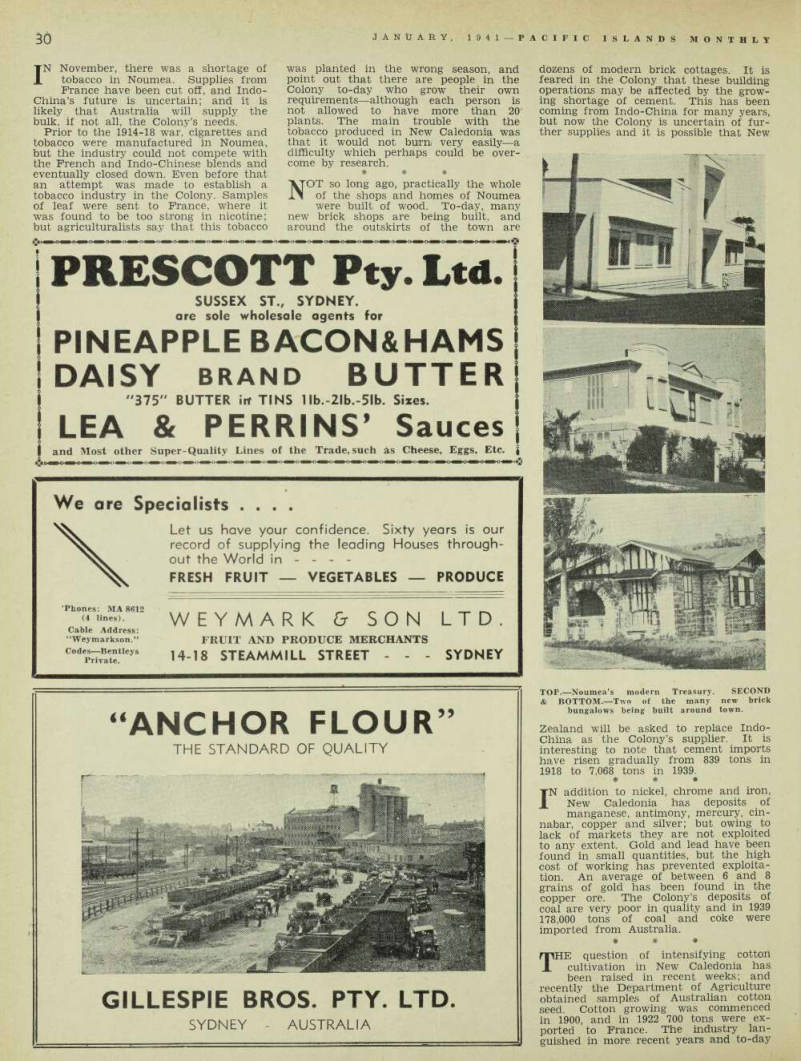
was planted in the wrong season, and point out that there are people in the Colony to-day who grow their own requirements—although each person is not allowed to have more than 20 plants. The main trouble with the tobacco produced in New Caledonia was that it would not burn very easily—a difficulty which perhaps could be over come by research, * * * VTOT 50 lon S ago, practically the whole ll of the shops and homes of Noumea were built of wood. To-day, many new brick shops are being built, and around the outskirts of the town are
dozens of modern brick cottages. It is feared in the Colony that these building operations may be affected by the grow ing shortage of cement. This has been coming from Indo-China for many years, but now the Colony is uncertain of fur ther supplies and it is possible that New
Zealand will be asked to replace Indo china as the Colony’s supplier. It is interesting to note that cement imports have risen gradually from 839 tons in 1918 to 7,068 tons in 1939. * * * IN addition to nickel, chrome and iron, New Caledonia has deposits of manganese, antimony, mercury, cin nabar, copper and silver; but owing to lack of markets they are not exploited to any extent. Gold and lead have been found in small quantities, but the high cost of working has prevented exploita tion. An average of between 6 and 8 grains of gold has been found in the copper ore. The Colony’s deposits of coal are very poor in quality and in 1939 178,000 tons of coal and coke were imported from Australia. » * * rE question of intensifying cotton cultivation in New Caledonia has been raised in recent weeks; and recently the Department of Agriculture obtained samples of Australian cotton seed. Cotton growing was commenced in 1900, and in 1922 700 tons were ex ported to France. The industry lan guished in more recent years and to-day
TOP. —Noumea’s modern Treasury. SECOND & BOTTOM.—Two of the many new brick bungalows being built around town.
the annual production is about 100 tons.
A cotton mill is operating at Kone, but another, at Noumea, has been closed.
New Caledonia cotton is not looked upon very favourably by Australian manufac turers, hence the importation of Aus tralian seed; but it is considered that the country between Noumea and La Foa is suitable for cultivating a large quantity of good cotton. * * * ALTHOUGH New Caledonia has about 103,000 head of cattle, only a small proportion of these are dairy breeds; and quite recently the Colony imported most of its butter and cheese from Aus tralia. A cheese factory has been established at Bourail and produces about 2 tons a month; butter-making machinery arrived from Australia re cently, and is expected to go into pro duction very soon. Meanwhile, attempts are being made to induce graziers to separate their milk and send the cream to Bourail. The main dairy herds of the Colony consist of Illawarra and Jer sey breeds (Australian). * * * rAVELLING along the road between Noumea and La Foa, on the west coast, one is struck by the undu lating country’s resemblance to Austra lia. It is covered with niaouli trees, which are similar to the eucalypt; and here and there are seen acres of dead niaouli trees, ringbarked by cattle own ers to make room for more grasslands, just as is done all over the country dis tricts of Australia. * * * WHEN the pro-Petain Government officials were repatriated from New Caledonia to Indo-China recently, Caledonians had the opportunity of establishing a civil service made up almost entirely of local Frenchmen. For years, the people had expressed dissatis faction with the system whereby the most important Government positions were held by civil servants sent out from France. They maintained that these positions could be filled quite easily by local men—and with less expense. * * * MANY visitors to Noumea complain of the lack of night-life. “Almost as soon as it gets dark the town becomes lifeless,” they say. This, to a degree, is correct. Apart from the three talkie theatres very little entertainment is found in the evenings, and the dances, etc., which were held quite regu larly before the war have now become few and far between.
The long working hours also must be takep into consideration. Noumeans rise between 5.30 and 6 a.m. Business commences at 7 and ceases at 11 a.m., for lunch and siesta. Shops re-open at 1.30 and close for the day at 5.30 p.m.
By the time business people have dinner at 7 p.m., possibly they do not feel inclined for much night life! * * -* THE lack of newspapers and magazines from France is one of the hardest trials Caledonians are put to.
One newsagent said he sold large quan tities of French daily newspapers, such as the “Matin” and “Soir”; but now the Colony gets nothing. In Noumea a daily, the “France-Austral”, and a bi-weekly, the “Bulletin du Commerce”, provide local news; but, owing to the shortage of newsprint, these papers have been reduced considerably in size. * * * NEW Caledonia imported 4,500 tons of rice in 1939; but, faced with the necessity of conserving overseas exchange, many people are asking whe ther this rice can be grown locally.
About 20 hectares of water-rice is under cultivation near St. Louis and yields about 3 tons to the hectare. Another man has been growing rice at Yate for several years and is getting 5 tons per hectare. The Department of Agriculture has been active, and recommends the Golden Caroline upland rice for culti vation in the Colony. Efforts were made to secure five tons of seed from the Indo-Chinese, Javanese and Austra lian Governments, without success, and now the Government has approached the Fiji Government for supplies. The whole question, as one man put it, was not whether rice can grow—it will! —but whether it can be grown as cheaply as the imported product. * * * NEW Caledonia has a most unusual pest in the 300,000 deer found all over the island. These deer origin ally came from Sumatra (Java), but multiplied to such a degree that they have become a nuisance. Several great shooting drives have taken place, and hunting is very popular. The law for bids night shooting, because of the pos sibility of the hunter mistaking a cow or horse for a deer. There are some law-breakers, however, who drive along the road, shining a torch into the bush.
The deer, attracted by the light, comes out into the beam and provides an
excellent target for the waiting marks man. * * * FORMER passengers on the Matson liner “Monterey” who have occasion to visit Noumea by P.A.A. Clipper, will meet an old friend in Mr. J. E. Higgins, formerly purser on the “Monterey”, and
who now is purser on the luxury yacht “Southern Seas”, stationed at Noumea as a floating hotel for the aerial travellers. * * * CALEDONIANS are interested in the future of the large meat canning works at Ouaco, on the north-west coast. The Societe de Ouaco was estab lished in 1880 by a group of French men: but, after years of financial trouble, the control of the company passed into British hands. Until the French armistice the Societe held large contracts for the supply of canned meats to the French Army, the penitentiary at Guiana and the French Colonies in the Pacific.
France was very particular in its speci fications—one of which provided that the meat juices must be contained in the pack. These meats, canned by spe cial machinery, are used as a hot food, with vegetables. Under the direction of Colonel H. B. Dix, the company also has built up a vegetable canning trade, and during dry seasons Caledonians can always get local vegetables, in cans.
Deer meat is also canned.
The Societe obtained its tin supply from France and was expecting a ship ment when that country collapsed. Can ning went on, however, until the stocks of tin were used up. Little canning is done during the summer months; and it is expected that during this period the company will make arrangements for supplies of tin. and still more important, look around for new markets. * * * AT several points around Noumea air raid shelters have been built. They are trenches, about 5 foot deep, which zig-zag along for a short dis
tance. When war "was declared the trenches were dug and for several nights the town was “blacked out”; but when it was seen that Hitler did not want to bomb the town, the lighting precautions were lifted.
JAPAN is not allowed to import any processed metals from New Cale donia: but over the past few years has been taking large quantities of nickel and iron ore out of the Colony, There is only one Japanese nickel com pany—the Societe de I’Oceanie —and it has French directors. This company has three mines at Kua, “Oulie-Oulie”, ‘•Yamamoto SI” and Yamamoto PI”: and commenced operations in 1936. The following year production was 13,400 tons, and this has increased until in 1939 nearly 40.000 tons were produced. In addition to their own production, the Japanese buy ore from small mining concerns, and this is taken away by large Japanese cargo vessels.
Another Japanese company—Societe le Fer—is exploiting the Colony’s resources of iron ore at the “Cascade” mine, Goro.
This company commenced operations early in 1939 and by the end of the year had exported 83,000 tons of ore in 10 vessels. The company expects to export between 400,000 and 500,000 tons a year eventually, and it is said that the only reason which might prevent it from doing so is the inability of its plant to handle this vast quantity.
The Department of Mines, in an offi cial report, said the iron ore was just as rich in its natural state as after cal cination. and estimated that there were several thousand million tons in the Colony.
Compared with other irons, however, New Caledonia’s 50-52 per cent, ore is not very rich.
Japan has become interested in the Colony’s cobalt deposits and recently a sample shipment of 14 tons was sent to Japan by the “Naniwa Maru”. This mineral has never been exploited, as much experience is necessary for its extraction.
On April 18, Governor Pelicier, acting
TOP.—Air raid shelter in Place de Cocotier.
BOTTOM. —A frequent visitor to Noumea—the Japanese “Momoyama Maru”.
under instructions from Paris, gave the Japanese quite a shock, when he pro hibited the export of metals to Japan.
Shortly afterwards this ban was lifted. ♦ * * I FORMERLY New Caledonia obtained its school books and writing paper from France, but now the Colony is looking for a new source of supply.
Samples of writing paper have been sent to Australia: but it is unlikely that this country will be given the opportunity of printing French text books. Those from France were cheap, and it would be very expensive to get the Colony’s small needs printed in Australia. New Cale donia is making efforts to get text books from Canada, where there is a large French population. * * *
CALEDONIANS, particularly the younger
generation, drive very fast, outside the towns. They admit this, but say any risk is outweighed by their knowledge of the roads. “Knowledge of roads” is certainly necessary, for the country is rugged in parts and roads do not just wind in and around the hills in “hairpin” bends, but in “corkscrew bends”. For the hardier souls, a fast drive up into the country is a thrilling experience. * * * A N important problem in New Cale- A donia to-day is the future of 11,000 Javanese and Tonkinese, who, under five-year contracts, supply the bulk of the Colony’s labour requirements. Fur ther supplies from Indo-China are un certain, owing to the lack of shipping and the disturbed state of affairs there; and an adverse exchange position tends to make the indenturing of Javanese expensive. The only labour alternative,
however, is the still more expensive and lackadaisical natives. One cattle owner, who employs indentured labour on his station, summed up the general feeling among employers by saying, “We dare not even think of our Javanese and Tonkinese labour, being curtailed.” * * * THE far-reaching effect of being cut off from France was felt even in the garage business of New Caledonia.
The most popular cars are Citroens and Renaults, and one garage owner said that prior to the war he imported about 53 cars a year. When war broke out that figure decreased slightly. To-day he did not know where he was going to get cheap cars. Another problem which pre sented itself was a supply of spare parts for these cars when they break down.
This difficulty is expected to be over come by sending samples to Australia to be duplicated.
The Colony gets petrol direct from America and when war broke out, a petrol-rationing scheme was introduced.
When it was found that the saving was so slight that it was not worth the trouble, the restrictions were lifted, and the best petrol in Noumea to-day costs 1/9 a gallon.
Mr. R. Mounsey, acting-manager for Messrs. W. H. Grove & Sons, in Raro tonga. returned to New Zealand in December. Mr. A. L. Lewis, late mana ger, who is also well-known in Samoa, has joined the staff of the Internal Marketing Division at Wellington.
Dr. C. M. Dawson, MLC, of Western Samoa, after a short visit to the Terri tory, left again for New Zealand, to con tinue his war-work, as a medical officer.