Enemy Raiders In S. Pacific
pp. 17-53 · Read in the full issue
First Connected Account of How Ten Ships Were Sunk and 496 Castaways Rescued
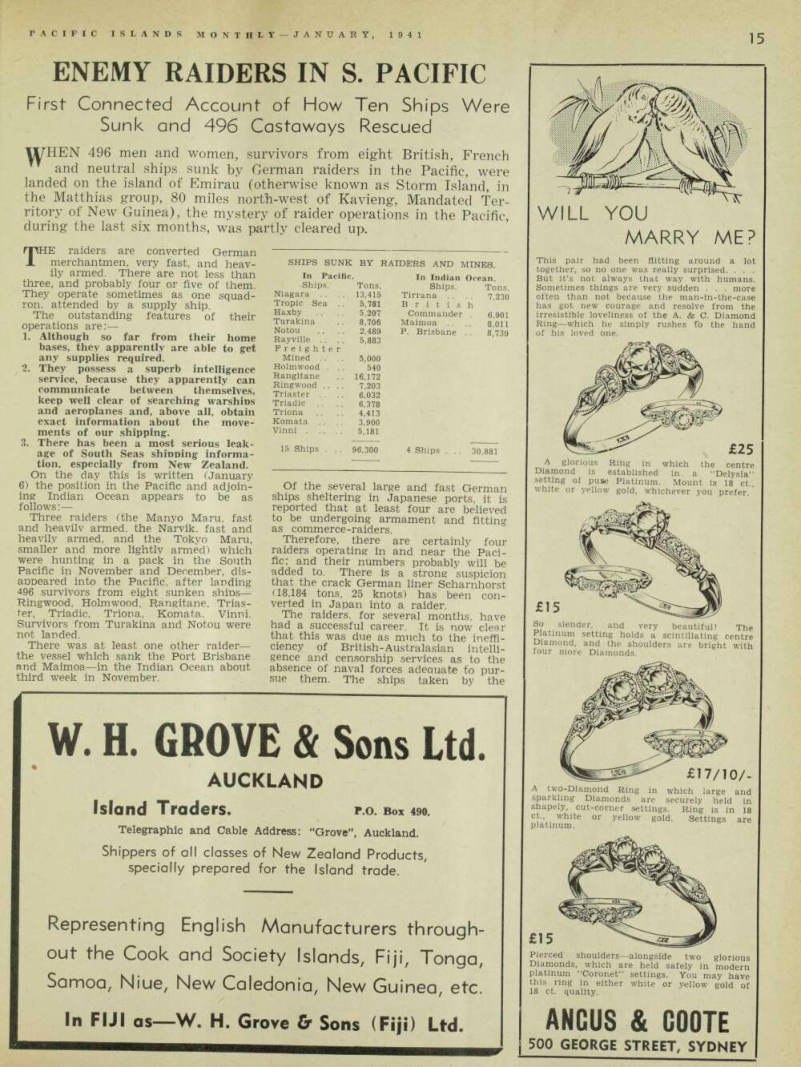
Vi/’HEN 496 men and women, survivors from eight British, French T and neutral ships sunk by German raiders in the Pacific, were landed on the island of Emirau (otherwise known as Storm Island, in the Matthias group, 80 miles north-west of Kavieng, Mandated Ter ritory of New Guinea), the mystery of raider operations in the Pacific, during the last six months, was partly cleared up.
rE raiders are converted German merchantmen, very fast, and heav ily armed. There are not less than three, and probably four or five of them.
They operate sometimes as one squad ron. attended by a supply ship.
The outstanding features of their operations are:— 1. Although so far from their home bases, they apparently are able to get any supplies required. 2. They possess a superb intelligence service, because they apparently can communicate between themselves, keep well clear of searching warshins and aeroplanes and, above all, obtain exact information about the move ments of our shipping. 3. There has been a most serious leak age of South Seas shinning informa tion. especially from New Zealand.
On the day this is written (January 6) the position in the Pacific and adjoin ing Indian Ocean appears to be as follows: Three raiders (the Manyo Maru. fast and heavily armed, the Narvik, fast and heavily armed, and the Tokyo Maru, smaller and more lightly armed) which were hunting in a pack in the South Pacific in November and December, dis anpeared into the Pacific, after landing 496 survivors from eight sunken shins — Ringwood, Holmwood, Rangitane, Trias ter, Triadic, Triona. Komata. Vinni.
Survivors from Turakina and Notou were not landed.
There was at least one other raider— the vessel which sank the Port Brisbane and Maimoa—in the Indian Ocean about third week in November.
Of the several large and fast German ships sheltering in Japanese ports, it is reported that at least four are believed to be undergoing armament and fitting as commerce-raiders.
Therefore, there are certainly four raiders operating in and near the Paci fic; and their numbers probably will be added to. There is a strong suspicion that the crack German liner Scharnhorst (18,184 tons, 25 knots) has been con verted in Japan into a raider.
The raiders, for several months, have had a successful career. It is now clear that this was due as much to the ineffi ciency of British-Australasian intelli gence and censorship services as to the absence of naval forces adequate to pur sue them. The ships taken by the
Ships Sunk
By Raiders And Mines.
In Pacific.
In Indian Ocean.
Ships.
Tons.
Ships.
Tons.
Niagara 13,415 Tirrana 7.230 Tropic Sea 5.781 B r i t i s h Haxby 5,207 Commander 6,901 Turakina 8,706 Maimoa 8,011 Notou 2,489 P. Brisbane 8,739 Rayville .. .. 5,883 Freighter Mined .. 5,000 Holmwood . . . 540 Rangltane 16,172 Ringwood .. 7,203 Triaster 6,032 Triadic 6.378 Triona 4.413 Komata .. 3,900 Vinnl 5.181 15 Ships ... I 96,300 4 Ships . .. 30.881
raiders —especially the five sunk at Nauru —were just a gift to the enemy.
But the lesson has been learned. A new system of naval protection for our ships, and a much closer guard over shipping information, is coming rapidly into operation. The raiders will not have such pleasant cruising, in the future.
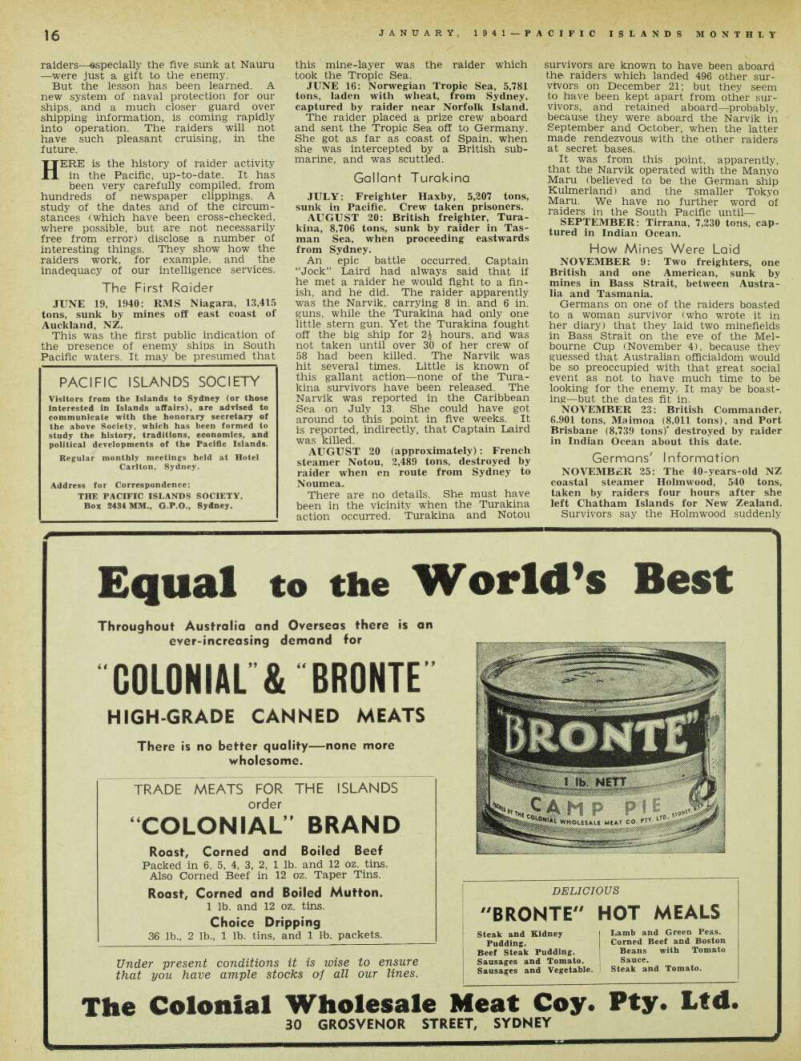
HERE is the history of raider activity in the Pacific, up-to-date. It has been very carefully compiled, from hundreds of newspaper clippings. A study of the dates and of the circum stances (which have been cross-checked, where possible, but are not necessarily free from error) disclose a number of interesting things. They show how the raiders work, for example, and the inadequacy of our intelligence services.
The First Raider
JUNE 19, 1940: RMS Niagara, 13,415 tons, sunk by mines off east coast of Auckland, NZ.
This was the first public indication of the presence of enemy ships in South Pacific waters. It may be presumed that
this mine-layer was the raider which took the Tropic Sea.
JUNE 16: Norwegian Tropic Sea, 5,781 tons, laden with wheat, from Sydney, captured by raider near Norfolk Island.
The raider placed a prize crew aboard and sent the Tropic Sea off to Germany.
She got as far as coast of Spain, when she was intercepted by a British sub marine, and was scuttled.
Gallant Turakina
JULY: Freighter Haxby, 5,207 tons, sunk in Pacific. Crew taken prisoners.
AUGUST 20: British freighter, Tura kina, 8,706 tons, sunk by raider in Tas man Sea, when proceeding eastwards from Sydney.
An epic battle occurred. Captain “Jock” Laird had always said that if he met a raider he would fight to a fin ish, and he did. The raider apparently was the Narvik, carrying 8 in. and 6 in. guns, while the Turakina had only one little stern gun. Yet the Turakina fought off the big ship for 2i hours, and was not taken until over 30 of her crew of 58 had been killed. The Narvik was hit several times. Little is known of this gallant action—none of the Tura kina survivors have been released. The Narvik was reported in the Caribbean Sea on July 13. She could have got around to this point in five weeks. It is reported, indirectly, that Captain Laird was killed.
AUGUST 20 (approximately) : French steamer Notou, 2,489 tons, destroyed by raider when en route from Sydney to Noumea.
There are no details. She must have been in the vicinity when the Turakina action occurred. Turakina and Notou
survivors are known to have been aboard tho raiders which landed 496 other sur vivors on December 21; but they seem to have been kept apart from other sur vivors, and retained aboard—probably, because they were aboard the Narvik in September and October, when the latter made rendezvous with the other raiders at secret bases.
It was from this point, apparently, that the Narvik operated with the Manyo Maru (believed to be the German ship Kulmerland) and the smaller Tokyo Maru. We have no further word of raiders in the South Pacific until — SEPTEMBER; Tirrana, 7,230 tons, cap tured in Indian Ocean.
How Mines Were Laid
NOVEMBER 9: Two freighters, one British and one American, sunk by mines in Bass Strait, between Austra lia and Tasmania.
Germans on one of the raiders boasted to a woman survivor (who wrote it in her diary) that they laid two minefields in Bass Strait on the eve of the Mel bourne Cup (November 4), because they guessed that Australian officialdom would be so preoccupied with that great social event as not to have much time to be looking for the enemy. It may be boast ing—but the dates fit in.
NOVEMBER 23: British Commander, 6.901 tons, Maimoa (8,011 tons), and Port Brisbane (8,739 tons)’ destroyed by raider in Indian Ocean about this date.
Germans 7 Information
NOVEMBER 25: The 40-years-old NZ coastal steamer Holmwood, 540 tons, taken by raiders four hours after she left Chatham Islands for New Zealand.
Survivors say the Holmwood suddenly
found itself amid three hostile ships. The Germans explained that they wanted fresh meat. They knew exactly when the old Holmwood was leaving the Chat hams, and that she was carrying 1,400 sheep, so they just came along, gathered her in, transferred passengers and crew (29 altogether) and sheep, and sank her.
NOVEMBER 27: Liner Rangitane, 16,172 tons, built in 1929, met at dawn by two raiders, which immediately opened fire upon her, without warning.
Three were killed and many wounded, including women, before boats were launched. Ship was sunk.
This was a brutal and horrible sea crime. The liner carried over 100 pas sengers, some of whom, especially two young women, were badly wounded and facially disfigured. The Rangitane’s one gun was not used —it was put out of action by the first salvo.
Passengers aboard included Judge and Mrs. Stuart, lately of Tonga. He was on transfer to British Guiana.
The Germans boasted that they “knew exactly where to pick up the Rangi tane”—and their actions suggested that this was true.
NOVEMBER: Norwegian motorship Ringwood, 7,203 tons, built in 1926, sunk by raiders.
When and where this happened, there is no indication. But it apparently was in November in the South Pacific/
A "Sitting Shot"
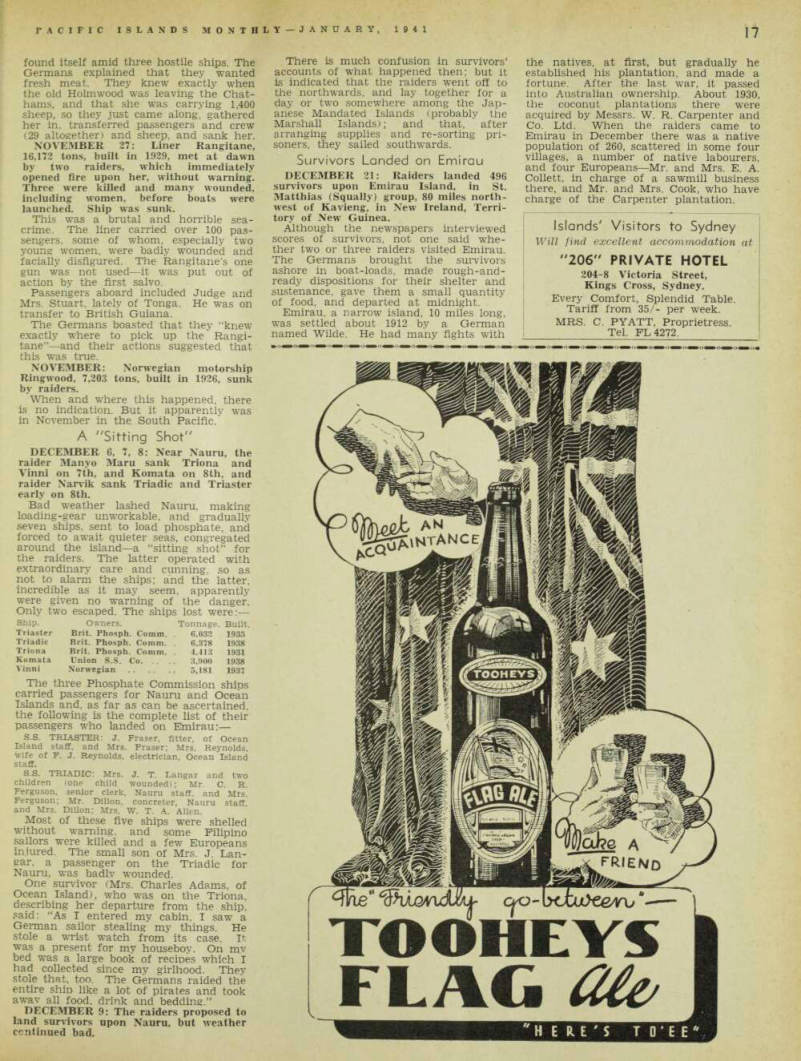
DECEMBER 6,7, 8: Near Nauru, the raider Manyo Maru sank Triona and Vinni on 7th, and Komata on Bth, and raider Narvik sank Triadic and Triaster early on Bth.
Bad weather lashed Nauru, making loading-gear unworkable, and gradually seven ships, sent to load phosphate, and forced to await quieter seas, congregated around the island—a “sitting shot” for the raiders. The latter operated with extraordinary care and cunning, so as not to alarm the ships; and the latter, incredible as it may seem, apparently were given no warning of the danger.
Only two escaped. The ships lost were;—
The three Phosphate Commission shins carried passengers for Nauru and Ocean Islands and, as far as can be ascertained, the following is the complete list of their passengers who landed on Emirau:— 5.5. TRIASTEH: J. Fraser, fitter, of Ocean Island staff, and Mrs. Fraser; Mrs. Reynolds, wife of F. J. Reynolds, electrician, Ocean Island staff. 5.5. TRIADIC: Mrs. J. T. Langar and two children (one child wounded); Mr. C. R.
Ferguson, senior clerk, Nauru staff, and Mrs.
Ferguson; Mr. Dillon, concreter, Nauru staff, and Mrs. Dillon; Mrs. W. T. A. Allen.
Most of these five ships were shelled without warning, and some Filipino sailors were killed and a few Europeans injured. The small son of Mrs. J. Lan gar. a passenger on the Triadic for Nauru, was badlv wounded.
One survivor (Mrs. Charles Adams, of Ocean Island), who was on the Triona, describing her departure from the ship, said: “As I entered my cabin. I saw a German sailor stealing my things. He stole a wrist watch from its case. It was a present for my houseboy. On my bed was a large book of recipes which I had collected since my girlhood. They stole that, too. The Germans raided this entire ship like a lot of pirates and took awav all food, drink and bedding.”
DECEMBER 9: The raiders proposed to land survivors upon Nauru, but weather continued bad.
There is much confusion in survivors’ accounts of what happened then; but it is indicated that the raiders went off to the northwards, and lay together for a day or two somewhere among the Jap anese Mandated Islands (probably the Marshall Islands); and that, after arranging supplies and re-sorting pri soners, they sailed southwards.
Survivors Landed on Emirau
DECEMBER 21: Raiders landed 496 survivors upon Emirau Island, in St.
Matthias (Squally) group, 80 miles north west of Kavieng, in New Ireland, Terri tory of New Guinea.
Although the newspapers interviewed scores of survivors, not one said whe ther two or three raiders visited Emirau.
The Germans brought the survivors ashore in boat-loads, made rough-and ready dispositions for their shelter and sustenance, gave them a small quantity of food, and departed at midnight.
Emirau, a narrow island, 10 miles long, was settled about 1912 by a German named Wilde. He had many fights with
the natives, at first, but gradually he established his plantation, and made a fortune. After the last war, it passed into Australian ownership. About 1930, the coconut plantations there were acquired by Messrs. W. R. Carpenter and Co. Ltd. When the raiders came to Emirau in December there was a native population of 260, scattered in some four villages, a number of native labourers, and four Europeans—Mr. and Mrs. E. A.
Collett, in charge of a sawmill business there, and Mr. and Mrs. Cook, who have charge of the Carpenter plantation.
Ship.
Owners.
Tonnage.
Built.
Triaster Brit. Phosph. Comm. 6,032 1935 Triadic Brit. Phosph. Comm. 6,378 1938 Triona Brit. Phosph. Comm. 4,413 1931 Komata Union S.S. Co. , . . 3,900 1938 Vinni Norwegian 5,181 1937
It would appear that the raiders anchored in a little bay at one end of the island (where their seaplane flew about continually) and that the survivors had to make their way as best they could to the settlement at the other end, 9i miles away. Considerable parties appear to have camped anywhere, and actually, despite poor food and plagues of mos quitoes, to have revelled in the clean sea and bush, after German prison-ships. .The island is traversed by a road, and there is one motor-truck and one bul lock-waggon. The truck was used for the transport of the 70 women and 7 children among the 496 survivors; and the men, many of them barefoot, walked.
The women have told how, as they travelled along in the truck, they saw scores of exhausted men lying down beside the road.
The seven captains, under the senior captain (from the Rangitane) took charge of the extraordinary community, and the two European couples (the Col
letts and the Cooks) placed their houses, food and all they had unreservedly at the disposal of the castaways; and, gradually, some order was evolved.
The first consideration was food and shelter for the various camps. There were four classes of people to be pro vided for—the passengers from the vari ous ships; the officers; the European crews; and some 200 Chinese and Fili pinos, from the various crews. It seems that an attempt was made to provide a general camp for each class. The Europeans’ houses, and rapidly con structed palm-leaf huts, were given to the women and children, and the men camped out comfortably enough under the trees. Food was scarce. The island produces little beyond coconuts. The food grown by the natives barely suffices for their own needs.
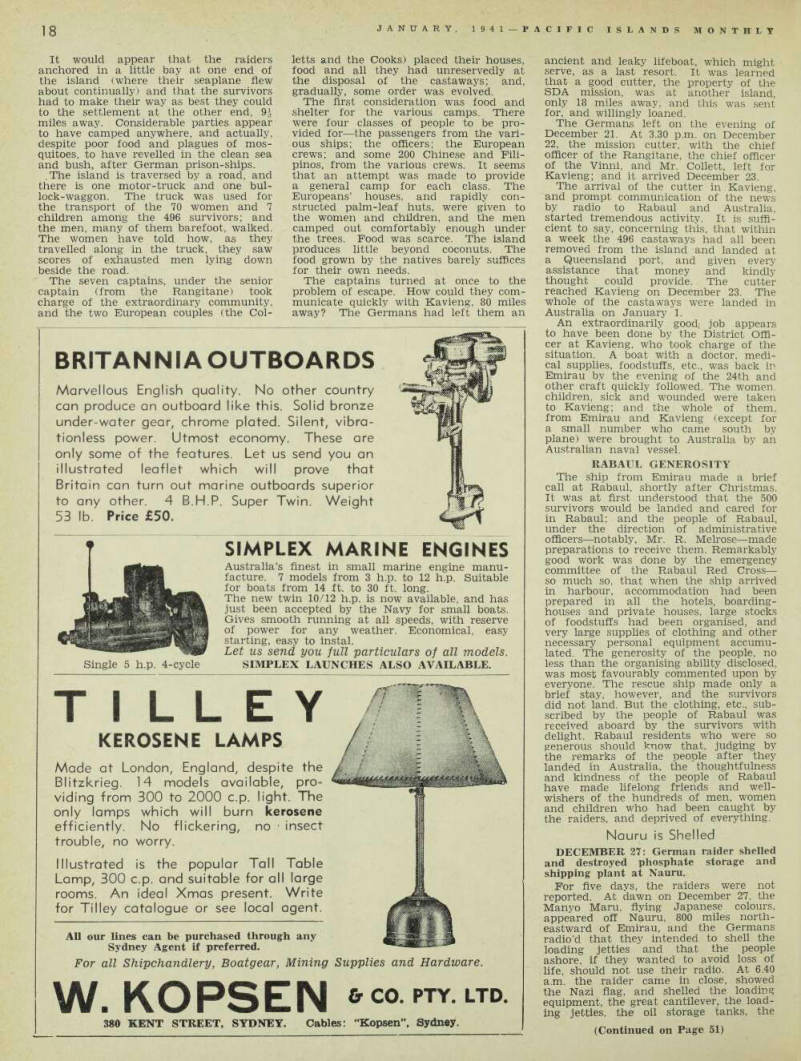
The captains turned at once to the problem of escape. How could they com municate quickly with Kavieng, 80 miles away? The Germans had left them an
ancient and leaky lifeboat, which might serve, as a last resort. It was learned that a good cutter, the property of the SDA mission, was at another island, only 18 miles away, and this was sent for, and willingly loaned.
The Germans left on the evening of December 21. At 3.30 p.m. on December 22, the mission cutter, with the chief officer of the Rangitane, the chief officer of the Vinni, and Mr. Collett, left for Kavieng; and it arrived December 23.
The arrival of the cutter in Kavieng, and prompt communication of the news by radio to Rabaul and Australia, started tremendous activity. It is suffi cient to say, concerning this, that within a week the 496 castaways had all been removed from the island and landed at a Queensland port, and given every assistance that money and kindly thought could provide. The cutter reached Kavieng on December 23. The whole of the castaways were landed in Australia on January 1.
An extraordinarily good/ job appears to have been done by the District Offi cer at Kavieng, who took charge of the situation. A boat with a doctor, medi cal supplies, foodstuffs, etc., was back in Emirau by the evening of the 24th and other craft quickly followed. The women, children, sick and wounded were taken to Kavieng; and the whole of them, from Emirau and Kavieng (except for a small number who came south by plane) were brought to Australia by an Australian naval vessel.
Rabaul Generosity
The ship from Emirau made a brief call at Rabaul, shortly after Christmas.
It was at first understood that the 500 survivors would be landed and cared for in Rabaul; and the people of Rabaul, under the direction of administrative officers —notably, Mr. R. Melrose —made preparations to receive them. Remarkably good work was done by the emergency committee of the Rabaul Red Cross — so much so, that when the ship arrived in harbour, accommodation had been prepared in all the hotels, boarding houses and private houses, large stocks of foodstuffs had been organised, and very large supplies of clothing and other necessary personal equipment accumu lated. The generosity of the people, no less than the organising ability disclosed, was most favourably commented upon by everyone. The rescue ship made only a brief stay, however, and the survivors did not land. But the clothing, etc., sub scribed by the people of Rabaul was received aboard by the survivors with delight. Rabaul residents who were so generous should know that, judging by the remarks of the people after they landed in Australia, the thoughtfulness and kindness of the people of Rabaul have made lifelong friends and well wishers of the hundreds of men, women and children who had been caught by the raiders, and deprived of everything.
Nauru is Shelled
DECEMBER 27: German raider shelled and destroyed phosphate storage and shipping plant at Nauru.
For five days, the raiders were not reported. At dawn on December 27, the Manyo Maru. flying Japanese colours, appeared off Nauru, 800 miles north eastward of Emirau, and the Germans radio’d that they intended to shell the loading jetties and that the people ashore, if they wanted to avoid loss of life, should not use their radio. At 6.40 a.m. the raider came in close, showed the Nazi flag, and shelled the loading equipment, the great cantilever, the load ing jetties, the oil storage tanks, the
(Continued on Page 51)
Mr. L. E. Ford, of Rarotonga, who went to NZ in August, is now serving with the Royal NZ Air Force.
mooring gear, etc. It departed soon afterwards. The destruction was great.
The oil was still burning 24 hours later.
No private property was damaged, and no one was injured.
Fortunately, the power plant was intact, and the news was radio’d to Aus tralia immediately.
Much valuable plant has been erected at Nauru Island since the British Phosphate Commission began working the deposits at the end of the Great War. Formerly the island belonged to Germany, and between 1906 and 1919 the deposits were worked by the Anglo-Ger man Pacific Phosphate Company, which also operated at Ocean Island and else where. The company’s Nauru and Ocean Island interests were purchased by the British, Australian and New Zealand Governments for £3,500,000 in 1919, and the British Phosphate Commission, con sisting of one representative of each Government, was set up that year.
The construction of a great cantilever wharf at a cost of about £200,000, as a means of overcoming the lack of a har bour of any kind, has been a major development carried out by the commis sion. The phosphate is carried out to the end of the cantilever by an endless chain of buckets and is tipped auto matically into the hold of the vessel moored below. It is estimated that the destruction of all this equipment, and of three modern ships, means a loss to the Commission of well over £1,000,000.
The Commission employs a white staff of about 90 on the island, many of the employees having their wives and fami lies with them. The white population also includes an administration staff and a number of missionaries. There are also about 1,400 Chinese coolies and about 100 Chinese artisans in the Commission’s employ, while the native Nauru Island ers total about 1,700.