Memories Of Loma
pp. 40-42 · Read in the full issue
Loma
Charming Old Port in a Forgotten Archipelago
By G. Scoresby Shepherd
STRANGE how memories of Loma Loma, that slumbering old port in the Lau (South-eastern Fiji) Archi pelago, persist so vividly.
Several years ago, I left it and later, after eight roving months, left Fiji.
Since then, I have wandered far and fre quently among the Western Pacific Is lands, touching at dozens of different ports, sometimes lingering, other times just passing through on tourist cruises.
Loma Loma, should be submerged be neath a welter of other kaleidosconic Is-
lands memories, like something fine that has to be sifted out through the running sands in the glass; but it is not so. Mem ories of the old port stand out with crystalline clearness.
Indelible pictures flash across my mind. I see the faded port languishing on the eastern shores of Vanua Balavu, far away east from flourishing Suva, some 180 miles. I see its forsaken appearance —the tumbledown villas that straggled along the contour of the palm-fringed beach, now occupied by Euronesians and Fijians; the faded administrative Gov ernment buildings on the town’s northern outskirts, with the walls of their com pound gapped and crumbling; the ruins that were once stores and hotels, when cotton was King of Commerce in early halcyon days, and Loma Loma was on the map.
I see its driftage-strewn beach and crashing surf. Rather do I hear the surf.
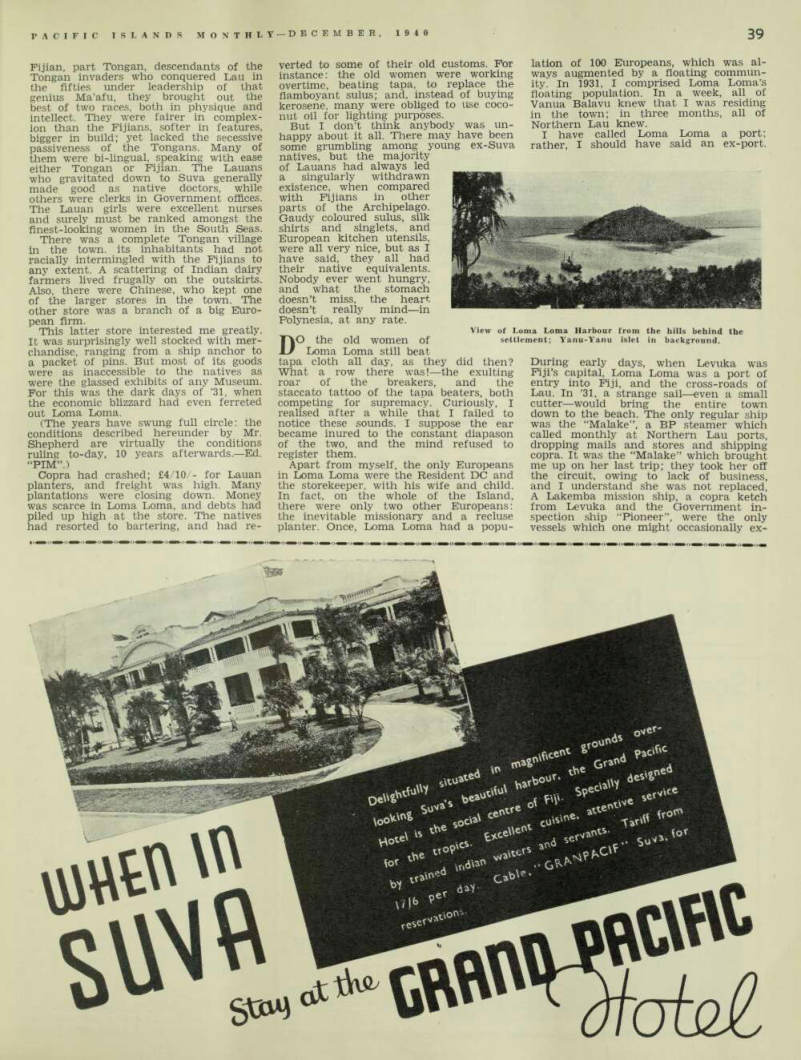
And what a surf it was! The reef was far out, broken, and could not check the breakers. On they came, an endless pro cession of them, until they piled up on the beach, and then their roar was like the reverberation of artillery. Between impacts there was a heavy silence, dramatically intensified by the previous roar. A little pyramid-shaped islet, Yanu-Yanu, in the centre of the harbour, barely took off their rough caress. I do not recollect ever seeing that lagoon
tranquil.
MEMORY recalls its inhabitants —the Lauans. A fine, yet curiously little known race, these natives. Part
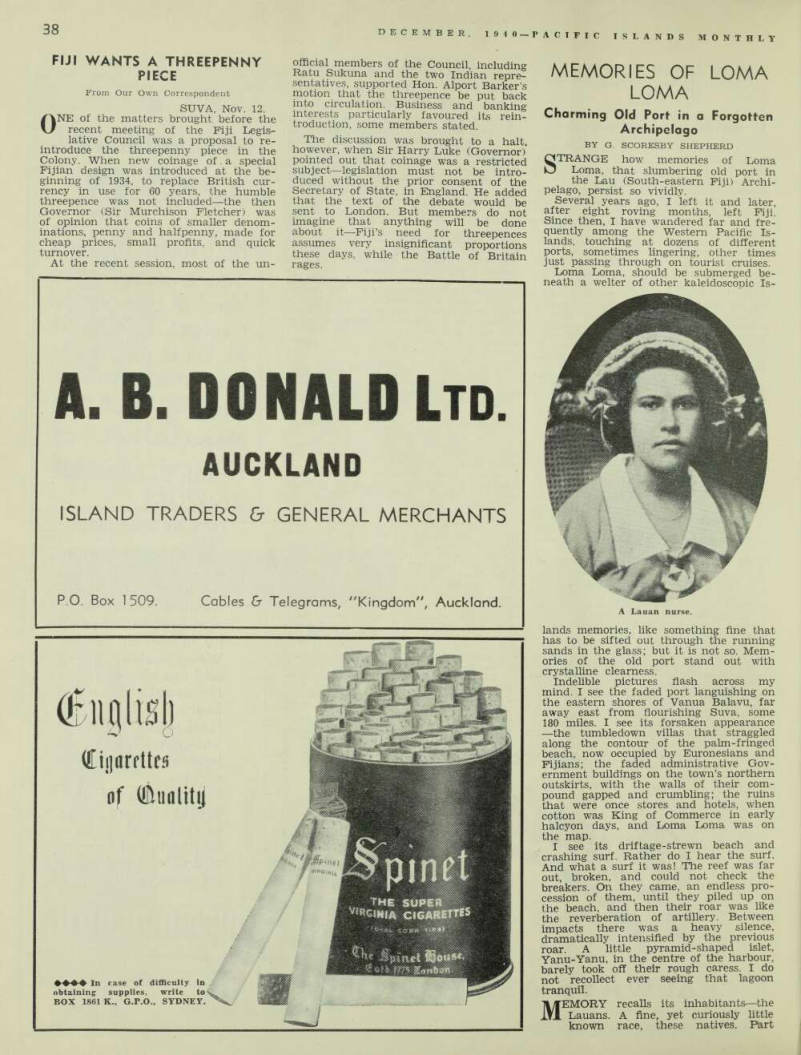
A Lauan nurse.
Fijian, part Tongan, descendants of the Tongan invaders who conquered Lau in the fifties under leadership of that genius Ma’afu, they brought out the best of two races, both in physique and intellect. They were fairer in complex ion than the Fijians, softer in features, bigger in build; yet lacked the secessive passiveness of the Tongans. Many of them were bi-lingual, speaking with ease either Tongan or Fijian. The Lauans who gravitated down to Suva generally made good as native doctors, while others were clerks in Government offices.
The Lauan girls were excellent nurses and surely must be ranked amongst the finest-looking women in the South Seas.
There was a complete Tongan village in the town, its inhabitants had not racially intermingled with the Fijians to any extent. A scattering of Indian dairy farmers lived frugally on the outskirts.
Also, there were Chinese, who kept one of the larger stores in the town. The other store was a branch of a big Euro pean firm.
This latter store interested me greatly.
It was surprisingly well stocked with mer chandise, ranging from a ship anchor to a packet of pins. But most of its goods were as inaccessible to the natives as were the glassed exhibits of any Museum.
For this was the dark days of ’3l, when the economic blizzard had even ferreted out Loma Loma. (The years have swung full circle: the conditions described hereunder by Mr.
Shepherd are virtually the conditions ruling to-day, 10 years afterwards. —Ed.
“Pim”.)
Copra had crashed; £4/10/- for Lauan planters, and freight was high. Many plantations were closing down. Money was scarce in Loma Loma, and debts had piled up high at the store. The natives had resorted to bartering, and had re
verted to some of their old customs. For instance: the old women were working overtime, beating tapa, to replace the flamboyant sulus; and, instead of buying kerosene, many were obliged to use coco nut oil for lighting purposes.
But I don’t think anybody was un happy about it all. There may have been some grumbling among young ex-Suva
natives, but the majority of Lauans had always led a singularly withdrawn existence, when compared with Fijians in other parts of the Archipelago.
Gaudy coloured sulus, silk shirts and singlets, and European kitchen utensils, were all very nice, but as I have said, they all had their native equivalents.
Nobody ever went hungry, and what the stomach doesn’t miss, the heart doesn’t really mind—in Polynesia, at any rate.
DO the old women of Loma Loma still beat
tapa cloth all day, as they did then?
What a row there was!—the exulting roar of the breakers, and the staccato tattoo of the tapa beaters, both competing for supremacy. Curiously, I realised after a while that I failed to notice these sounds. I suppose the ear became inured to the constant diapason of the two, and the mind refused to register them.
Apart from myself, the only Europeans in Loma Loma were the Resident DC and the storekeeper, with his wife and child.
In fact, on the whole of the Island, there were only two other Europeans: the inevitable missionary and a recluse planter. Once, Loma Loma had a popu
lation of 100 Europeans, which was al ways augmented by a floating commun ity. In 1931, I comprised Loma Lomas floating population. In a week, all of Vanua Balavu knew that I was residing in the town; in three months, all of Northern Lau knew.
I have called Loma Loma a port, rather, I should have said an ex-port.
During early days, when Levuka was Fiji’s capital, Loma Loma was a port of entry into Fiji, and the cross-roads of Lau. In ’3l, a strange sail—even a small cutter—would bring the entire town down to the beach. The only regular ship was the “Malake”, a BP steamer which called monthly at Northern Lau ports, dropping mails and stores and shipping copra. It was the “Malake” which brought me up on her last trip; they took her off the circuit, owing to lack of business, and I understand she was not replaced, A Lakemba mission ship, a copra ketch from Levuka and the Government in spection ship “Pioneer”, were the only vessels which one might occasionally ex
View of Loma Loma Harbour from the hills behind the settlement; Yanu-Yanu islet in background.
pect to see. Lau’s waters had a monopoly of submerged coral reefs, and there had to be definite inducement for ships to make the long trip from Suva.
Regular appearance of the “Malake” was not the only sight the natives were to miss, late in ’3l. The European Commissioner was replaced by Ratu Sukuna, that brilliant Fijian chief, who administered Lau until 1939; the missionary on Vanua Balavu was recalled to Suva; ditto the storekeeper and his family, a Euronesian trader taking his place. And, fir Vl lly vJ le ? •• • down to Levuka, with the firm resolution of returning
soon. But, somehow there was that nme for fresh Islands horizons and new faras I never did go back—and now Isunnose that I never shall suppose Mrs nollpl G Jfnea D a?rfvcd u on ?£’ y W hfle d her h„S d * sho . r V holl ?S y Mnrnhp h rnidfipiH<f d wa vlsltm £ the Morot)e Goldfields.
Miss A. Brown of thP rvrmm r Office, Rabaul NG, is at Aus^ tralia on four months’ leave