It's Over The Reef!
pp. 36-38 · Read in the full issue
Landing a Motor Truck on Coral Island
rE exacting feat of getting their out rigger canoes over the foaming reefs of Mangaia has been the daily task of the natives of that island for long generations. Mangaia has no har bours or anchorages. The outer edge of the reef falls away into deep water.
Crossing the reef is at all times a tricky business, but in bad weather the Man gaians perform miracles of seamanship.
Their greatest feat is that of landing a modern motor truck. To date, seven vehicles have been brought ashore with out mishap.
Two canoes, which are hollowed from single tree-trunks, are lashed parallel, spaced with timbers, so that the wheels of the vehicle will settle snugly into the hulls, and taken out to the ship.
Now comes the nerve-racking business of lowering the truck into the canoes from the deck of a pitching and sway ing schooner.
We hold our breath as it dangles pre cariously from the cargo hoist, swinging with the motion of the ship and rising and falling in alternate rushes. Time and again, the hovering truck is almost settled into the canoes, but before it can be released it is jerked into the air, and the canoes go sheering off. Eventually it is settled in the canoes and the tackle cleared.
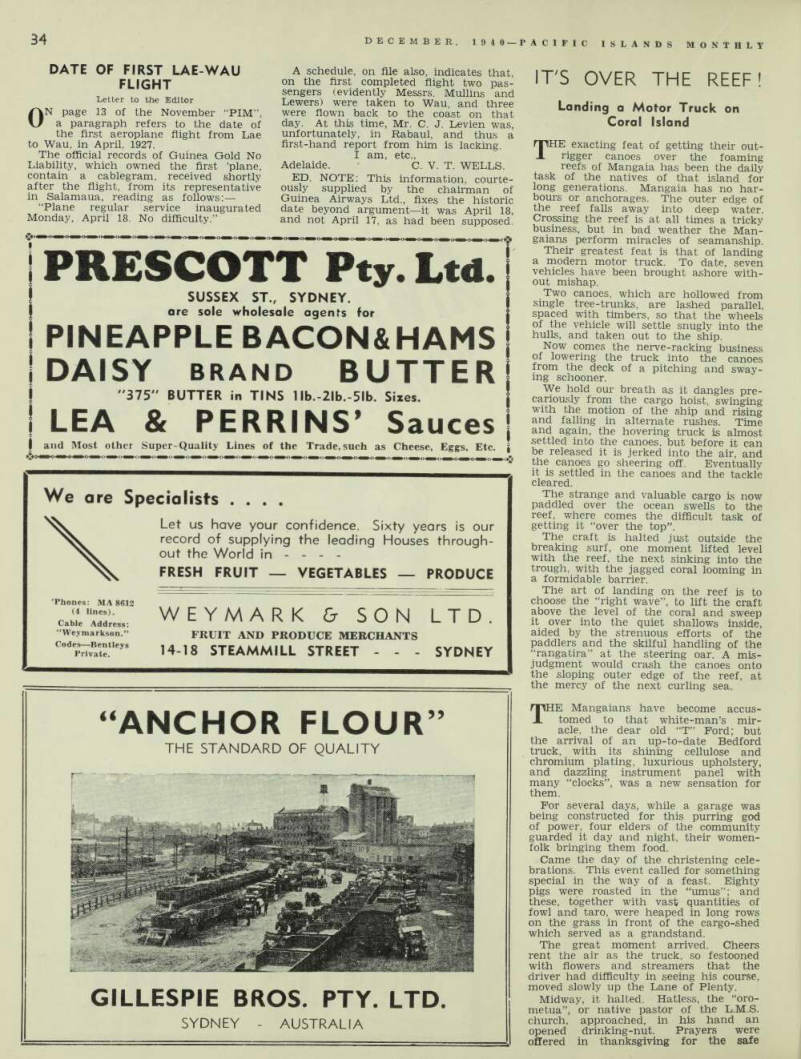
The strange and valuable cargo is now paddled over the ocean swells to the reef, where comes the difficult task of getting it “over the top”.
The craft is halted just outside the breaking surf, one moment lifted level with the reef, the next sinking into the trough, with the jagged coral looming in a formidable barrier.
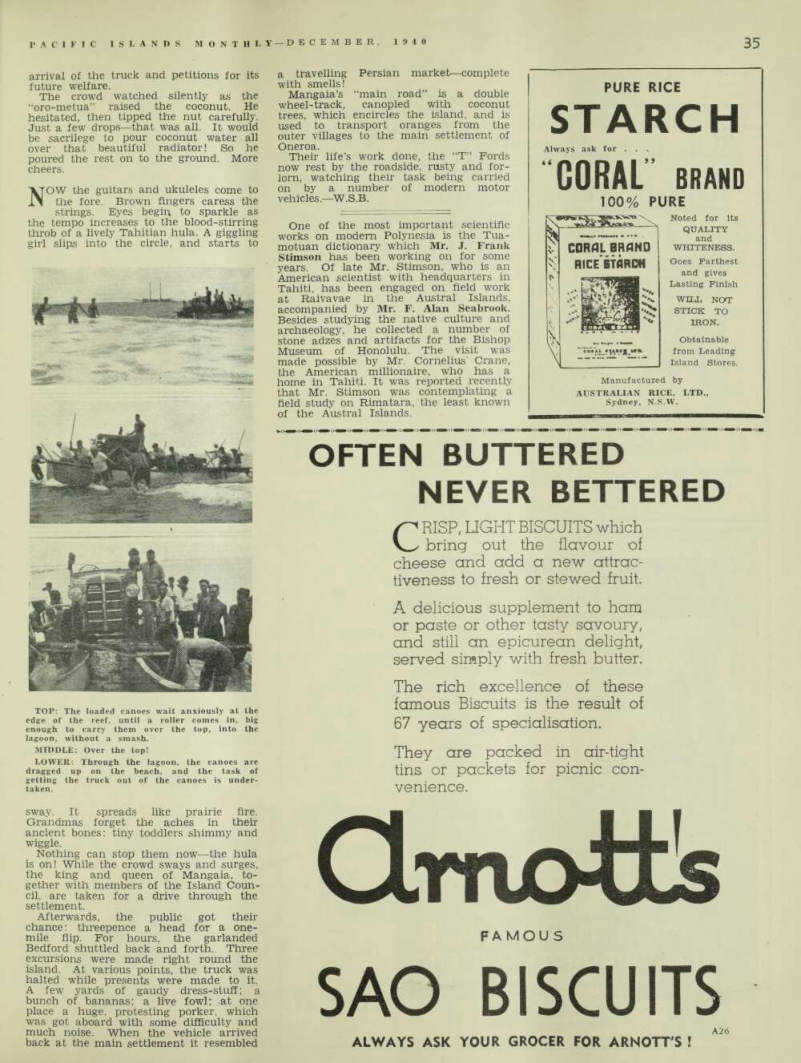
The art of landing on the reef is to choose the “right wave”, to lift the craft above the level of the coral and sweep it over into the quiet shallows inside, aided by the strenuous efforts of the paddlers and the skilful handling of the “rangatira” at the steering oar. A mis judgment would crash the canoes onto the sloping outer edge of the reef, at the mercy of the next curling sea, rpHE Mangaians have become accus- JL tomed to that white-man’s mir acle, the dear old “T” Ford; but the arrival of an up-to-date Bedford truck, with its shining cellulose and chromium plating, luxurious upholstery, and dazzling instrument panel with many “clocks”, was a new sensation for them.
For several days, while a garage was being constructed for this purring god of power, four elders of the community guarded it day and night, their women folk bringing them food.
Came the day of the christening cele brations. This event called for something special in the way of a feast. Eighty pigs were roasted in the “umus”; and these, together with vast quantities of fowl and taro, were heaped in long rows on the grass in front of the cargo-shed which served as a grandstand.
The great moment arrived. Cheers rent the air as the truck, so festooned with flowers and streamers that the driver had difficulty in seeing his course, moved slowly up the Lane of Plenty.
Midway, it halted. Hatless, the “oro metua”, or native pastor of the L.M.S. church, approached, in his hand an opened drinking-nut. Prayers were offered in thanksgiving for the safe
arrival of the truck and petitions for its future welfare.
The crowd watched silently as the “oro-metua” raised the coconut. He hesitated, then tipped the nut carefully.
Just a few drops—that was all. It would be sacrilege to pour coconut water all over that beautiful radiator! So he poured the rest on to the ground. More cheers.
NOW the guitars and ukuleles come to the fore. Brown fingers caress the strings. Eyes begin, to sparkle as the tempo increases to the blood-stirring throb of a lively Tahitian hula. A giggling girl slips into the circle, and starts to
sway. It spreads like prairie fire.
Grandmas forget the aches in their ancient bones: tiny toddlers shimmy and wiggle.
Nothing can stop them now—the hula is on! While the crowd sways and surges, the king and queen of Mangaia, to gether with members of the Island Coun cil, are taken for a drive through the settlement.
Afterwards, the public got their chance: threepence a head for a one mile flip. For hours, the garlanded Bedford shuttled back and forth. Three excursions were made right round the island. At various points, the truck was halted while presents were made to it.
A few yards of gaudy dress-stuff; a bunch of bananas; a live fowl; at one place a huge, protesting porker, which was got aboard with some difficulty and much noise. When the vehicle arrived back at the main settlement it resembled
a travelling Persian market—complete with smells!
Mangaia’s “main road” is a double wheel-track, canopied with coconut trees, which encircles the island, and is used to transport oranges from the outer villages to the main settlement of Oneroa.
Their life’s work done, the “T” Fords now rest by the roadside, rusty and for lorn, watching their task being carried on by a number of modern motor vehicles. —W.S.B.
One of the most important scientific works on modem Polynesia is the Tua motuan dictionary which Mr. J, Frank Stimson has been working on for some years. Of late Mr. Stimson, who is an American scientist with headquarters in Tahiti, has been engaged on field work at Raivavae in the Austral Islands, accompanied by Mr. F. Alan Seabrook.
Besides studying the native culture and archaeology, he collected a number of stone adzes and artifacts for the Bishop Museum of Honolulu. The visit was made possible by Mr. Cornelius Crane, the American millionaire, who has a home in Tahiti. It was reported recently that Mr. Stimson was contemplating a field study on Rimatara, the least known of the Austral Islands.
TOP: The loaded canoes wait anxiously at the edge of the reef, until a roller comes in, big enough to carry them over the top, into the lagoon, without a smash.
MIDDLE: Over the top!
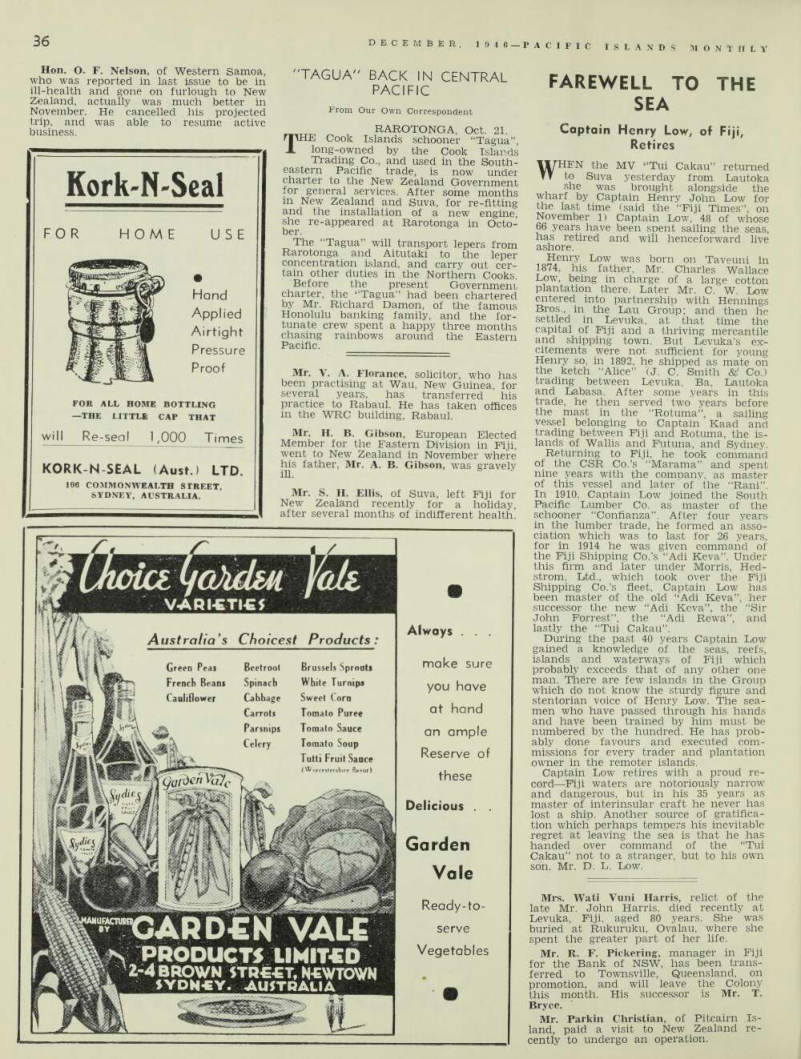
LOWER: Through the lagoon, the canoes are dragged up on the beach, and the task of getting the truck out of the canoes is under taken.
Hon. O. F. Nelson, of Western Samoa, who was reported in last issue to be in ill-health and gone on furlough to New Zealand, actually was much better in November. He cancelled his projected trip, and was able to resume active business.