New Caledonia
pp. 27-32 · Read in the full issue
From Notes Mode in New Caledonia
By Brian Stein
LIKE most large Pacific towns, Noumea has its daily market; and, early in the morning, all kinds of gardeners begin to arrive at the market place with horse-drawn carts, cars, lorries, and even wheelbarrows. Their loads of vegetables and fruits are laid out on a long counter, running between avenues of large Jameloynien trees. The mistress of the average household usually sends her Javanese or Tonkinese servant to buy the day’s requirements; but some of the French ladies prefer to do their own shopping, and these, together with the natives, Tonkinese and Javanese, make the market an interesting, animated place between 5.30 and 6.30 a.m.
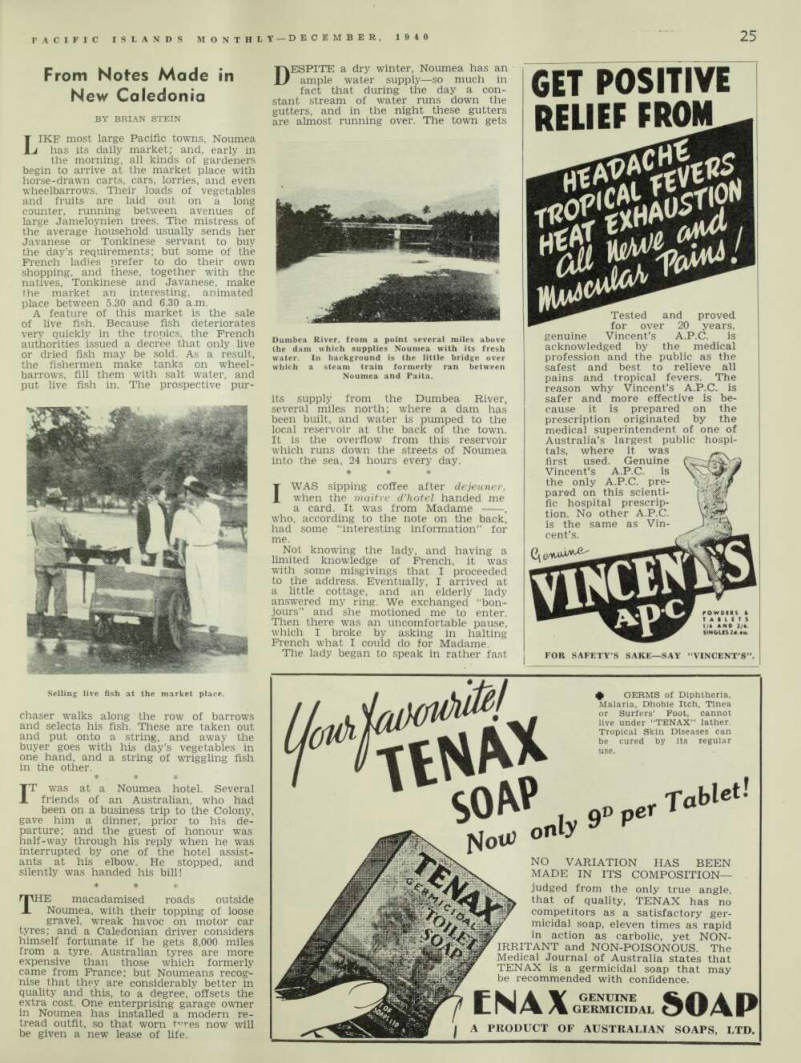
A feature of this market is the sale of live fish. Because fish deteriorates very quickly in the tropics, the French authorities issued a decree that only live or dried fish may be sold. As a result, the fishermen make tanks on wheel barrows, fill them with salt water, and put live fish in. The prospective pur-
chaser walks along the row of barrows and selects his fish. These are taken out and put onto a string, and away the buyer goes with his day’s vegetables in one hand, and a string of wriggling fish in the other. * * * IT was at a Noumea hotel. Several friends of an Australian, who had been on a business trip to the Colony, gave him a dinner, prior to his de parture; and the guest of honour was half-way through his reply when he was interrupted by one of the hotel assist ants at his elbow. He stopped, and silently was handed his bill! * * * THE macadamised roads outside Noumea, with their topping of loose gravel, wreak havoc on motor car tyres; and a Caledonian driver considers himself fortunate if he gets 8,000 miles from a tyre. Australian tyres are more expensive than those which formerly came from France; but Noumeans recogl - that they are considerably better in quality and this, to a degree, offsets the extra cost. One enterprising garage owner in Noumea has installed a modern re tread outfit, so that worn now will be given a new lease of life.
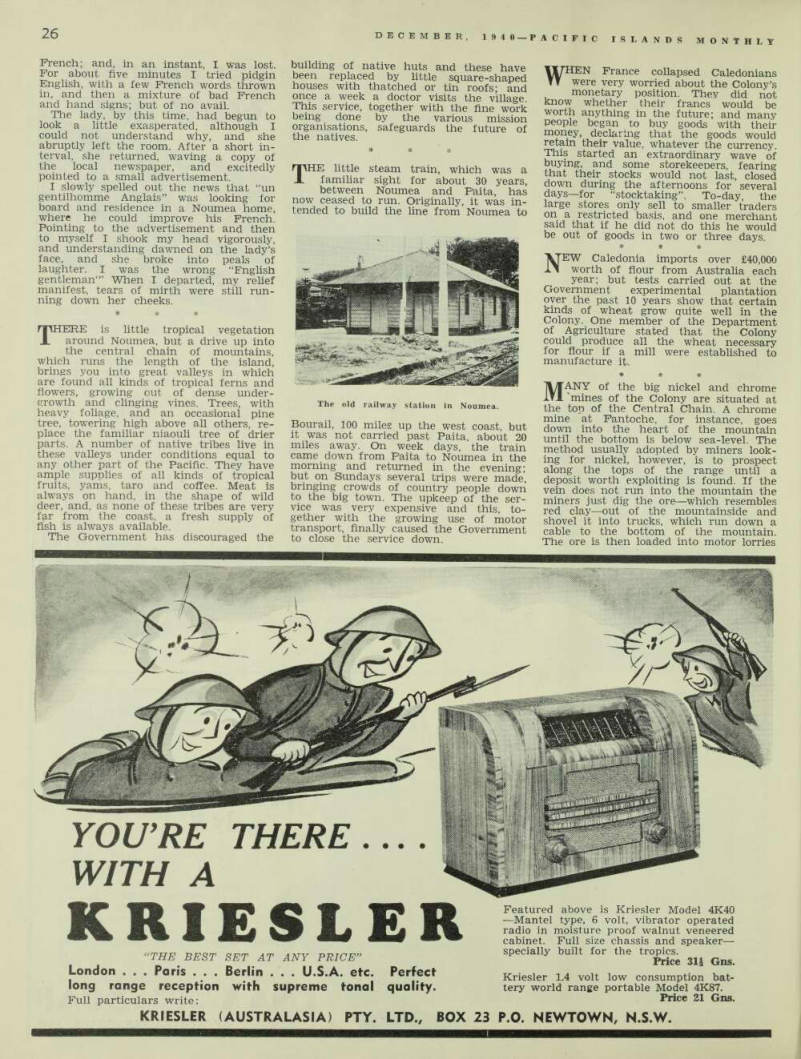
DESPITE a dry winter, Noumea has an ample water supply—so much in fact that during the day a con stant stream of water runs down the gutters, and in the night these gutters are almost running over. The town gets
its supply from the Dumbea River, several miles north; where a dam has been built, and water is pumped to the local reservoir at the back of the town.
It is the overflow from this reservoir which runs down the streets of Noumea into the sea, 24 hours every day. ♦ * * I WAS sipping coffee after dejeuner, when the maitre d’hotel handed me a card. It was from Madame , who, according to the note on the back, had some “interesting information” for me.
Not knowing the lady, and having a limited knowledge of French, it was with some misgivings that I proceeded to the address. Eventually, I arrived at a little cottage, and an elderly lady answered my ring. We exchanged “bon jours” and she motioned me to enter.
Then there was an uncomfortable pause, which I broke by asking in halting French what I could do for Madame.
The lady began to speak in rather fast
Selling live fish at the market place.
Dumbea River, from a point several miles above the dam which supplies Noumea with its fresh water. In background is the little bridge over which a steam train formerly ran between Noumea and Paita.
French; and, in an instant, I was lost.
For about five minutes I tried pidgin English, with a few French words thrown in, and then a mixture of bad French and hand signs; but of no avail.
The lady, by this time, had begun to look a little exasperated, although I could not understand why, and she abruptly left the room. After a short in terval, she returned, waving a copy of the local newspaper, and excitedly pointed to a small advertisement.
I slowly spelled out the news that “un gentilhomme Anglais” was looking for board and residence in a Noumea home, where he could improve his French.
Pointing to the advertisement and then to myself I shook my head vigorously, and understanding dawned on the lady’s face, and she broke into peals of laughter. I was the wrong “English gentleman 0 ’ When I departed, my relief manifest, tears of mirth were still run ning down her cheeks. * * * THERE is little tropical vegetation around Noumea, but a drive up into the central chain of mountains, which runs the length of the island, brings you into great valleys in which are found all kinds of tronical ferns and flowers, growing out of dense under growth and clinging vines. Trees, with heavy foliage, and an occasional pine tree, towering high above all others, re place the familiar niaouli tree of drier parts. A number of native tribes live in these valleys under conditions equal to any other part of the Pacific. They have ample supplies of all kinds of tropical fruits, yams, taro and coffee. Meat is always on hand, in the shape of wild deer, and, as none of these tribes are very far from the coast, a fresh supply of fish is always available.
The Government has discouraged the
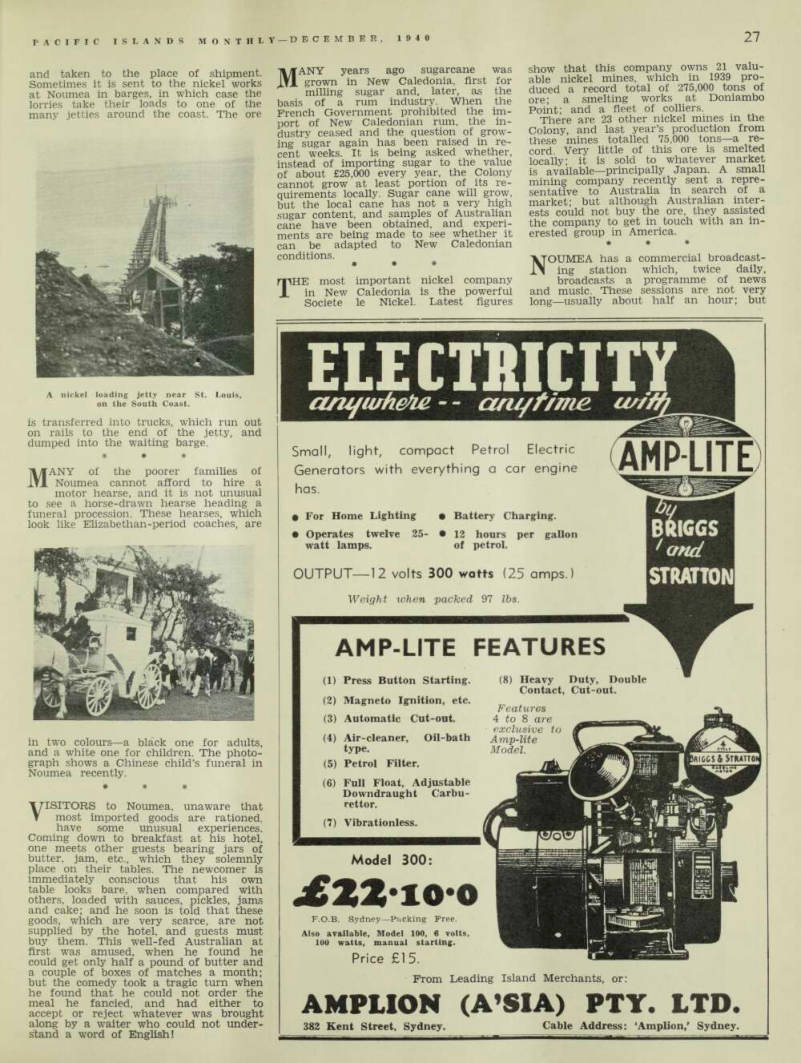
building of native huts and these have been replaced by little square-shaped houses with thatched or tin roofs; and once a week a doctor visits the village This service, together with the fine work being done by the various mission organisations, safeguards the future of the natives. * * * THE little steam train, which was a familiar sight for about 30 years, between Noumea and Paita, has now ceased to run. Originally, it was in tended to build the line from Noumea to
Bourail, 100 miles up the west coast, but it was not carried past Paita, about 20 miles away. On week days, the train came down from Paita to Noumea in the morning and returned in the evening; but on Sundays several trips were made, bringing crowds of country people down to the big town. The upkeep of the ser vice was very expensive and this, to gether with the growing use of motor transport, finally caused the Government to close the service down.
IITHEN France collapsed Caledonians ▼ ▼ were very worried about the Colony’s monetary position. They did not know whether their francs would be worth anything in the future; and many people began to buy goods with their money, declaring that the goods would retain their value, whatever the currency.
This started an extraordinary wave of buying, and some storekeepers, fearing that their stocks would not last, closed down during the afternoons for several days—for “stocktaking”. To-day, the large stores only sell to smaller traders on a restricted basis, and one merchant said that if he did not do this he would be out of goods in two or three days. * * * NEW Caledonia imports over £40,000 worth of flour from Australia each year; but tests carried out at the Government experimental plantation over the past 10 years show that certain kinds of wheat grow quite well in the Colony. One member of the Department of Agriculture stated that the Colony could produce all the wheat necessary for flour if a mill were established to manufacture it. * * * MANY of the big nickel and chrome 'mines of the Colony are situated at the top of the Central Chain. A chrome mine at Fantoche, for instance, goes down into the heart of the mountain until the bottom is below sea-level. The method usually adopted by miners look ing for nickel, however, is to prospect along the tops of the range until a deposit worth exploiting is found. If the vein does not run into the mountain the miners just dig the ore—which resembles red clay—out of the mountainside and shovel it into trucks, which run down a cable to the bottom of the mountain.
The ore is then loaded into motor lorries
The old railway station in Noumea.
and taken to the place of shipment.
Sometimes it is sent to the nickel works at Noumea in barges, in which case the lorries take their loads to one of the many jetties around the coast. The ore
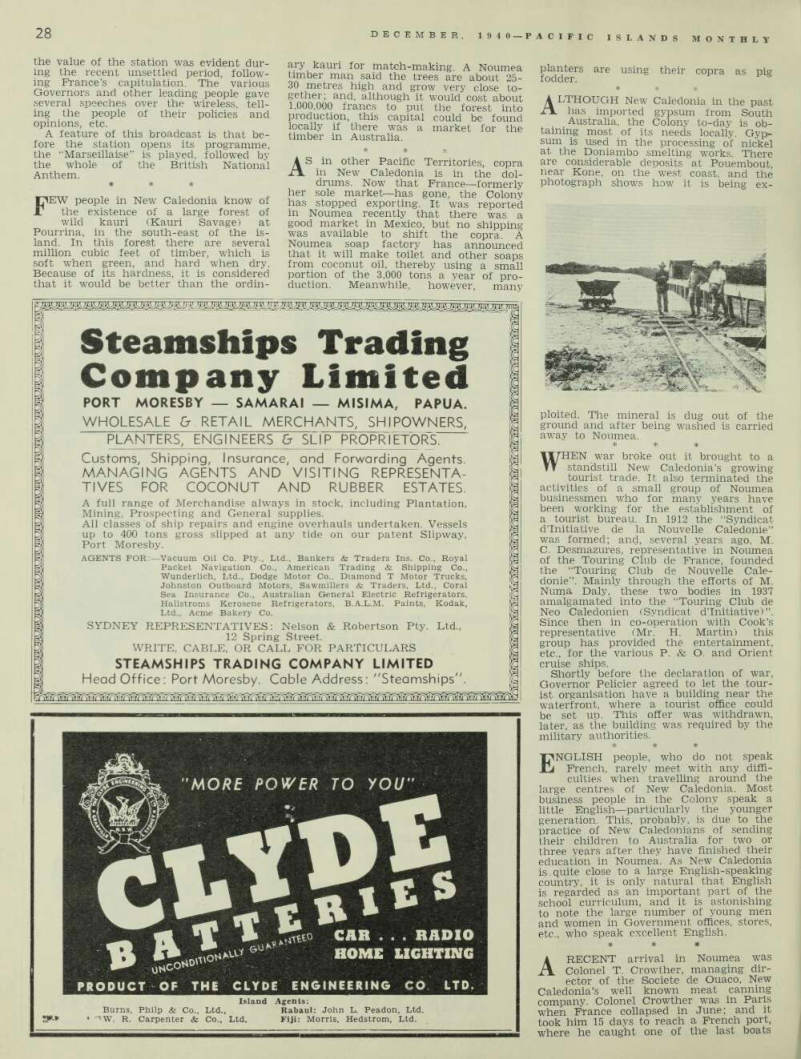
is transferred into trucks, which run out on rails to the end of the jetty, and dumped into the waiting barge. * * ♦ MANY of the poorer families of Noumea cannot afford to hire a motor hearse, and it is not unusual to see a horse-drawn hearse heading a funeral procession. These hearses, which look like Elizabethan-period coaches, are
in two colours—a black one for adults, and a white one for children. The photo graph shows a Chinese child’s funeral in Noumea recently. * * * VISITORS to Noumea, unaware that most imported goods are rationed, have some unusual experiences.
Coming down to breakfast at his hotel, one meets other guests bearing jars of butter, jam, etc., which they solemnly place on their tables. The newcomer is immediately conscious that his own table looks bare, when compared with others, loaded with sauces, pickles, jams and cake; and he soon is told that these goods, which are very scarce, are not supplied by the hotel, and guests must buy them. This well-fed Australian at first was amused, when he found he could get only half a pound of butter and a couple of boxes of matches a month; but the comedy took a tragic turn when he found that he could not order the meal he fancied, and had either to accept or reject whatever was brought along by a waiter who could not under stand a word of English!
MANY years ago sugarcane was grown in New Caledonia, first for milling sugar and, later, as the basis of a rum industry. When the French Government prohibited the im port of New Caledonian rum, the in dustry ceased and the question of grow ing sugar again has been raised in re cent weeks. It is being asked whether, instead of importing sugar to the value of about £25,000 every year, the Colony cannot grow at least portion of its re quirements locally. Sugar cane will grow, but the local cane has not a very high sugar content, and samples of Australian cane have been obtained, and experi ments are being made to see whether it can be adapted to New Caledonian conditions. * * * THE most important nickel company in New Caledonia is the powerful Societe le Nickel. Latest figures
show that this company owns 21 valu able nickel mines, which in 1939 pro duced a record total of 275,000 tons of ore; a smelting works at Doniambo Point; and a fleet of colliers.
There are 23 other nickel mines in the Colony, and last year’s production from these mines totalled 75,000 tons—a re cord. Very little of this ore is smelted locally; it is sold to whatever market is available—principally Japan. A small mining company recently sent a repre sentative to Australia in search of a market; but although Australian inter ests could not buy the ore, they assisted the company to get in touch with an in erested group in America. ♦ ♦ • NOUMEA has a commercial broadcast ing station which, twice daily, broadcasts a programme of news and music. These sessions are not very long—usually about half an hour; but
A nickel loading jetty near St. Louis, on the South Coast.
the value of the station was evident dur ing the recent unsettled period, follow ing France’s capitulation. The various Governors and other leading people gave several speeches over the wireless, tell ing the people of their policies and opinions, etc.
A feature of this broadcast is that be fore the station opens its programme, the “Marseillaise” is played, followed by the whole of the British National Anthem. * * * FEW people in New Caledonia know of the existence of a large forest of wild kauri (Kauri Savage) at Pourrina, in the south-east of the is land. In this forest there are several million cubic feet of timber, which is soft when green, and hard when dry.
Because of its hardness, it is considered that it would be better than the or din
ary kauri for match-making. A Noumea timber man said the trees are about 25- 30 metres high and grow very close to gether; and, although it would cost about 1,000.000 francs to nut the forest into production, this canital could be found locally if there was a market for the timber in Australia. * * * AS in other Pacific Territories, copra in New Caledonia is in the dol drums. Now that France—formerly her sole gone, the Colony has stopped exporting. It was reported in Noumea recently that there was a good market in Mexico, but no shipping was available to shift the copra. A Noumea soap factory has announced that it will make toilet and other soaps from coconut oil, thereby using a small portion of the 3,000 tons a year of pro duction. Meanwhile. however, manv
planters are using their copra as pig fodder. * * * ALTHOUGH New Caledonia in the past has imported gypsum from South Australia, the Colony to-day is ob taining most of its needs locally. Gyp*sum is used in the processing of nickel at the Doniambo smelting works. There are considerable denosits at Pouembout. near Kone, on the west coast, and the photograph shows how it is being ex-
ploited. The mineral is dug out of the ground and after being washed is carried away to Noumea. * * * WHEN war broke out it brought to a standstill New Caledonia’s growing tourist trade. It also terminated the activities of a small group of Noumea businessmen who for many years have been working for the establishment of a tourist bureau. In 1912 the “Syndicat d’lnitiative de la Nouvelle Caledonie” was formed; and, several years ago, M.
C. Desmazures, representative in Noumea of the Touring Club de France, founded the “Touring Club de Nouvelle Cale donie”. Mainly through the efforts of M.
Numa Daly, these two bodies in 1937 amalgamated into the “Touring Club de Neo Caledonien (Syndicat d’lnitiative)”.
Since then in co-operation with Cook’s representative (Mr. H. Martin) this group has provided the entertainment, etc., for the various P. & O. and Orient cruise ships.
Shortly before the declaration of war, Governor Pelicier agreed to let the tour ist organisation have a building near the waterfront, where a tourist office could be set uo. This offer was withdrawn, later, as the building was required by the military authorities. * * * ENGLISH people, who do not speak French, rarely meet with any diffi culties when travelling around the large centres of New Caledonia. Most business people in the Colony speak a little English—particularly the younger generation. This, probably, is due to the practice of New Caledonians of sending their children to Australia for two or three vears after they have finished their education in Noumea. As New Caledonia is quite close to a large English-speaking country, it is only natural that English is regarded as an important part of the school curriculum, and it is astonishing to note the large number of young men and women in Government offices, stores, etc., who speak excellent English. * * * A RECENT arrival in Noumea was Colonel T. Crowther, managing dir ector of the Societe de Ouaco, New Caledonia’s well known meat canning company. Colonel Crowther was in Paris when Prance collapsed in June; and it took him 15 days to reach a French port, where he caught one of the last boats
for England. After a stay in London, he left for America, arriving there after 16 days’ zig-zagging across the Atlantic. At New York he caught a plane for San Francisco; spent a day there, and flew to Noumea by PA A clipper—the whole journey from New York to Noumea taking just 6 days.
Colonel Crowther’s last visit to the Colony was some 20 years ago, and he said the outstanding change which had taken place was the road system in the country. Formerly, he had had to travel up the coast by boat, and then on horseback, to reach his company’s prop erties. To-day, main roads take him to any of his interests in the island.