Was Suppressed
p. 10 · Read in the full issue
How a Fascist Clique Was Suppressed
Prom Our Own Correspondent
Papeete, Oct. 18.
AT last, after many delays due to a variety of causes—of which trans port is not the least—l am able to supply a connected story of what hap pened here between the time when France made her tragic capitulation to the enemy in June, and we in French Oceania finally placed ourselves in the ranks of Prep France at the end of August.
Here, in French Oceania, we are very
isolated. We knew in June, of course, that Prance had been over-run by the Hun and that French leaders, of whom we had expected resistance to the death, had surrendered to Hitler and formed what was called the Vichy Government.
But, until the middle of August, we in Papeete believed that we were nart of the French Empire, and that, whatever Vichy might do, we were definitely still at war on the side of our British allies.
That, we believed, was the wish, and per haps the intention, of our then Governor, M. de Gery, whom we highly esteemed.
On June 25, the Governor issued a proclamation to the ponulation of Tahiti virtually stating that we were still at war as an ally of Great Britain. We did hear, however, that certain Fascist gentlemen in high places in this colony were bringing heavy pressure to bear on the head of our colony to induce him to adhere to the Vichy Government.
A large section of our community be came restless and suspicious. The “Com mittee of Free France” was formed.
When certain regulations, manifestly emanating from Vichy, appeared in our official journal, and at the same time our local Fascists issued a manifesto demand ing restrictive laws—comparable only to those in force in Poland and Nazi Ger many—against those who favoured Free France, the Committee of Free France decided to act.
It insisted that there be taken a plebi scite of the whole population. The plebi scite was taken in mid-August and it re sulted in 5,564 people voting for Free France and General de Gaulle, and only 18 voting against. Thus was disclosed the real strength of our gang of Fascists.
Thereupon the Governor, the popular M. de Gery, took the only course open to him, and resigned office. He shortly afterwards departed for Ban Francisco, en route to Europe. The direction of the Government was assumed by three mem bers of his private council—namely MM.
Erahnne, G. Lagarde and E. Martin, to gether with the Mayor of Papeete, M.
George Bambridge. All of these men are members of old and influential families in Tahiti.
The radiogram announcing the result of the plebiscite, and the fact that the Government temporarily was in the hands of the four men named, was despatched to General de Gaulle on the evening of September 2. Listeners were
thrilled to hear, in the early morning broadcast of the 8.8. C. on September 3, the announcement that the message had been received by General de Gaulle.
Early in September, the Government of New Zealand arranged an economic accord with the Tahiti administration, to last for the duration of the war. New Zealand, in many ways, gave the French colony immediate assistance.
A steamer of the Messageries Maritime Line, which had come from France via Panama, and had been lying in Papeete for a considerable time, was brought into useful operation.
On September 18 our local Fascists tried to stage a coup d’etat, but it was immediately put down by the authorities, without any riot or bloodshed. The Fascist ring-leaders were then gathered up and placed aboard the MM liner, which sailed away with them a few days later.
Since that day everything in the colony has - been calm.
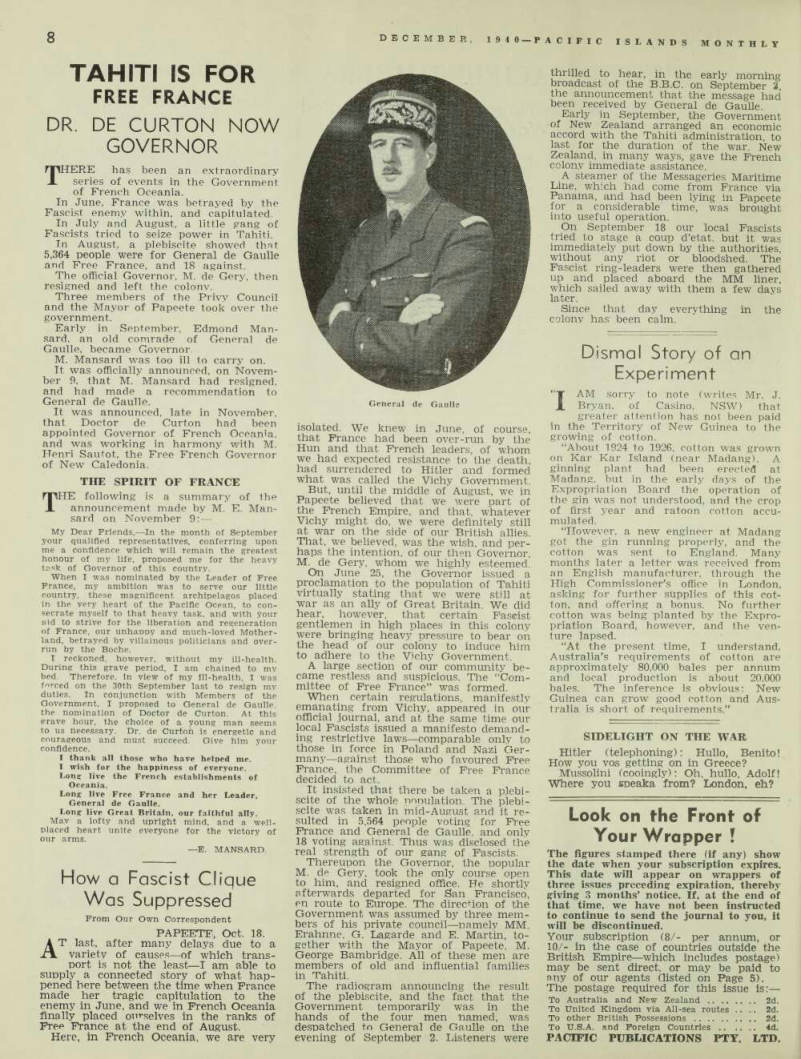
General de Gaulle