New Light on the Rossel
pp. 36-39 · Read in the full issue
Eating A Chinaman
A Day
New Light on the Rossel Island Horror
MOST persons familiar with Western Pacific history have heard of the Rossel Island horror. Some 80 years ago, a ship carrying Chinese coolies was lost on either Heron or Rossel Island, in Eastern Papua. Some escaped, but most of the 300 who remained were captured by the natives, imprisoned (some say, in a compound, where they were fattened) and slaughtered, cooked and eaten at the rate of two or three a day.
The following article is a translation by Mrs. Mollie Lett, of Port Moresby, of a section of an old book which she found, written by V. de Rochas.
IN the month of December, 1858, seven castaways, rescued by the English schooner “Prince of Denmark” ar rived at Port de France in New Cale donia. The leader of these unfortunate men, Captain P— appeared before the authorities of the colony, where I hap pened to be when he made his report, of which the following is a summary.
Captain P— had left Hong Kong the previous July, on the three master “Saint Paul”, with a crew of twenty, and 317 Chinese passengers, engaged for work on the Australian gold-fields. De layed by calms, and threatened by shortage of supplies, the captain, in his anxiety to reach Sydney as soon as pos sible, decided upon a course between the Solomons and the Louisiade Archipelago, rather than the usual course round these islands.
This, it is true, was a dangerous pro cedure, but he was driven to it by sheer necessity. Unfortunately, gales and thick mists followed calm weather, and for three days the captain was unable to get his correct bearings, and was forced to rely on dead reckoning; with the re sult that, on the third day, the vessel grounded on a reef.
But where? The captain was not cer tain. All he knew was that he was some where in Melanesia, and therefore in in hospitable country.
The vessel struck several hours before dawn, and at daylight it was clear that they were fast on the extreme point of a large reef; running for several thou sand yards from the shore, which was banked by densely wooded mountains; probably inhabited.
Owing to heavy seas, it was soon neces sary to abandon the “Saint Paul” and, fortunately, rocks afforded means of crossing to a small island, some distance away; otherwise it would have been im possible to transport the large number of men before the vessel became a total wreck. Here, at least, they obtained refuge. All that they were able to rescue from the wreck were a few barrels of damp flour, two or three sides of salt meat, and a number of cases of pre served foods. Slender resources indeed, for so large a partv. and added to their problems was that of water. There was none on the island.
Captain P — made haste to cross to the mainland with a number of his crew and passengers, where he chose a camping ground on the bank of a creek, a short distance from the beach, in sight of the island. Here, while preparing the ground, they made contact with natives, black in colour, and extremely ugly and savage and naked. At first sight, they appeared timid, which was encouraging, and the captain was even able to secure a few coconuts. They were making arrange ments for the accommodation of the en-
tire party, when they were suddenly at tacked by a large number, armed with spears and clubs.
The fight was not long in doubt. Sev eral sailors and Chinese were killed; others escaped by swimming, while some were rescued by the captain’s boat, al ready transporting men to the camp.
When the roll was called, it was found that 8 sailors and several Chinese were missing. Thev were short of arms, pos sessing only 5 or 6 muskets and a num ber of hatchets, and the boats were un able to carry a large party. Moreover, the Chinese had become demoralised.
Natives were prowling round the island in canoes, but a few shots were enough to frighten them away. But here they were faced with a crowning misfortune.
They had no percussion caps—which made it impossible to fire without dis mounting the nipples of the muskets, and applying fire with a fire-stick, as was the custom centuries ago. Two men were re quired to fire a shot. One to aim. the other to apply the fire.
The following morning Captain P— landed at the camping place, and searched for his companions. He found the camp destroyed, and not a living thing in sight. Returning to the isle he laid the position before the Chinamen, and asked them whether they did not
agree that the best plan for all con cerned would be for him to leave with the 11 sailors, in an attempt to reach an English settlement in Australia, where he hoped to charter a vessel to come to their aid at once.
The proposal was accepted. It was difficult to perceive a better plan. The Chinese had sufficient food from the wreck to support them on short rations for a week. Those who accompanied the captain had nothing except a dozen cases of preserved foods, and as much water as three pairs of sea boots could hold. The firearms and ammunition were left with the Chinese.
The captain s party was picked up in a sad plight, and taken to New Caledonia, five months after the wreck.
SO far, I have only related Captain P—’s statements. I will now give my own experiences on board the warship which was despatched from New Cale donia to rescue the wretched men, who had been waiting 100 days on a coral rock of Rossel Island, looking out for help that was so long overdue.
We left Port de France on December 27. 1858. According to the captain’s re port, he had struck at the eastern ex tremity of the Louisiade Archipelago, probably at Adele Island. On January 5,
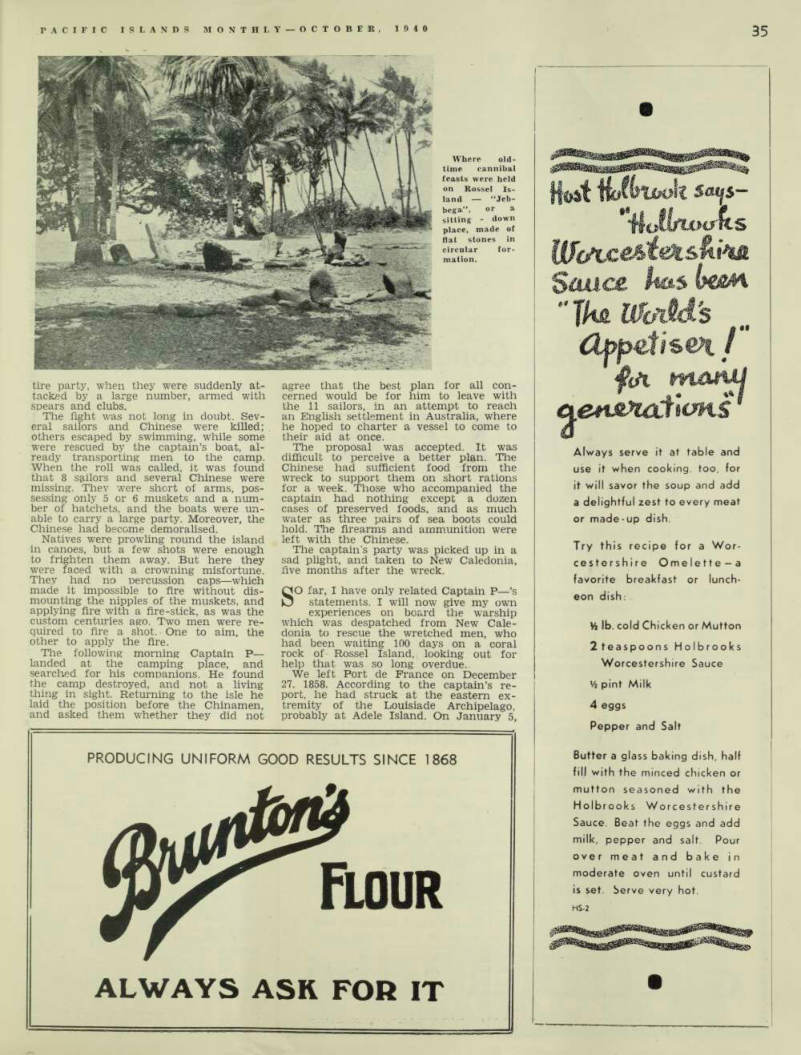
Where old time cannibal feasts were held on Rossel Is land “Jeb bega”, or a sitting - down place, made of flat stones in circular for mation.
-1859, a small and densely wooded island hove in sight, but we could see no sign of the “Saint Paul” on the low coral shore, and Captain P — who accompanied us, knowing that he had grounded near high land, suggested an island ahead.
This was Rossel Island and we approached it and soon sighted the “Saint Paul”, with her bowsprit and poop still showing above the reef. It could be seen that had the “Saint Paul” passed only a few hundred yards further on her course, she would have weathered the reef.
Nearby, lay the - isle, only about 20 by 35 yards in area. It was deserted. We looked in vain for signals from the 300 Chinamen who had been left on this coral patch.
On landing, one officer found a ragged tent still fixed to two trees, some rags, and two corpses buried under a layer of pebbles. He also found a large quantity of burnt shells, which had apparently served as food for the unfortunate men.
Several tree-trunks, sawn a few feet
from the ground, had been hollowed out for the purpose of collecting water The light was failing and as the anchorage was unknown to us we were compelled to wait outside.
At the first streak of dawn, our com mander sought for an entrance through the reef and found an anchorage Immediately on anchoring, armed parties were sent in search of the cast aways. We kept close to the shore in the hope of meeting natives or some of the missing Chinamen. We sighted two canoes containing natives. They evaded us and soon disappeared in the thick mangrove. 11 fE continued on our course, and while we were skirting the shore, we saw a small, naked figure wading to wards us in the water, beckoning to us without speaking a word. This conduct suggested a fugitive, and therefore one of the castaways.
The poor little Chinaman threw him
self into the arms of Captain P— and his first words were “all dead”. We were horrified. It was inconceivable that 317 Chinamen could have become the prey of the type of native we had just seen, badly armed and of poor physique. How ever, the Chinaman, who expressed him self as much by signs as by broken Eng lish, soon left us in no doubt of the dreadful tragedy. Four of his companions, he informed us, remained on shore, one of whom belonged to the crew, and was probably the master-carpenter. This was a Prussian, shipped at Hong Kong.
According to the Chinaman, this un fortunate man was tied up and was be ing closely watched, and was in the last stages of consumption. The natives had decorated him with a nose-bone, one of their most favoured ornaments. Without doubt, the carpenter had been adopted by some chief, like the little Chinaman, who wore a necklace and armlets.
We continued until we came to a creek, where the Chinaman assured us stood a village. We very soon found ourselves in the presence of about 30 natives. We had hidden our arms but they held aloof and it was impossible to come to friendly terms. However, one of the boldest ap proached armed with spears, and at tempted to persuade the Chinaman to return to them.
Having failed with the Chinaman, they turned their attention to us. The natives, after refusing our gifts, attempted to surround us, but seeing that we were pre pared they withdrew. In the end we were forced to retire, as we could gain noth ing from the wretched people. Our de mands for the return of the four prisoners, through the intervention of the little Chinaman, fell on deaf ears. We therefore proceeded along the coastline.
We stopped at the mouth of a stream, where Captain P— had established his first camp. There a dreadful sight met our eyes. Heaps of clothes, and pig-tails, marked the spot where the unfortunate Chinamen had been massacred. An over thrown trunk had served as a block, on which they placed the neck of each victim.
It appeared from the Chinaman’s de scription (which he succeeded in making us understand) that the natives had torn off the pig tails before the Chinamen were killed, and had afterwards cut their throats with a spear, but not be fore flogging them with sticks to make their flesh soft for eating.
This frightful description was later confirmed and elaborated in Sydney by an interpreter. It was true in every de tail.
IT appeared that, so long as the cast aways were able to sustain them selves on the islet they remained deaf to the invitations of the savages, who prowled round their refuge in canoes, offering them food and water on thes mainland. By a miracle of industry and ingenuity, the Chinamen had succeeded in making drinking water by means of a distilling apparatus, improvised with large marine shells, and pipes of leather saved from the wreck. They had also cut and hollowed trees, only a little larger than brushwood, in which they had stored water caught in the canvas of their tents.
But at last, having long exhausted their provisions and the beds of shell-fish nearby, and having already seen two of their number die of starvation, the bravest, or the most desperate, succumbed to the treacherous advances of the savages and left for the mainland. The savages took them by threes, which was as’ many as the canoes would hold, to the old camping ground, where they were met by a howling mob. The cries of the victims could not reach the island, and trees concealed the massacre from the
sight of the luckless creatures who re mained on the rock.
The sight of this human slaughter yard so affected us that we hastened to leave it, and, returning to the ship, we reached the mouth of the creek opposite the anchorage. Here, clouds of smoke could be seen inland and, thinking the creek might contain a village, we entered.
So luxuriant was the vegetation that we were plunged in darkness, which pre vented us from seeing the movements of the natives. But, the appearance of a scout in the trees was soon followed by yells and a shower of stones. We seized our arms and, though the first shot had no effect, it was not long before they vanished, howling like wild beasts. Only two or three of our men were hit.
We continued up stream but, owing to shallow .vater, were forced to retire be fore the village was in sight, and we re turned to our vessel.
ALL through the following night we heard shouting and trumpet notes (conch shell), and fires burned on all sides of our anchorage, and we con cluded that they were rallying for an attack. The following morning our boats returned to the spot where we had met the Chinaman and to the village nearby, but, being attacked, they were forced to defend themselves. They returned, how ever, without any satisfactory results.
For one could not regard the shooting of 3 or 4 savages as an adequate reprisal.
We later approached a second village.
Here the result was as unsatisfactory as before. Our commander, realising that we could gain nothing and that each fresh attempt to make friendly contact would fail, turned his attention to reprisals.
The resources of a despatch boat are limited: but two boats were sent ashore, manned by 32 men, under four officers, and carrying in addition to small arms, a light howitzer. The boats were taken in f o shallow water.
Before a landing could be made, the crews were attacked by a howling mob of savages, who hurled stones at them from the beach, where a large body of young men stood in the rear waiting with their killing spears to despatch the in vaders as soon as they should be stunned by the stones. Women urged on their men. thrashing the water with long poles, shrieking in hysterical fury.
The reply was brief and emphatic. The naval party landed, and the howitzer fired a single charge, backed by the muskets of the naval men, before the savage mob had time to retreat into the jungle. Nor were they seen again and, beyond the burning of a small village, nothing more could be done. The order given to our Commander before leaving Port de France was clear and stringent.
Before the village was burned, we searched in vain for the missing men. A pole planted in the ground, carrying a crosspiece painted with red and black bars, suggested their presence. We searched the neighbourhood, but with out finding a trace of our compatriots.
At last, after collecting all the Chinese clothing, found heaped in the huts, we returned to our vessel, and shortly after wards got under way for Sydney.
The reader may judge whether the re prisals were comparable with the san guinary horrors that provoked them. But he may be assured that everything that was possible was done, with the limited resources at our command, and restricted as we were by the very rigid instructions from New Caledonia.
That is the end of the story of M. de Rochas.
It is easy to understand the disappoint ment, expressed by de Rochas, that the punishment inflicted should fail by so large a margin to fit the hideous crime
that earned it, but orders are orders, and must be obeyed.
Had de Rochas lived, he may have been interested to learn that the savages of Rossel Island, accruing to the old men of Rossel to-day, regarded the wholesale massacre of the Chinamen, if not with horror, at least with something like shame, and a crime against the custom which demanded sacrifices only on the death of chiefs. They attributed the crime to the ungovernable appetite for human flesh of their chief Muwo, which had reached its peak when the luckless castaways were stranded on Heron Island in 1858.
Apparently, the Chinamen had saved the inhabitants frcm an embarrassing situation.
Monsieur C. Schmidt, who for eighteen months has been editor of the New Cale donian newspaper “La France Australe’’, published daily at Noumea, has resigned.
Surgeon-Lieutenant Pouliquen recently arrived in Vila to take up the post of medical officer to the New Hebrides militia.
Mr. A. W. Donald, director of A. B.
Donald, Ltd., Islands merchants of Auck land, N.Z., recently paid a brief visit to Fiji and Tahiti.
Dr. R. A. Spence, of Rabaul, New Guinea, has taken un duties with the
military garrison at Port Moresby, Papua.