—C. H. Karius
pp. 19-55 · Read in the full issue

Man Who Conquered N. Guinea
Untimely Death of the Explorer Who First Crossed Papua and N.G.
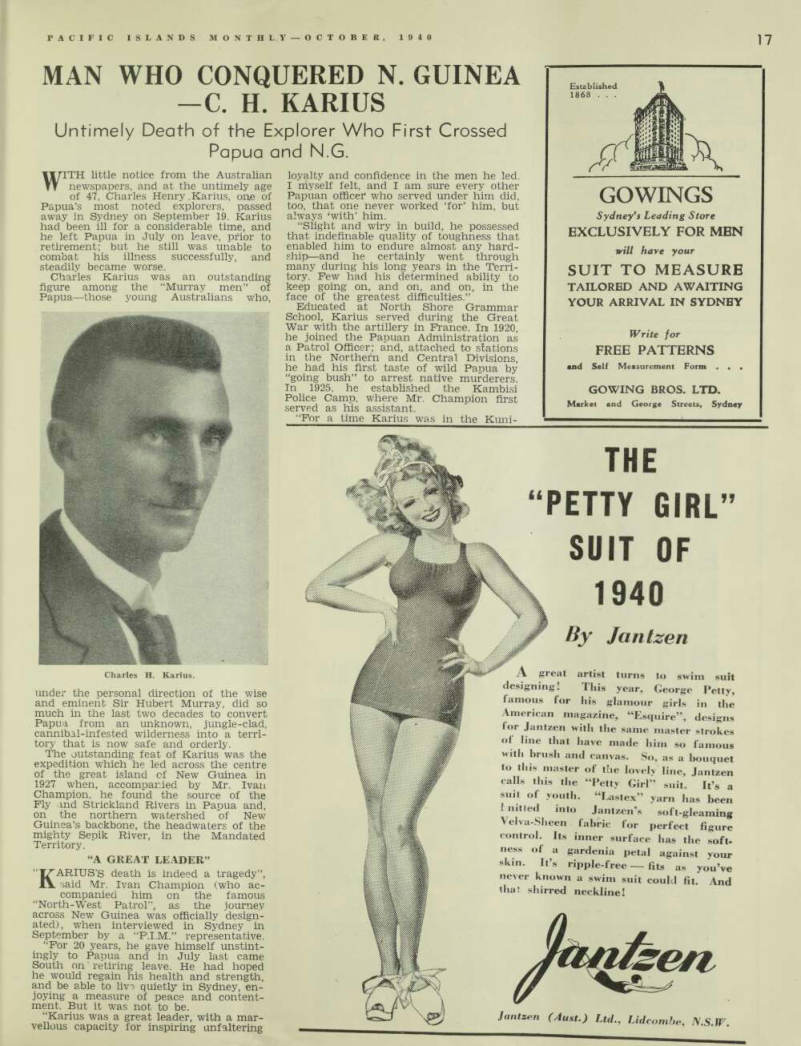
WITH little notice from the Australian newspapers, and at the untimely age of 47, Charles Henry .Karius, one of Papua’s most noted explorers, passed away in Sydney on September 19. Karius had been ill for a considerable time, and he left Papua in July on leave, prior to retirement: but he still was unable to combat his illness successfully, and steadily became worse.
Charles Karius was an outstanding figure among the “Murray men” of Papua—those young Australians who,
under the personal direction of the wise and eminent Sir Hubert Murray, did so much in the last two decades to convert Papua from an unknown, jungle-clad, cannibal-infested wilderness into a terri tory that is now safe and orderly.
The outstanding feat of Karius was the expedition which he led across the centre of the great island of New Guinea in 1927 when, accompanied by Mr. Ivan Champion, he found the source of the Fly and Strickland Rivers in Papua and, on the northern watershed of New Guinea’s backbone, the headwaters of the mighty Sepik River, in the Mandated Territory.
“A Great Leader”
KARIUS’s death is indeed a tragedy”, said Mr. Ivan Champion (who ac companied him on the famous “North-West Patrol”, as the journey across New Guinea was officially design ated) , when interviewed in Sydney in September by a “P.1.M.” representative.
“For 20 years, he gave himself unstint ingly to Papua and in July last came South on retiring leave. He had hoped he would regain his health and strength, and be able to liv'? quietly in Sydney, en joying a measure of peace and content ment. But it was not to be.
“Karius was a great leader, with a mar vellous capacity for inspiring unfaltering
loyalty and confidence in the men he led.
I myself felt, and I am sure every other Papuan officer who served under him did, too, that one never worked ‘for’ him, but always ‘with’ him.
“Slight and wiry in build, he possessed that indefinable quality of toughness that enabled him to endure almost any hard ship—and he certainly went through many during his long years in the Terri tory. Few had his determined ability to keep going on, and on, and on, in the face of the greatest difficulties.”
Educated at North Shore Grammar School, Karius served during the Great War with the artillery in France. In 1920, he joined the Papuan Administration as a Patrol Officer; a'nd, attached to stations in the Northern and Central Divisions, he had his first taste of wild Papua by “going bush” to arrest native murderers.
In 1925, he established the Kambisi Police Camp, where Mr. Champion first served as his assistant.
“For a time Karius was in the Kuni
Charles H. Karius.
maipa Valley and Mount Yule area, and it was there that his doggedness and per sistency showed themselves”, remarked Mr. Champion, “Untamed natives attacked an officer named Flint, killing
some of his police. Karius was sent after the murderers, and for eight weary months he chased them up and down valleys, over mountains, and through rain-soaked jungles and swamps. Eventu ally he caught them, after the leader, Gouri, had put up a great fight. Inci dentally, Gouri became a well-known figure in Port Moresby while serving five years’ gaol sentence for his part in the attack on Flint.”
First Expedition Unsuccessful
THE Lieutenant-Governor (Sir Hubert Murray) held Karius in extremely high regard”, said Mr. Champion, “and he personally selected him to lead a small expedition in an attempt to cross New Guinea from south to north. I was at Kambisi as officer-in-charge in June, 1926, when Karius unexpectedly -walked into my camp and invited me to go with him, having been given a free hand to choose a European assistant. Naturally, I jumped at the chance.”
Mr. Champion described the expedition thus:— Leaving Port Moresby in the Govern ment vessel, “Elevara”, on December 3, they crossed the Gulf of Papua and went 500 miles up the Fly River in the Western Division. Stores were transported another 8 miles up-river in the launch of the Daru A.R.M. (Mr. W. Lambden). and the party, consisting of the two white officers, 30-cdd native carriers and a small squad of police, was left to its own resources. Kayius set off in advance, to wards the mountains which divide Papua from the Mandated Territory, while Champion and the main party com menced to relay stores and equipment from one base camp to the next further on.
“During these operations”, Mr. Champ ion recalled, “20 carriers stole some canoes and deserted. This was a bad set back, for we were entirely dependent upon carriers and only 12 remained, with practically the whole of the journey yet to go. I left my camp and went on *to Karius to report the desertions. Another man would have fumed in exasperation, but it was typical of his philosophic calmness that when he heard the news he merely looked northwards at the broad expanse of mountainous country stretching before us, the whole of un known New Guinea, and said quietly, de liberately, ‘We’ll go on, of course’.
“Some days later, the deserting carriers were rounded up by the local R.M. near Daru, having travelled the length of the Fly through hostile territory, and the R.M. sent them back to us under a police escort”, added Mr. Champion.
A Nightmare Journey
EVENTUALLY, after having been de layed by floods, Karius and Champ ion reached the great limestone barrier, which was crossed only after a difficult, heart-breaking journey. At Mt.
Blucher, Karius decided, after recon noitring, that the only chance of reach ing the Sepik, across the Victor Emanuel Range, was for him to make a dash with a small party. Accordingly they split forces —Ka'rius, with 18 carriers and 6 police, going north-east, and Champion remaining for a time to explore the country north-west.
Karius was not able to find a passage through the main dividing range and, short of supplies, was forced to return down the Strickland by rafts. After many adventures he succeeded in reaching Daru. His trip down the Strickland was practically the same nightmare journey as that which Jack Hides and David Lyall made 10 years later, and which ended in the death of Lyall at Daru and of Hides, shortly afterwards, in Sydney.
“Karius's journey through the tortuous Strickland gorges and his descent of the river was an epic in courage and endur ance”, stated * Mr. Champion. “I was privileged, a few years ago, to fly over that broken, terrible country and I was appalled by its nature. They were lucky to reach the coast alive, and it is no wonder that it took such a toll of his health.”
After Karius and Champion separated at Mt. Blucher, the latter traced the Palmer River to its source and, from Bolivip village where he stayed for a time, tramped to the Fly, close to its head waters. Faced with food shortage, he re turned to Blucher and then by the Palmer and Fly rafted 500 miles. Finally, he was picked up by Karius who, anxious for the party’s safety, had left Daru in the “Elevara”, almost immediately after his Strickland journey.
(Continued on Page 52)
THOUGH far from well on his return to Port Moresby, Karius sought per mission to attempt the crossing again, confident that it would succeed in the light of knowledge gained from the first expedition, and Sir Hubert Murray readily consented. After several months’ leave, regaining their severely damaged health, Karius and Chamnion left again on September 17, 1927.
Following much the same route, they went up the Fly, again in the “Elevara”, and then struck overland across to Mt.
Blucher and Bolivip. Obtaining food proved a serious problem, the natives scarcely having sufficient for their own needs in this off-season. After finding the actual source of the Fly the party pushed on through treacherous limestone, at a high altitude. They continued north north-west, along country pitted with yawning chasms and huge crater-like pot holes; and, finally, they crossed the Victor Emanuel Range at 8,500 ft. and came down upon the valley from whence the Sepik flows.
Following the Sepik, the party went through country hitherto unmapped, in habited by many types of new natives. At this stage Champion became almost a cripple, the result of a knee injury, and had to be carried on a litter up and down the precipitous mountain-sides and along the broken terrain through which the Sepik runs Brucken and Hoffnungs Rivers, flowing in from the west, were crossed, and the party finally emerged from the mountains on to flat forest country.
Karius’S Bravery
“ TUST about this time”, interrupted Mr.
J Champion, “Karius figured in an in cident that will remain long in my
memory. With three police, he was ahead of the main party and I, still handicap ped by my bad leg, was limping along with the carriers.
“Suddenly, we heard a commotion and much shouting in front. Karius had come upon a native village and taken it com pletely by surprise. Scores of fully armed men piled out of a large village-house and in an instant three lines of warriors stood a dozen yards in front of him, with bows drawn. Karius faced them without flinching, and continued to walk towards them, knowing that any trace of hesita tion or unfriendliness would have been the signal for a deadly flight of arrows.
“There were tense moments as he kept advancing, with arm unraised and call ing peace words we had learnt from other tribes, but which these men, of course, did not understand. Then a change came over the natives —they relaxed, seeing there was no intention of an attack; and soon they were crowding around us with gifts of sago. It was touch and go, but Karius’s pluck and nerve saved us.”' Onward' the expedition marched, keeping as close to the river as the country per mitted. Then, having passed Mountain Gate, where Dr. Schultze, the German scientist arrived with the Dutch-German Boundary Commission in 1910-11, it was decided to take to rafts, but when a num ber had been built, heavy rains swelled the river into a roaring, swirling mass of water impossible to navigate with any de gree of safety. One experiment by Champion resulted in his nearly being drowned, when the frail log-raft cap sized.
Continuing overland again, through a maze of swamps and thick jungle, the leaders and men were seized with violent illness and fever, from polluted drinking water. A few more day?’ travelling, and they were able to begin rafting, at a point some 580 miles from the river
mouth. Then, after a day on rafts, they came quite unexpectedly upon the Papuan Government vessel “Elevara”. Never was a sight more welcome.
By a fine feat of navigation, Mr. B. W.
Ritchie, of the Papuan Service, had brought the “Elevara” around the coasts of Papua and New Guinea and 500 miles up the dangerous waters of the Sepik.
The party was exceptionally fortunate in meeting the vessel, for Ritchie intended, within a day or so to return down the river to replenish supplies. As it was, they v/ere saved many days of hazardous rafting, and returned to Port Moresby on board the little steamer.
Honoured By King
ON all sides, the epic journey across Papua and New Guinea was hailed as one of the finest exploits in the history of the two territories. It was a triumph for the policy of peaceful pene tration, for on both expeditions there was no brush with any of the countless tribes met with—the only loss to the party was a carrier who died from sickness a day before they were picked up by the “Ele vara”. The following year, the King awarded Karius the Patron’s Gold Medal of the Royal Geographical Society.
After an extended period of leave abroad—he was a very keen traveller ana invariably spent his furlough in foreign parts—Karius returned to Papua and went to Baniara station, in the North- Eastern Division. Then followed four or five years at Kokoda (N.D.), until he was appointed Acting Resident Magistrate at Buna. Subsequently he served at Cape Nel son (N.E.D.), Rigo (C.D.) and Kerema (GD.), before being appointed Resident Magistrate at Kikori, in the Delta Divi sion, remaining there until he left for Australia.
It was a peculiar coincidence that Ivan Champion was sent to Kikori to relieve Karius, when Lake Kutubu Police Camp was closed down a few months ago; and the reunion called for much reminiscing.
Mr. Champion did not remain long at Kikori after Karius left—he decided to come to Australia to seek enlistment.
Apart from his renown as an explorer, Karius won the admiration of his fellow officers in the Service by the way he laid-out and arranged the various posts he was stationed at. He had a fine repu tation as a builder, and he made Kikori, where he served last, one of the best out stations in the Territory. Though modest about his accomplishments, he really could turn his hand to almost anything— cooking and piano playing were two of his hobbies that delighted his close friends—but always throughout his life his first and foremost interest was Papua, the land of his adoption, and he was never more content than when “on patrol”.
Mr. Karius was married, and is sur vived by his wife, who now is living in Sydney.
Back in the Solomons after a term on secondment to the G. and E. Islands Colony as Secretary to the Government at Ocean Island, is Mr. L. W. S. Wright, who had been nested to the Ysabel Dis trict. Mr. Wright was D.O. at Guadal canal for some years prior to his tem porary transfer to Ocean Island. He is regarded as something of an authority on the native people of Guadalcanal and their culture, of whch he made a special study during his term as District Officer there.
Monsieur Loraine Chevillard, second son of the late Monsieur M. F. Chevil lard, one of the foremost French pioneers in the New Hebrides, died at the end of August. His plantation was at Sarmettes, Malekula Island.