Tropicaoties
pp. 14-17 · Read in the full issue

HAVING gone to Tahiti by Matson liner as (as he described it) a “banana tourist”, Sir Maynard Hedstrom, of Suva, contributed some inforesting impressions of Tahiti to the “Fiji Times”. He disagreed emphatically with some of the guide-book stuff published in relation to these Polynesian islands. For instance: — “I have quoted the statement that ‘the women (of Tahiti) are admittedly the most beautiful in the South Seas’. An expression of personal opinion—l saw some beautiful and attractive girls, mostly of mixed blood. One resident told me that only three or four families in Tahiti have preserved the purity of their Poly- * m lno SSjJ, rQ 1 / 1 Sh™
S Q!r a f"“yf
than those I happened to see in Tahiti.
At a cabaret we visited, the flpor dancing, P r actically confined to swinging and twitching of the hips, was less graceful than I have seen amongst other Polynesians or Euronesians.
T . 117 HEN, in September, Pan American Tf Airways great Boeing flying-boat was passing south-east of Howland Island, in the Central Pacific, on its first commercial passenger flight from San Francisco to Auckland, one of the passengers, Mrs. Clare Adams, a vice-president of the Women’s International Association of Aeronautics, cast into the sea a large wreath of bronze magnolia leaves, in memory of Amelia Earhart Putnam.
On July 3, 1937, Mrs. Putnam, one of the foremost women fliers of the world,
who was atempting to fly around the world from west to east, left Lae in New Guinea for Howland Island, where there was a newly-constructed aerodrome, and was never seen again. She was accotn panied by her co-pilot, Captain Fred Noonan. * * * A SHILLING was found inside a coco- J\ nut recently bought at a London shop. Perhaps the Islands planter had crossed his palm with silver!
“Punch”. * * ♦ rpHF. “banana tourists” who arrived by I the Mat son liners “Monterev” and A -Marinos!” in Tahiti in August were t allowed to get any advantage from the confused exchange position. Although at that time the la test quotation in the United States was 86 francs to the dollar, the P e °P le who arrived on the two Ameri can hners were not allowed to receive in Papeete more than 44 francs to the dol iar> This was not muc h more than the normal rate of exchange. Just before the arrival of the “banana tourists” in Papeete, traders there were giving from 100 to 120 francs for every American dol lai—but this trading advantage was not going to be permitted to ordinary com mon tourists whose main purpose in life is regarded as that of leaving as much money as possible in the various ports at which they call. Some of the tourists who knew their currency onions went ashore and insisted on having 60 and even 80 francs for their dollars; but the majority with the fear of the law before them (the French authorities had announced that nothing more than 44 francs were to be given to each dollar) meekly
accepted the controlled price. Conse quently nothing that the tourists bought in Tahiti was cheap—and the tourist snip left behind in the French Colony many thousands of dollars in good money, just at a time when the unfortunate French community wanted it most. * * ♦ rE anxious advice of a prospective husband in the Islands:— ‘•Don't play morning bridge—it’s noth ing but gossip.
“Don’t visit the women in the mornings —there s- too much scandal.
“Don’t be motherly to young cadets, or you’ll be talked about.
“Don’t go to the Club on Saturday or Sunday—the men don’t like it.
“Don’t play games in shorts; Mrs. So and-So looks ridiculous in them.’’ * * * THE idea of using coconut oil as a fuel for diesel engines is not new, and has been tried out a number of times in Australia”, writes “Islands Engineer”, commenting on a report in September “P.1.M.” that the Fiji Govern ment was experimenting with coconut oil.
“About 10 years ago, a German engineer ran a regular motor transport service be tween Sydney and the Hawkesbury Dis trict, N.S.W., with a Mercedes-Benz diesel engine burning coconut oil and it gave quite satisfactory performance. Expert opinion is that diesel engines can be adapted and adjusted to run on practi cally any vegetable oil fuel, but such sub stitutes usually cause premature wearing of vital parts, the injector pump par ticularly, which is one of the most ex pensive parts of a diesel engine to re place.” * * * WHEN a beloved missionary, in one oi the islands of the Pacific, was being transferred to another station, the native congregation he was leaving made him a present ,with these words: “Though you have a white face, you have a black heart.” ♦ ♦ ♦ RECENTLY, spread over a double page, a journal called “Match” published a most sensational photograph en titled “Cannibals Cooking a Man”, ac companied by this story: “This extraordinary photograph was taken by Mrs. Osa Johnson, in the course of a journey which she made with her late husband, Martin, to the island of Esperitu Santo, in the New Hebrides. It is probably the only document in ex istence showing this monstrous ceremony.
Different parts of a human body may be seen roasting on the spit; a foot, a calf of a leg, and to the right, a human stomach. The other parts are more diffi cult to identify. However, the entrails are easily discernible. The natives eat human flesh in the belief that they will become imbued with the strength, courage and other qualities of their victim. That is why they prefer men to women.”
After the publication of this photograph, these lines appeared in a Parisian journal; “I was myself in New Caledonia, in 1921, when the Johnson couple were there taking their photographs. I saw them, with my own eyes, arrange and set up the scene of this ‘monstrous cere mony’, the picture of which they proposed to spread across the world. The press of Noumea denounced their imposture. But, 20 years afterwards, these neonle can still abuse the easy minds of the French public, thanks to the facilities afforded by an irresponsible Dress.” (“Bulletin du Commerce”, Noumea). * * * SOME happy reunions are reported by Mr. Oscar Nordmann, of Papeete, as a result of the visit to Tahiti of the two Matson liners “Monterey” and “Mari posa”, in August. Mr. Nordmann formerly
was connected with the Matson Line, and he found many of his old friends on the ships. First to arrive was Captain James Rasmussen, to supervise berthing arrange ments at Papeete. Mr. Rasmussen and Mr. Nordmann were shipmates on the old “Hilomau” in 1907. Then came the “Monterey”, under command of Captain Johanson, with whom Mr. Nordmann was shipmates on the old “Mariposa”, in 1907. Another old shipmate was Mr. Dan nie Mehigan, the purser—they were to
gether on the old “Mariposa” and the “Sonoma”. Then the “Mariposa” came in, and Mr. Nordmann met Mr. Knudson, with whom he was associated on the old “Ventura”, and Mr. Bill Casey, with whom he was shipmates on the old “Sierra”.
“This Matson cruise to Papeete has been a great success”, said Mr. Nord mann, casting a calculating eye over the 15,000 dollars which the tourists left in Tahiti, “and we all pray that the Mat son line will make this a regular call.” * * ♦ THERE are few public movements on record in the South Seas to com pare in promptness and generosity, with the action of the people of the Man dated Territory in subscribing £4,318 in about 12 days, for the London Relief Fund. Lists published in the “Rabaul Times” suggest that nearly every Euro pean and Chinese resident in New Guinea subscribed —£10 was a common donation.
Here is how the various districts found the £4,318.
Rabaul £1,733 4 7 fc>aiamau~ 203 17 0 Lae 161 0 0 Sepifc (Maprik £52/10/-, Angoram £3l/10/-, Wewak £lB/5/-) 102 5 0 Goldfields and Wau . . . , 1,618 16 6 Kavieng 216 11 2 Namatanai 11 16 Madang 100 0 0 Manus 21 10 0 Kieta 108 1 3 Kokopo 20 13 0 Talasea 21 0 0 * * * \ CORRESPONDENT to “Tooth’s KB Chronicle” declares that a certain workman in North Sydney has been given the nickname “U-Boat”—because he sinks so many schooners! * * * THERE is still no word of the fate of Mr. Paul Vois, the distinguished manager of chrome interests in New Caledonia who was aboard the little cargo ship “Notou” when she disappeared in August between Sydney and New Caledonia—apparently the victim of an enemy raider. Madame Vois and his three children were in France at the time—al though the arrival of Madame Vois in Noumea by air line was expected about the end of August. Before France capitu lated, Madame Vois drove a Red Cross ambulance in France as her contribution to her country’s war effort. * * * “lITHEN you want to kill a man, take tt him off the road.”
Two natives from a remote mount ain community were being tried for murder in Papua. They had waylaid a member of a hostile tribe on the track as he travelled homewards from the coast, and they left the corpse lying there, to be found later by the police.
They were convicted and sentenced to two years’ imprisonment. At the close of the case, the court interpreter trans lated the sentence into their language.
“That’ll teach you not to kill a man on the Government road”, he added. “Next time you want to kill a man, take him into the grass. Don’t kill him on the road.
The Government doesn’t like it.” * * * THE love of a Polynesian for a child is well-known. But it is not generally realised to what extent a Polynesian women will go at times in order to gratify that ambition. Some years ago a couple were married in Rarotonga, with all customary feasting. The husband, naturally, wanted offspring, but time passed and there was no sign of a happy event. At last, the husband’s relatives showed impatience, and it was then that the wife resorted to stratagem. To her lord’s delight, she announced that she was in that condition which, to quote Mr.
Dickens, “every wife who truly loves her husband would wish to be”. Months passed. Pregnancy is a state that cannot be unduly prolonged—especially when one has a suspicious mother-in-law. The wife arose early one morning, and presented her husband with a small bundle bound in tapa which, she said, was their off spring. At the same time, she warned him that he was on no account to gaze upon its dead features. During the subsequent obsequies, however, the inquisitive “in law” did so, and so confirmed her sus picions. The “corpse” were merely por tion of a banana branch! Thoroughly whakama, or ashamed, the young wife took to the bush. But Polynesian hearts are ever-loving. The husband forgave her.
History does not relate whether they lived happily ever after.—“VAKATINI”. * * * AN interesting sidelight on the value of airways communications in the Pacific was provided last month by
the arrival in New Zealand of the Gov ernor of Alaska, Dr. Ernest Gruening. He left his Arctic headquarters in Nome, on the Bering Strait, flew through the in terior of Alaska and Canada down to San Francisco, there joined a Pan Ameri can Airways clipper and was in Auckland less than a fortnight after leaving his home. He gave New Zealand reporters some interesting information about the great military, naval and air bases, which the United States is building up along the Central Pacific line from Alaska right down to the Equator, * * * THE little evacuee from London had been using some London language and the mistress of the house was so upset that she asked the village policeman to try to frighten the lass into better behaviour.
“Are you the little girl who uses bad language?” asked the kindly old cop as the door opened to his knock. “Who
told you?” queried the kid. “A little bird,” replied Robert archly. “Well, can you beat it!” gasped the intelligent child. “I like that! And I’ve been feeding the little b s!” ♦ ♦ ♦ PTE. O’Leary: “What’s that yer put ting in yer breast pocket, Murphy?”
Pte. Murphy: “It’s a Mills bomb, so it is. I’m gettin’ one back on O’Reilly.
Ivery time he sees me he slaps me on the chest and breaks me pipe. Next time he’ll blow his hand off, and serve him right.”
Pastor L. V. Wilkinson, of the Austral asian Union Conference and a member of the Australasian Missionary College Faculty, has been reappointed Superin tendent of the Seventh Day Adventist Mission in Fiji. With his family he will leave for Fiji about December.
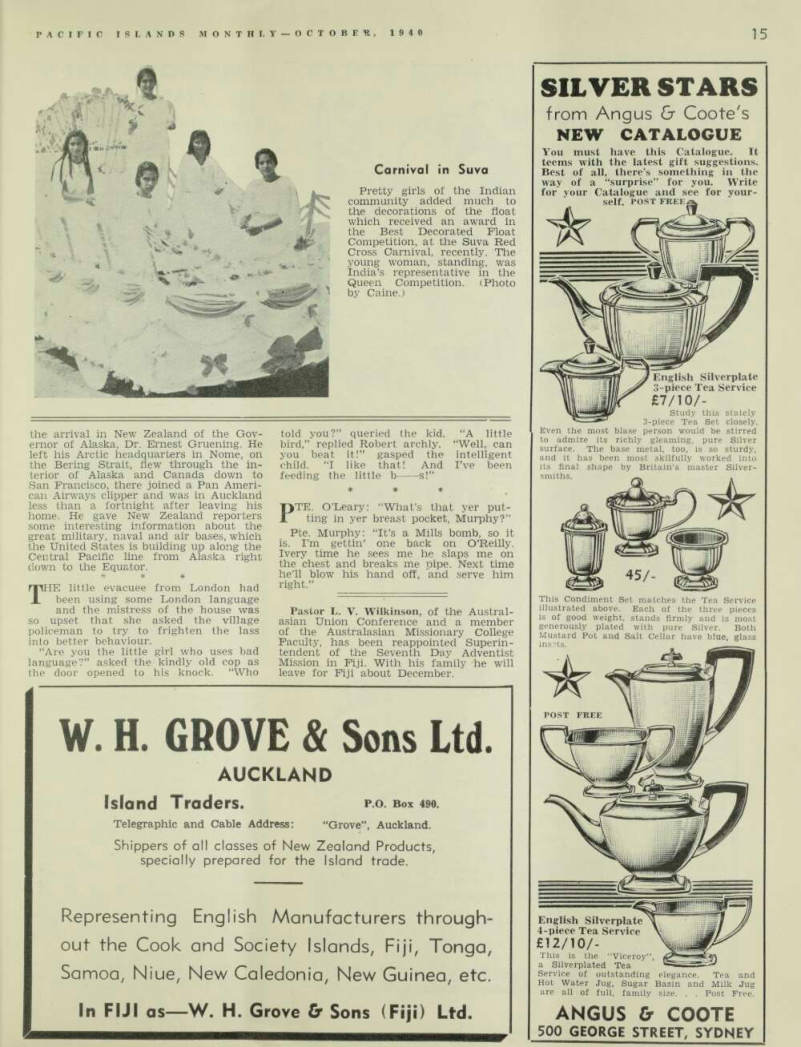
Carnival in Suva Pretty girls of the Indian community added much to the decorations of the float which received an award in the Best Decorated Float Competition, at the Suva Red Cross Carnival, recently. The young woman, standing, was India’s representative in the Queen Competition. (Photo by Caine.)