French Pacific Colonies
pp. 10-60 · Read in the full issue
Wholly For De Gaulle
M. Sautot Becomes Governor After Dramatic Events in N. Caledonia
THE French colonies in the Pacific (New Caledonia and Dependencies, French Oceania and New Hebrides—that is, the French half of the Condominium) have now declared clearly and unequivocally for Free France and the British Alliance. The Nazi-dominated Vichy Government has been repudiated, and the few French officials still loyal to Petain have been allowed to depart. . . .
Britain, Australia and New Zealand, while doing everything possible to assist these isolated colonies, are not interfering in any way with the Free French administrations. The latter, however, are faced with such heavy economic and financial troubles that it would appear that some closer union with the British Dominions is inevitable. . . . There were dramatic incidents in New Caledonia before the position there finally was clarified.
IN the September issue of the “P.1.M.”, it was apparent that, although 95 per cent, o'f the 15,000 European popu lation of New Caledonia were for de Gaulle, the high officials insisted on re maining loyal to the puppet government set up by the Nazis in France: and revolt was threatened.
At the end of August, the Governor, M.
Maurice Pellicier, resigned, and on Sep tember 4 he left Noumea for U.S.A. by Pan American Airways, en route for Prance. On August 28. by special decree (from Vichy) Colonel Denis, Commander of the garrison, was appointed temporary Governor.
At noon on Friday, August 30, the British High Commissioner for the West ern Pacific (Sir Harry Luke) accompanied by Mr. R. D. Blandy (British Resident Commissioner in the New Hebrides) arrived in Noumea, in the Fiji patrol boat “Viti”, and that afternoon, and dur ing the morning of August 31, the British officials held conferences with M. Pellicier (retiring Governor), Colonel Denis (new Governor) and various French officials.
One matter discussed, of course, was the administration of the Anglo-French Con dominium (the New Hebrides).
It was assumed, in Sydney in mid- September, that Sir Harry Luke would remain for a time in Noumea, and try to assist the French; but, although they were most cordially greeted by all classes in Noumea, and they knew that a tense situation existed, the British scrupulously followed their policy of not interfering in French affairs. They left Noumea on the “Viti”, for Port Vila and Suva, at 3 p.m. on August 31.
FOR a week after that —in which week, ex-Governor Pellicier departed— matters appeared fairly quiet. But a very ugly situation was developing.
Governor Denis started fairly well. He expressed friendly feelings towards Eng land, in a broadcast, and he sent the sloop “Dumont d’Urville” (1,969 tons, 136 men), whose commander appeared aggressively anti-de Gaulle, to an anchor age several miles away so that the sight of it at the quay-side should not provoke the already murmuring populace.
Denis urged the people to await the im minent arrival from France of their deputy, M. Brunet, a former Governor of N.C., who would explain to them the whole position.
But the situation rapidly deteriorated.
Denis proceeded to exercise dictatorial powers, and frowned officially upon all de Gaulle organisation; and the people would not have it that way. They organ ised a de Gaulle Committee of 15, under Michel Verges, which was much resented by the high officials.
The Committee demanded that a refer endum be taken, on the question of whether the Colony was for or against de Gaulle. Denis sharply refused. All this time, Denis exercised a heavy censorship, and the outside world knew little of what was happening.
The business community was angry and dissatisfied. Its markets were gone and its currency was almost useless. Appeals to Vichy were useless.
One order, presumably from Vichy, issued by Governor Denis, was that the Colony’s products were to be sold to Japan. This might be the voice of Vichy, but it clearly was the order of the com mon enemy, the Nazi Hun, who thus hoped to get, via Japan, valuable metals and vegetable oils. This order was fiercely resented in Noumea, One source of serious embarrassment was the loss, with M. Paul Vois, on the steamer “Notou” (presumed taken in August by an en°my raider) of documents relating to the reorganisation of the nickel and chrome export business, which M. Vois had dealt with in Australia. Close co-operation with Australia was neces sary, if this confusion was to be straight ened out.
There were frequent reports, about this time, of a revolt on the warship. They were officially denied. Beyond doubt, how ever, the bluejackets were for de Gaulle, irrespective of the officers.
THE de Gaulle Committee now began to organise, on a definite plan. Emis saries went from Noumea far up through New Caledonia, inviting farmers, planters and miners to come to Noumea, and help.
A cutter left Noumea for Port Vila, with the announced intention of bringing Henri Sautot, pro-de Gaulle Resident Commissioner in the New Hebrides, to Noumea, to be Governor. It flew the flag of Free France (the Cross of Lorraine imposed on the Tricolour). The port authorities would not let it go until it flew the flag of the Vichy Government.
Governor Denis saw a revolt develop ing. He began to threaten punishment, and military law. The de Gaulle Com mittee defied him, and carried on.
Men from the country, armed, began to converge on Noumea. The Governor put barricades cut on the roads, and brought the sloop from her anchorage to the quay.
By Wednesday, September 18, it was clear that the de Gaulle section had organised a big demonstration. It was freely stated that Sautot would arrive the following day.
Denis declared martial law, and called out all soldiers (including certain trained
New Caledonian natives) and navv men.
He put guards on the roads, and instituted patrols.
Countrymen were pouring in. They had left their arms outside the town, beyond the barricades, but their numbers were formidable.
A de Gaulle leader, a one-armed man of 55, Francois Pere, who led the agitation for the referendum, was arrested by gendarmes and taken aboard the sloop.
Indignant citizens, in vain demanded his release, demonstrating on the quav be side the warship.
Denis was reported to have called
Sautot a traitor, and threatened to have him arrested. Posters which appeared, reading “Down with Jews and Free masons” did nothing to allay public anger.
IT was not Denis, but Commander Toussaint de Quievrecourt, of the gun-boat “Dumont d’Urville”, who was looked on as Public Enemy Number One. This aristo-royalist from Reunion tried to turn Noumea into a vast prison, with himself as chief jailer.
New Caledonian people resented the appearance of his warship there at all.
They learned that, as he approached the port from Tahiti, in mid-August, he made hostile preparations. When he came into Noumea, at Denis’s orders, his orders to his men might easily have caused bloodshed.
When Francois Pere was imprisoned aboard the warship, he crossed verbal swords with the officer.
“The commander”, he said, “asked if I wanted to come under the Ehglish? I replied that though there was no fear of that. I’d rather be English than macaroni. It was the French of Vichy”, I said, “who had deserted the English, not the English who were deserting the French. Caledonians didn’t intend to be
(Continued On Page 54)
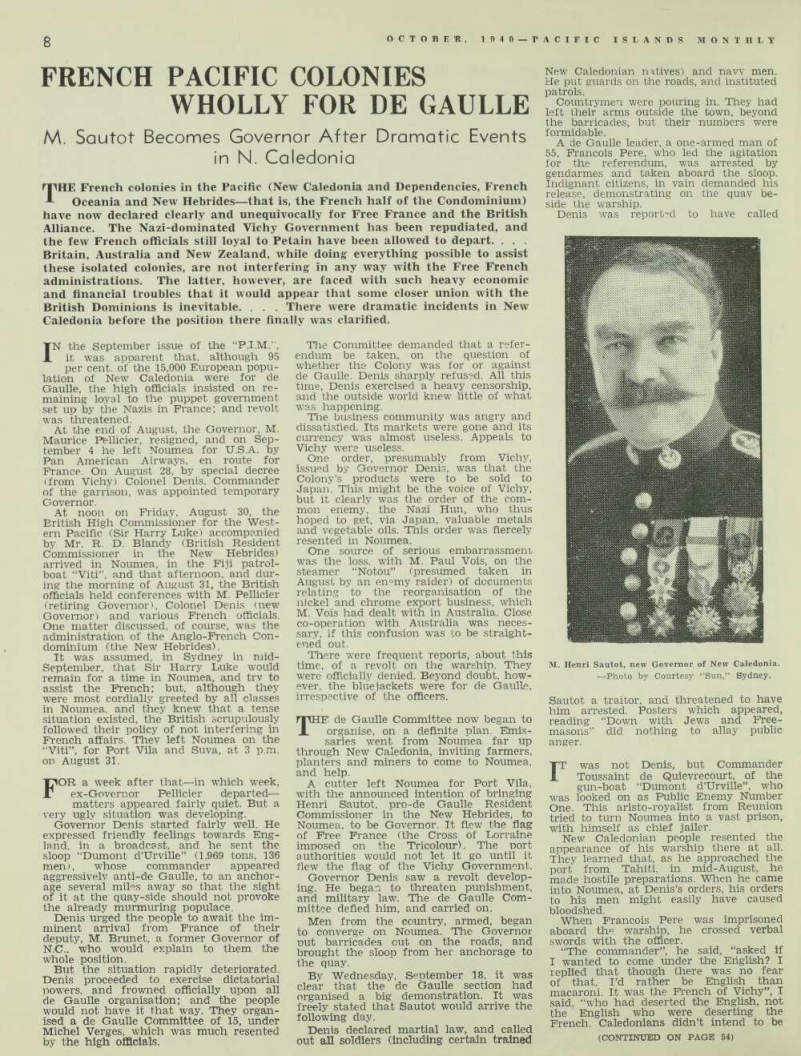
M. Henri Sautot, new Governor of New Caledonia. —Photo by Courtesy “Sun,” Sydney.
deserters, anyway. The commander didn’t seem to relish what I said.”
THINGS happened in Noumea streets that Wednesday evening, after Pere was taken aboard, for which the gun boat only was to blame.
It was an unforgivable mistake to asso ciate native New Caledonian troops (Tirailleurs de la Pacifique, good soldiers and popular locally) with the gun-boat’s sailors in the patrol, which blundered its way through the town, after a state of siege had been proclaimed by Governor Denis.
Cinemas, bars, etc., were promptly closed. Control formally passing from the civil police to the military.
But this measure did not procure tran quility. The patrol found an angry crowd waiting for them, the moment they arrived at the market place.
An ensign from the gun-boat, striking ridiculous attitudes, kept shouting, “In the name of the law. I order you all to disperse.” But nobody listened to him — or, rather, they told him to go away and treat himself in an Impolite manner.
The patrol was quickly surrounded and swamped. Being reassembled, and moving off under difficulty, the local lads linking arms with the Caledonian troops and even helped to carry their rifles. It was evident that no Tirailleur would obey any order to fire on a fellow citizen, though the sailors might do so.
The crowd arrived at the quay, and the gun-boat turned a hostile searchlight on the crowd, and seemed to have hoses and guns ready.
Then things got warmer. Stones flew
from all quarters after the patrol had been reinforced by a score or more of sailors. Volleys and cries of “Vive de Gaulle” were answered by sudden rushes by armed men. There were one or two injured, but injuries were slight.
The patrol went on board at 10 p.m. after one sailor had discharged his rifle in the air; and the whole town went to bed to await a stirring morrow.
That morrow (Thursday, September 19) turned out a day of emotion and final rejoicing.
Hundreds more men poured in, full of fight, from the bush. They had dumped their rifles en route, as town entrances were guarded by military.
The crowd passed from war memorial to Town Hall and Signal Hill and where ever they went, de Gaulle flags were hoisted. A deputation demanded the re signation of Colonel Denis in favour of M. Henri Sautot, who was by now out side the harbour, on board a Norwegian ship which had brought him from the New Hebrides.
Instead of ordering Sautot’s arrest, as he had promised the previous day, Denis allowed him to land unopposed.
M. Sautot landed about noon. Shortly before, Pere was released from the war ship.
Sautot was met by the acting-command ant of the troops who, with Messrs.
Verges, Prinet, Rabot, Pognon and others, members of the de Gaulle Committee asked him to arrange matters with Gov ernor Denis in keeping with the people’s decision.
Henri Sautot’s journey, on foot, to Gov ernment House, at the head of a vast crowd singing the “Marseillaise”, was a triumphal procession.
It was about 1 p.m. when Sautot, from the balcony of Government House, was able to announce that Denis had resigned and he had assumed control. The popu lar will had won.
The French Empire, said M. Sautot, amid cheers, must save the Mother Country, crushed under the German boot, and the only way to do that was to rally to the great patriot de Gaulle, whom future history would call liberator. Up to now New Caledonia had been the only French Pacific Colony whose directors had been able to suppress the popular will. But now they, with the people of the New Hebrides and Tahiti, formed a Pacific bastion alongside the British Fmpire, against aggression. Their sole aim was to save France.
Following this speech, the de Gaulle flag was hoisted over Government House; and when the new Governor formally took over at 2 p.m. Australian pressmen (one of whom had been threatened by Denis with expulsion the previous week) were able to get off cables that at last they felt had some chance of reaching their destination.
That evening, September 19. Colonel Denis and his family proceeded to the northern town of La Poa, under a civil guard, while another civil guard looked after Government House.
The Departmental heads decided to carry on, and the 600 men from the country were able to return, satisfied with the part they had played for the cause they had at heart.
They were, however, within two days
called back (and in even greater force, and this time armed with rifles) to counter plotting by a group of dis gruntled metropolitan officers and sous officiers. Supported by the New Caledon ian-born troops almost to a man, they cleaned up the situation by securing pos session of the infantry and artillery bar racks, and of the coastal batteries at Artillery Point and He de Nou.
IT happened that Tuesday, September 24, was the 87th anniversary of the
founding of the Colony: and the occasion was marked by practically the whole population—including men from the outside districts —making an enthusiastic demonstration for Free France, General de Gaulle, and the British alliance. Gov ernor Sautot laid a wreath upon the memorial of the Great War; and after wards he took the salute in a grand march-past.
There were notable speeches. Governor Sautot declared that there was nothing
to indicate that Australia has designs upon the independence of New Caledonia.
A leader of the de Gaulle movement said: ‘None will suffer by the Colony’s de cision to follow de Gaulle. Nothing is more certain than that France will be reborn.”
Everywhere there were great displays of friendship, towards Britain and Aus tralia.
Meantime, refractory officers and their
The Fiji Government’s new patrol vessel “Viti”, just after it arrived beside the wharf at Noumea, with Sir Harry Luke (High Commissioner for the Western Pacific) on August 20. Residents of Noumea are seen gathering on the wharf. Soon afterwards, they made a strong, spontaneous demonstration in favour of General de Gaulle and the British Alliance, and against the Petain Government.
families were put aboard a merchant ship with the intention of sending them to Indo-China; but the situation was then obscure, since the New Caledonian crew, being for de Gaulle, wanted to go to Sydney.
To save the warship commander's face, an arrangement was announced, permit ting the departure for Indo-China, ap parently, of the hostile “Dumont d’Urville”.
An interesting incident occurred aboard this warship when a group of soldiers assembled on the wharf, shouting “Vive de Gaulle” and singing the “Marseillaise”.
The sailors aboard (many among them
de Gaulle supporters when ashore) joined in the singing, and one of them was heard to shout the de Gaulle rallying cry.
By the time this appears in print, a clean-up appears possible in the magi strature. Meanwhile, Governor Sautot is proving an energetic and popular admini strator, and the way his speeches are greeted show that both he and the cause of Free France, for which he stands, have taken a real hold on the people of New Caledonia.
It is reported in Australia that there are in New Caledonia 1,200 Free French men who are anxious to join General de
Gaulle’s forces against Nazi Germany.
Many of them, if they cannot join de Gaulle, would like to form a unit of the Australian Army.
The Displaced Officials
It was offcially reported in Canberra on September 26 that the little group of high French officials who had tried to hold New Caledonia for the pro-Nazi Government at Vichy had been gathered aboard the warship “Dumont d’Urville” at Noumea, and permitted to leave—for Indo-China, it was understood. But, as Japan since has displayed activity in Indo-China, this plan may have been changed.
The position of M. Maurice Pellicier is obscure. He left by P.A.A. flying-boat for U.S.A. and Europe on September 4. Later reports indicate that, instead of going to France, he may join General de Gaulle in London. He had been only 10 months in Noumea, where he succeeded M.
Barthes as Governor in October, 1939.
Position In French Oceania
IT was announced by the Prime Mini ster of New Zealand on October 1 that a representative of the New Zea land Government had discussed with the Free French Administration in Tahiti methods of collaboration between French Oceania and the British Commonwealth.
These matters were now the subject of consultation between New Zealand, Britain and Australia, and it was in tended that New Zealand, as the closest neighbour of French Oceania, should maintain contact with the islands.
Mr. Fraser denied a suggestion that Tahiti was now practically a British pro tectorate. “The administration of French Oceania, under the authority of General de Gaulle, and through his appointee, Governor Edmond Mansard, is freely co operating with the British Commonwealth in the struggle for freedom, and is in no way under the supervision of New Zea land or any other British Government”, Mr. Fraser said.
Mr. Fraser added that the new Gov ernor and his advisers appeared to be firmly in control of the situation and to have the support of the great majority of the French and Polynesian population.
Grave Economic Problem
It is clear, however, that the economic situation in Tahiti and throughout the Colony is very bad. Almost all essential supplies, like food and oil, are in short supply. The Colony is eager to buy British or American goods; but, owing to the collapse of its oversea markets, it has little external credit, and neither Aus tralia, New Zealand nor the United States has a demand for Tahitian products.
Ways and means of helping the French colonies through this crisis are being sought by the British and Dominions Governments.
Sympathy For Ex-Governors
TAHITI and French Oceania appear to have settled down quietly under the Free French regime. General de Gaulle, in September, nominated M.
Edmond Mansard to be Governor, after the popular M. de Gery, Governor under the old regime, had resigned and left the Colony.
Interviewed in San Francisco early in October, M. de Gery spoke in friendly fashion of the new regime M. de Gery, like M. Maurice Pellicier, while loyal to France, is not the type of Frenchman who would be expected to submit humbly to the Hun-dominated Government at Vichy.
Both are fine men and splendid officials.
It is to be hoped that British under
standing and sympathy will be extended to such men, in these cruel times. Imagine their position—their proud flag and their great Imperial services under the heel of the Hun, their possessions gone, their official future destroyed.