There Need be no War in the Pacific
pp. 7-8 · Read in the full issue
LAST month, reviewing a year of war, we said: “New phases should develop quickly, now. Hitler dare not stand still”.
Since then, Hitler, definitely de feated in his attempt to invade Britain, has over-run and occupied Roumania, without fighting; is pre paring, from there, a great thrust by German armies down through the Balkans and Asia Minor, to form part, with an Italian advance from Libya, of a pincers movement against the British in Egypt, and the Suez Canal; and, finally, he has brought Japan into an open pact with Germany and Italy, in an attempt to prevent the United States from giving much further assistance to Britain.
Britain, fighting alone in Egypt and Palestine against this double thrust, is faced with extremely grave prob lems of strategy, and of supplies. It is not certain that Turkey will join Britain. Turkey, in the development of this Hitler War, waits upon Russia —and Russia is incalculable. Russia’s only policy, apparently, is to wait until Hitlerism and Capitalism (Britain and U.S.A.), having destroyed each other, have laid the world open to the Stalin brand of Communism (which is something Lenin never dreamed of). Yet it is inconceivable that Russia will stand quietly by while over-runs the Balkans, and controls the Dardanelles and the Black Sea.
WE in the Pacific are more in terested, for the moment, in the Axis Pact, or Triple Alliance, be
tween Germany, Italy and Japan,
signed in Berlin on September 27. It
is a 10-years’ political, military and
economic pact of mutual assistance, and its terms are thus summarised:— (1) Japan recognises the leadership of Ger many and Italy In the creation of the new order in Europe. (2) Germany and Italy recognise Japan’s leadership in the creation of the new order of Great Asiatic lebensraum (living space). (3) The contracting parties agree to under take to support one another militarily, with all the means at their disposal, in the event of one of the parties being attacked by a Power not yet involved in either the war against Britain or the Sino-Japanese war. (4) With a view to implementing the terms of the pact, joint German, Italian, and Japanese Commissions will be appointed, and will meet without delay. (5) The agreement alters nothing in the political relations at present existing between each of the contracting parties and Soviet Russia. (6) The pact will be effective immediately it is signed, and will remain in force for 10 years.
The contracting parties, at the request of any one of them before the expiration of the pact, shall enter into negotiations for its renewal.
The course of events now seems clear.
Germany, in July and August, expected to conquer Britain. The invasion was to commence on September 15. In the greatest air battle of history, from about September 10 to September 26, the Ger mans were completely defeated—thanks to the magnificent R.A.F., the staunch ness of the British people, and the material and moral support of the United States.
A snarling Hitler returned to Berlin from his “invasion base” on the French coast, to think out a new plan. How was the A xis t° defeat a Britain that could not be invaded, and to whom the AmeHcans were giving ever-increasing aid? The Italians, who were to attack Egypt simultaneously with the German invasion of England, and who dulv marched into the Western Desert, from Libya, on September 15-20, were now standing, awaiting German orders.
Roumania, by now, was completely Nazified ; and Hitler and Mussolini, meeting on top of the Brenner Pass on October 4, decided to occupy Roumania and, from there, prepare an advance through the Balkans and Asia Minor- Turkey and Russia permitting! it is not yet clear whether the Italian Libyan army is to advance, or stay where it is until a German Balkans thrust develops British shipping is to be sunk, and British cities ceaselessly bombed.
Meanwhile, America! There was Hit lers worst headache. He thought he might presently destroy Britain; but what States combination, which plainly would come, if Britain were in danger of defeat? And so he bethought himself of opportunist Japan.
EVER since Holland was over-run and France was smashed, Japan had been in a political fever, eager to take advantage of the Nazi-given oppor tunity to seize new trade and territorial advantages in Indo-China and the East Indies, and cock-a-snook at preoccupied Britain: but afraid to make a grab, because of America’s clearly-stated demand for the status quo —a demand backed by the mighty American fleet at Hawaii.
Both Germany and Japan feared the
United States—though for different rea sons. If America could be involved in war with Japan, argued Hitler, she could not give aid to Britain.
And, so, the new Pact—long thought of, but only now definitely sought by Germany. The announcement of the Alliance, at first, shocked public opinion —just as it was intended to do. But that soon passed. To-day, it is seen in true perspective, merely as a bogey created by German and Japanese Nazis —an attempt either to involve Japan and America in an unnecessary war, or to scare America into cowed inactivity, while the three predatory nations sub due and carve up the British Empire. So far from scaring America, it has done more than any other single thing to unite Americans in a determination to assist Britain to rid the world of Nazi dom.
The Americans have kept their heads; and it can be said now that there will be no war in the Pacific, unless the United States goes to war in Europe beside Britain (which is not likely, at present) or unless Japan deliberately takes steps in the Pacific to force America to fight, which is equally unlikely.
Apart from the fire-eating Army and Navy elements which, at present, have charge of Japan’s government, Japan does not want war against a first-class power. The upper and middle-classes of Japan know well that, economically and militarily, Japan is poorly equipped to carry on a large-scale campaign. The condition of her internal affairs, and the position of her Army after three years of war against China, are sufficient proof of that. Her fine, modern Navy would be a great nuisance to Anglo- American Pacific trade; but a war in the Pacific, while greatly embarrassing American and British interests, would utterly destroy the Japanese Empire.
And Japan knows it.
UNLESS provoked by Japan, there is no reason why the United States should go to war. This is not—not yet, anyway—a contest between armies, but a war of machines —a struggle as between warships and aeroplanes.
America can give far more help to Britain through her workshops, than through her armies. Let our incompar able young Britishers have all the good ships and good planes they want, and they surely will hold secure the fron tiers of our free countries, so that we may grimly await the day when con quered Europe will turn upon and destroy the dictators.
The waiting may be long, and the years hard and harsh; but does anyone who knows history imagine that Prance, Bel gium. Holland, Denmark, Norway, Swe den, Poland. Czechoslovakia, Hungary, Roumania (not to mention Germany and Italy themselves) will remain indefinitely as the obedient subjects of the liberty hating beasts of Nazidom? Clearly, Britain’s plan must be to hold the seas, deliver shrewd blows upon the Axis war machine —especially by air—and avoid entanglement in any great military movements. For the rest, we can depend upon forces which have nothing to do with fighters, or fighting machines.
Furthermore, it is inevitable that Ger many and Russia will clash, sooner or later. If soon, it may shorten and end the war. Watch Balkans developments and Russia’s reaction.
And there is the possibility — fantastic, yet definitely there—that the new Pact is aimed, not at the United States, hut at Russia. * * * Do not worry about the Axis Pact,
and the Pacific, unless (a) Japan openly moves against Britain or Amer ica; (b) Japan tries to seize the Nether lands East Indies or the Philippines.
Already, Japan virtually has taken possession of Indo-China. Britain or U.S.A. could have regarded that as a casus belli. But why should they?
France, sold by anti-British political traitors to the Nazis, is no longer capable of protecting her Empire. Britain is doing her best for the Free French —but no French Colony is alone worth war with Japan. If possession of Indo-China will satisfy Japan, and keep her quiet while the European situation is cleaned up, and thus permit United States to remain at peace—then let her have it.
Miss June Mossman, aged 16, is Rabaul’s “wonder swimmer”. Recently, under official test by the Royal Life Saving Society, she swam 600 yards, fully dressed (200 yards breast-stroke; 200 yards back-stroke, 200 yards free-style) in 11 mins. 54 secs. The time officially allowed is 20 mins. Although fully clothed, she swam 200 yards over-arm in 3 mins. 15 secs. She is going to school soon, in Brisbane. Rabaul folk are eager that, in Australian swimming contests, she should represent New Guinea, rather than some Queensland club.
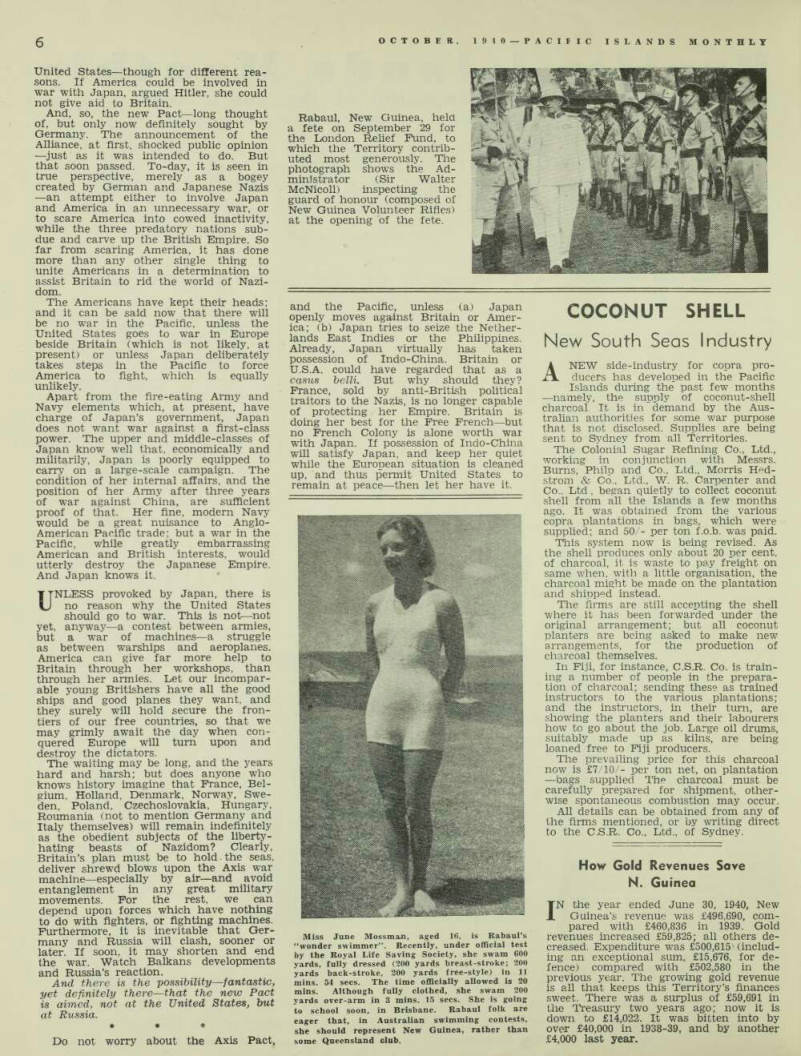
Rabaul, New Guinea, held a fete on September 29 for the London Relief Fund, to which the Territory contrib uted most generously. The photograph shows the Ad ministrator (Sir Walter McNicoll) inspecting the guard of honour (composed of New Guinea Volunteer Rifles) at the opening of the fete.