When Captain David Robbie
pp. 37-39 · Read in the full issue
Fooled The Police
Incidents in the Life of Fiji's "Grand Old Man", Just Dead at 91
AMONG the dwindling company of men and women who have grown old in the service of Fiji, who saw it develop, thrive, and advance and who helped in that development and ad vancement, few had such a reputation or commanded such respect as Captain David Robbie, whose death at 91, in Levuka, was announced in the last issue of the “P.1.M.”
A MERE recital of facts concerning Captain Robbie is impressive. He had been in Fiji for 64 years, a life time for many men; was Warden and Mayor of Levuka at various times for a period covering 30 years; was the first European member of the Legislative Council: and he was at one time Har bourmaster at Levuka. As a trader, planter and shipowner, he lived a life packed full of adventure and excite ment. Having sailed the length and breadth of the Pacific, he knew it as few men do—if you look at a chart of the South Seas you will find near Wallis Island (north-east of Fiji) a sunken lagoon marked Robbie Shoal, which he discovered.
Born in Forfarshire, Scotland, David Robbie first went to sea in a barque called the “Seafield”, after earlier hav ing tried his hand as a clerk in the Scottish Railway Co. An interesting story belongs to the time when he sailed in this ship.
On one occasion they met with a ter rific storm and spent the night shorten ing sail. At dawn, they saw an object in the distance, and coming closer found it to be the “Mary Pollock” in distress, with her sails gone and the seas rolling over her. Up in the mast, in the mizzen top, were four men —the captain, mate, second mate, and a volunteer from a Norwegian ship that had taken off the rest of the crew some time before. The “Seafield’s” captain signalled that al though he could not lower a boat owing to the weather, he would not desert the derelict as the other ship had done.
They lay by for a whole day, and then lowered a boat which rescued the men.
The coxswain of the rescuing boat was David Robbie.
Do you know your Kipling? If so, you will remember his poem, “The Derelict”, and recall that at the top of the verse is a quotation from the Ship ping News —“And reports the ‘Mary Pol lock’ still at sea. . . .”
IN 1873, Captain Robbie left England for New Zealand as second mate of an immigrant ship, the “Queen of the Age”. Some 400 immigrants were on board, sleeping in rows of bunks three tiers high that ran almost the whole length of the ship. The voyage out proved very lively—the ship’s officers were under arms practically all the way and many passengers (ex-Indian Army men) had to be sworn in as special constables. When the vessel reached Auckland every man of the crew, except the apprentices, was put into gaol for mutiny!
Having had enough of the sea for the present, Robbie left the ship and made his way to the Thames goldfields, where he worked underground for a consider able time. But the sea’s call could not remain unanswered and he joined a
vessel in the New Zealand coastal trade, eventually gaining his master’s ticket.
Captain Robbie went to Fiji in 1876 as master of the “Nymph” (43 tons) and, later, having acquired a vessel of his own, traded all through the Central Pacific groups. For many years his schooner “Midge” was engaged in the labour recruiting trade. This vessel was Captain Robbie’s pride and in his latter years he used to relate a fund of stories concerning her.
With a grin he would tell you, for instance, how he once conspired to defeat the ends of justice. A resident of Taveuni had received a summons to appear at court, and the magistrate who was to try the case had arranged to have a Government vessel anchored off-shore to take the man to Suva as soon as the court proceedings finished.
Now, it looked to Captain Robbie and some of the others at the island that
the magistrate had pre-judged the case; so it was decided to smuggle the accused man out of the group.
Late at night, the “Midge” picked the man up and took him across to Udu Point, where he was carefully hidden.
Then the schooner sailed back to Levuka to load cargo and obtain a clearance.
The police, learning of the Taveuni man’s disappearance, searched the ship, tiw °n C( ? urse Ca P^? in R f ob J? ie p £ ot . ested th l h n ll ” ,r. f , w g T® f Passage was the Government ketch “Barb” (50 tons), but the “Midge” gave her the slip by sailing through the Passage at night in the middle of a fierce thunderstorm. Robbie always said he made his way through the pass by flashes of lightning!
Next evening, anchor was dropped off
Udu and in the dim light of dawn the following morning the Taveuni man was brought on board. Then, not 300 yards away, they noticed a police boat mak ing towards them—but she was inside the reef and the “Midge” was outside, with a strong, fair wind. Captain Robbie dipped his flag in salute and headed to sea.
When Robbie returned to Levuka bo took the ship’s papers to the Collector Customs. Having examined them, the official was about to hand the sheat of documents back when the Inspector of p ° 1 * c l f- who had been waiting alongside ad time, held out his hand for them, The Customs man looked from one to the other, then exclaimed, “No. I’ve seen through the papers, they’re quite in order. That’ll be all, thanks, Captain.”
Robbie, with a wink and a nod, gladly took his leave.
ANOTHER of Captain Robbie’s stories concerned a mistake he himself made, but which was responsible for saving a number of lives.
On one trip from the Line Islands to the Leewards, the set of the current made it practically impossible to keep the ship on its course. They had been at sea for over a fortnight—the usual time for the journey was four days— and were acutely short of water, even tually reaching the stage where each person was allowed only a teaspoon of water a day. When they were almost on the verge of insanity through thirst, one of the passengers, who had been a whisky-maker in Hawaii, conceived the idea of rigging up a make-shift distilling
plant. With the aid of three kerosene tins and other crude apparatus, they were able to distil a bucket of fresh water every four hours.
Then, by some strange chance, Captain Robbie made an error in his reckoning and set a course that was wrong by 30 miles. At dusk the lookout man saw two masts; so the “Midge” tacked to windward and waited until daylight.
There, not more than 30 yards from them, was a whaleboat with 20 natives in it, dying of thirst and hunger. They were taken on board, fed, and given some of the distilled water. All survived and were later landed on the island Robbie was making for.
IN 1882, Captain Robbie settled down in Suva, at the time when the capital and seat of Government was transferred from Levuka, eight years after the group was annexed by Great Britain. He was the first manager of William Kopsen and Co., ship chandlers and general merchants, whose large building occupied practically the whole of Pier Street. It was while in this shop that the Captain, as he himself related jovially, became so exasperated with the annoying antics of a small boy that he up-ended him and soundly spanked the seat of his trousers; that little boy to-day is one of the best-known and successful merchants in the Colony, Mr. Tommy Horne.
Kopsen’s premises were destroyed in Suva’s big fire, in 1889, and Captain Robbie decided to return to Levuka. He always had a special weakness for that town and more than once remarked that though he had travelled all over the South Seas he had never seen a place more naturally beautiful.
About this time he married a Mrs.
Thompson and took charge of the Royal Hotel. Later, he went into business again, forming Robbie and Evans Ltd.
Some time afterwards, he joined Cap tain Christian Kaad, another pioneer trader who had interests at Rotuma.
Then, after retiring from business, he
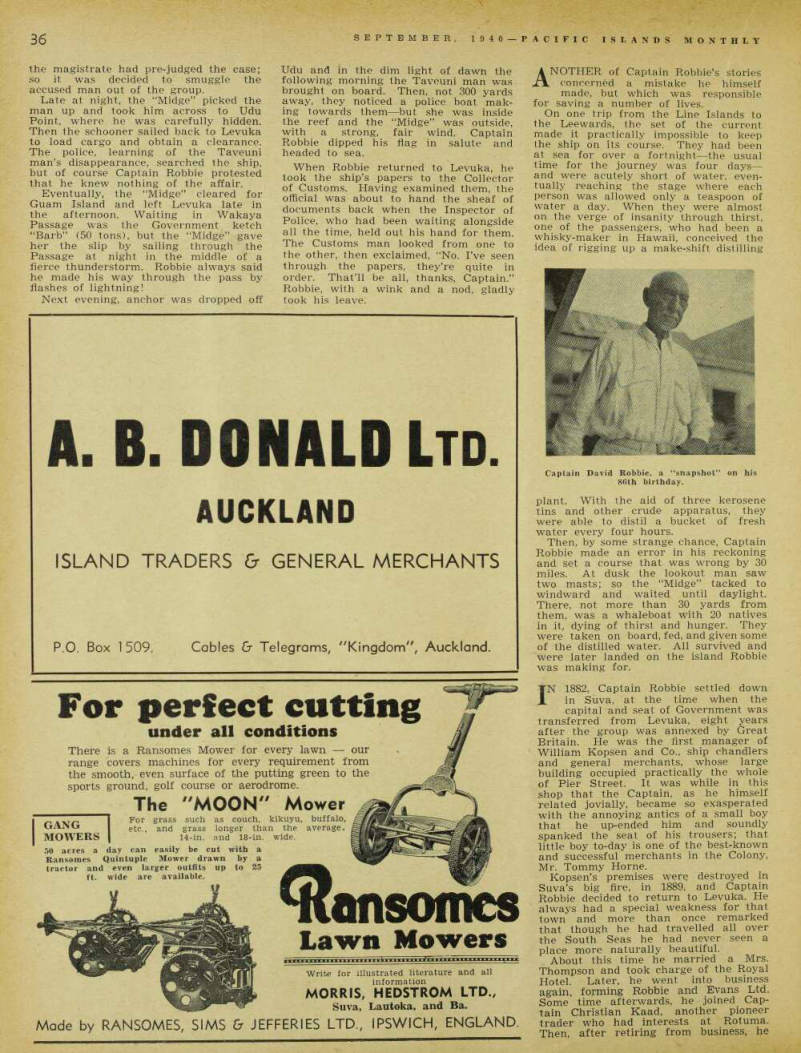
Captain David Robbie, a “snapshot” on his 86th birthday.
took up tea planting at Wainunu, on Vanua Levu, and made a success with his “Masusu” brand. Subsequently, he also engaged in copra production and rubber planting.
LEVUKA knew him as one of the most prominent citizens in the Colony: he never failed in his interest in public affairs and his open-handed generosity was a by-word. Some people in Levuka thought that the wharf there (one of its greatest assets) should have been called Robbie Wharf. Captain Robbie drove a ship right through the old wooden one—-not intentionally, of course, but still, as he declared later, it served the purpose of removing a nuisance and an eye-sore! When the new wharf was put up, Robbie drove the first pile, and he also filled in the last piece of decking. To-day, at the end of the wharf is an inscribed plate com memorating his association with the building of it.
His civic good deeds were legion. He donated part of the land on which the Anglican Church in Levuka stands; he helped found the Ovalau Club; and he played a great part in building up the traditions and prestige of the Levuka Public School.
One day a friend o his, Mr. Tom Burness, came in to Levuka from an out station. As they chatted, Burness asked what the town was doing to celebrate Queen Victoria’s Diamond Jubilee. It appeared that very little had been done; so the two men decided that it would be a fine gesture if a memorial hall were erected. Robbie took a sheet of paper from his pocket, wrote down their names with £5O beside each and then strolled down the road. When they returned, 10 more names were on
the list, each for £50 —£600 in half an hour! Other subscriptions were added later and so the Queen Victoria Memor ial Hall was built.
ALL who knew him insisted that “gentleman” was the word that came immediately and most natur ally to mind when Captain Robbie’s name was mentioned. Although he had lived a full life and had many irons in the fire during his prime, he was hard put during the last few years to make ends meet; but it was characteristic of him that one day when he met the widow of Tukai, his old skipper, he just emptied his pockets and gave her all the money he had with him.
Sir Maynard Hedstrom, who person ally knew Captain Robbie over a period of half a century, paid an apt tribute to his old friend recently. Writing in the “Fiji Times” he said: “No one who went to Robbie with a hard-luck story appealed in vain and, after he had given credit, he found it very difficult indeed to press for payment. In any case of distress in Levuka his hand went imme diately to his pocket. Working on these principles, a man may store up treasures in heaven, but does not acquire ‘filthy lucre’ on earth. Consequently, Captain Robbie died a poor man financially but rich in the esteem and affection of very many people.”; Mr. E. G. Theodore, well known resi dent of Fiji, who is a director of Emperor and Loloma gold mines, was in Victoria on a business visit in August.
Mr. H. C. Mac Lean, of Burns Philp (S.S.) Co. Ltd., Suva, Fiji, has left the Colony to enlist.