How To Skin A Shark
p. 35 · Read in the full issue
IN recent investigation has been made in several Pacific groups into the possibility of establishing a shark fishing industry. Products of shark-fish ing have a wide variety of uses—the fins are in demand for soup-making in China; the hide (shagreen) is made into leather for bags, ornaments, shoes, etc.; fertilisers are compounded from the car case: shark-liver oil 'has medicinal uses, rivalling cod-liver oil; and glue is ob tained from the head.
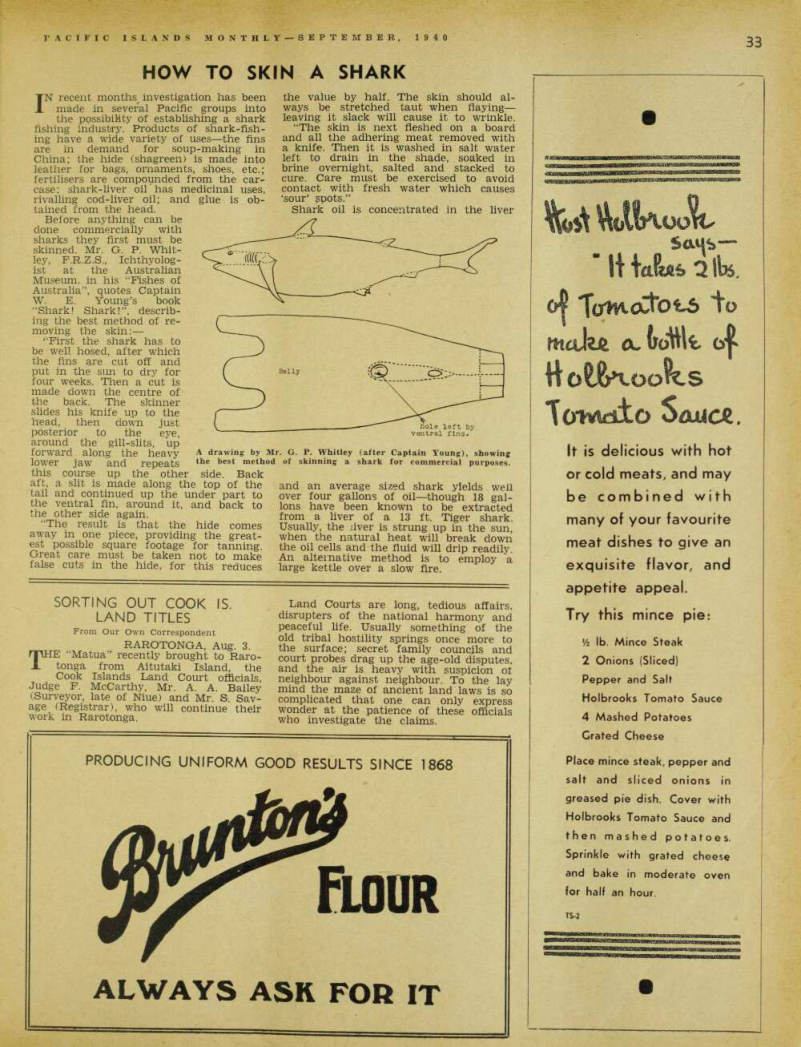
Before anything can be done commercially with sharks they first must be skinned. Mr. G. P. Whit ley, F.R.Z.S., Ichthyolog ist at the Australian Museum, in his “Fishes of Australia”, quotes Captain W. E. Young's book “Shark! Shark!”, describ ing the best method of re moving the skin;— “First the shark has to be well hosed, after which the fins are cut off and put in the sun to dry for four weeks. Then a cut is made down the centre of the back. The skinner slides his knife up to the head, then down just posterior to the eye, around the gill-slits, "up forward along the heavy lower jaw and repeats
this course up the other side. Back aft, a slit is made along the top of the tail and continued up the under part to the ventral fin, around it, and back to the other side again.
“The result is that the hide comes away in one piece, providing the great est possible square footage for tanning.
Great care must be taken not to make false cuts in the hide, for this reduces
the value by half. The skin should al ways be stretched taut when flaying— leaving it slack will cause it to wrinkle.
“The skin is next fleshed on a board and all the adhering meat removed with a knife. Then it is washed in salt water left to drain in the shade, soaked in brine overnight, salted and stacked to cure. Care must be exercised to avoid contact with fresh water which causes ‘sour' spots.”
Shark oil is concentrated in the liver
and an average sized shark yields well over four gallons of oil—though 18 gal lons have been known to be extracted from a liver of a 13 ft. Tiger shark.
Usually, the fiver is strung up in the sun when the natural heat will break down the oil cells and the fluid will drip readilv.
An alternative method is to employ a large kettle over a slow fire.
A drawing by Mr. G. P. Whitley (after Captain Young), showing the best method of skinning a shark for commercial purposes.