Central Pacific
pp. 24-25 · Read in the full issue
With a Camera in Central Pacific
HERE are some interesting photographs contributed by a “P.1.M.” corres pondent who recently was on a round trip on the Union Co.’s motorship “Matua” through the Cook Group and Tonga.
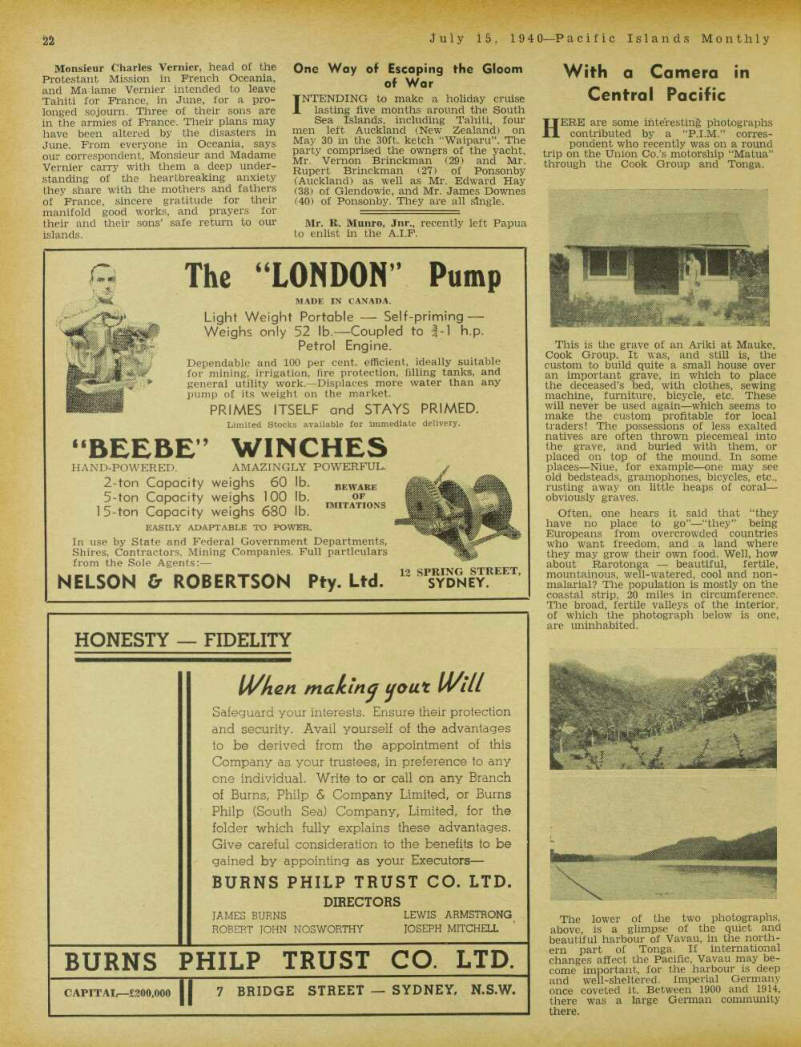
This is the grave of an Ariki at Mauke, Cook Group. It was, and still is, the custom to build quite a small house over an important grave, in which to place the deceased’s bed, with clothes, sewing machine, furniture, bicycle, etc. These will never be used again—which seems to make the custom profitable for local traders! The possessions of less exalted natives are often thrown piecemeal into the grave, and buried with them, or placed on top of the mound. In some places—Niue, for example—one may see old bedsteads, gramophones, bicycles, etc., rusting away on little heaps of coral— obviously graves.
Often, one hears it said that “they have no place to go”—“they” being Europeans from overcrowded countries who want freedom, and . a land where they may grow their own food. Well, how about Rarotonga beautiful, fertile, mountainous, well-watered, cool and non malarial? The population is mostly on the coastal strip, 20 miles in circumference.
The broad, fertile valleys of the interior, of which the photograph below is one, are uninhabited.
The lower of the two photographs, above, is a glimpse of the quiet and beautiful harbour of Vavau, in the north ern part of Tonga. If international changes affect the Pacific, Vavau may be come important, for the harbour is deep and well-sheltered. Imperial Germany once coveted it. Between 1900 and 1914, there was a large German community there.
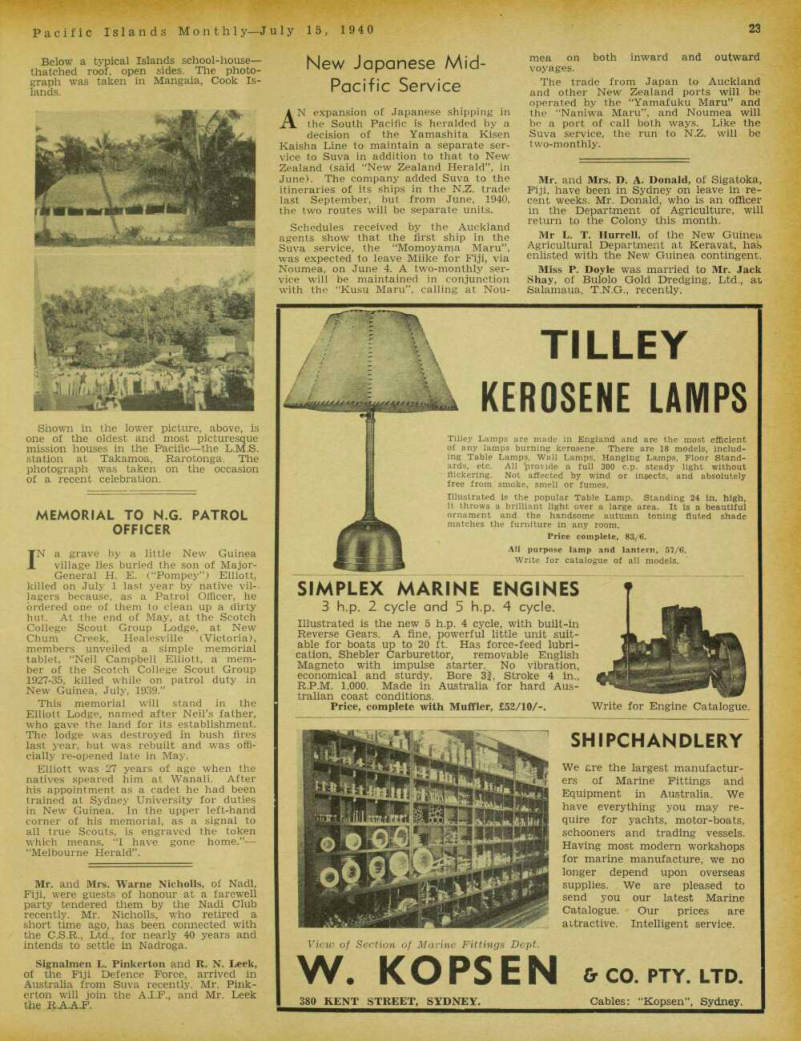
Below a typical Islands school-house — thatched roof, open sides. The photo graph was taken in Mangaia, Cook Is lands.
Shown in the lower picture, above, is one of the oldest and most picturesque mission houses in the Pacific—the L.M.S. station at Takamoa, Rarotonga. The photograph was taken on the occasion of a recent celebration.