The "Niagara"
How They Behaved On The "Niagara"
"Inside Glimpses" From a Private Letter
rERE were many Pacific Islands people on the R.M.S. “Niagara”, when she was sunk by a mine off the coast of New Zealand. Here is an account written by one of them, Mr.
Frank Exon, of Suva. Obviously, it was not written for publication—it is con tained in a private letter to the editor — and the liberty of publishing it is taken because of the sidelight thrown upon the behaviour of British people, in a crisis.
It is to be remembered that the vessel was mined at 3.45 a.m., in midwinter.
"■nOTH Auckland papers reported the 13 disaster excellently, and there is little I can add. It was a good show.
“Had you told me, a month ago that the bottom could be blown out of the old ‘Niagara’, at sea, on a winter’s night —with women and children, Chinese and Indians aboard—and that everyone would be saved uninjured—that not a boat would capsize or be launched minus its plug—that not a block would jamb or a fall fail to release —I should have said it couldn’t be done. Yet all that happened.
“I have had to re-align a somewhat cynical perspective. I saw the tenderness of the oft-maligned shellbacks with the women and kiddies —the resource and even seaman-like qualities of the stewards —the coolness and deftness of the pam pered modern miss, and her ability to suffer in that bleak before-dawn period —the grit of the children, despite their chattering teeth and their sea-sickness in the life-boats —the essential niceness of everyone when the bowels of the eld erly women just couldn’t make it—and so on.
“Three times after we mustered, and knew we must abandon ship, did my own wife go below and collect things that would make for the comfort of our nip per (aged nine months)—even to filling a vacuum flask with boiling water and salving his Lactogen, so that he had twq Truby King meals in the life boat, and saw little wrong with his world. It took some doing, to leave the cheerful com pany on the decks and go below, with the knowledge that a bulkhead might go at any moment—yet she seemed to think nothing of it, nor of her coldness and sea-sickness in the boats. Eight hours later, when we reached the comfort of the rescue ships, she still would not rest but set to and washed the infant’s only clothes. And she was typical of all the women.
“But her tenseness, that night, when the reaction set in, was a pitiful thing; and it, too, I believe, was typical of all the women.
“After eight hours, an Air Force tender picked us up. It had a speed, they say, of 35 knots—but more important than that, it had a lavatory. I realised anew one of the major amenities of life!
“Another thing was the genuine sym pathy and help of the Aucklanders—and their well-organised relief measures. I refer to the general public, and not neces sarily to the bureaucrats, nor even the shipping companies.
“It seemed to me that a third degree by the police at 9 p.m., out in the stream, as to where everyone had been at the time of the explosion, and what were their views as to its cause—when we were rocking on our feet with weariness and cold—was a little redundant. Especi ally as Mr. Fraser had announced the
cause as a mine, at 5.15 p.m,! . . . But one could not expect the common sense and efficiency that had prevailed through out the day to continue indefinitely.”
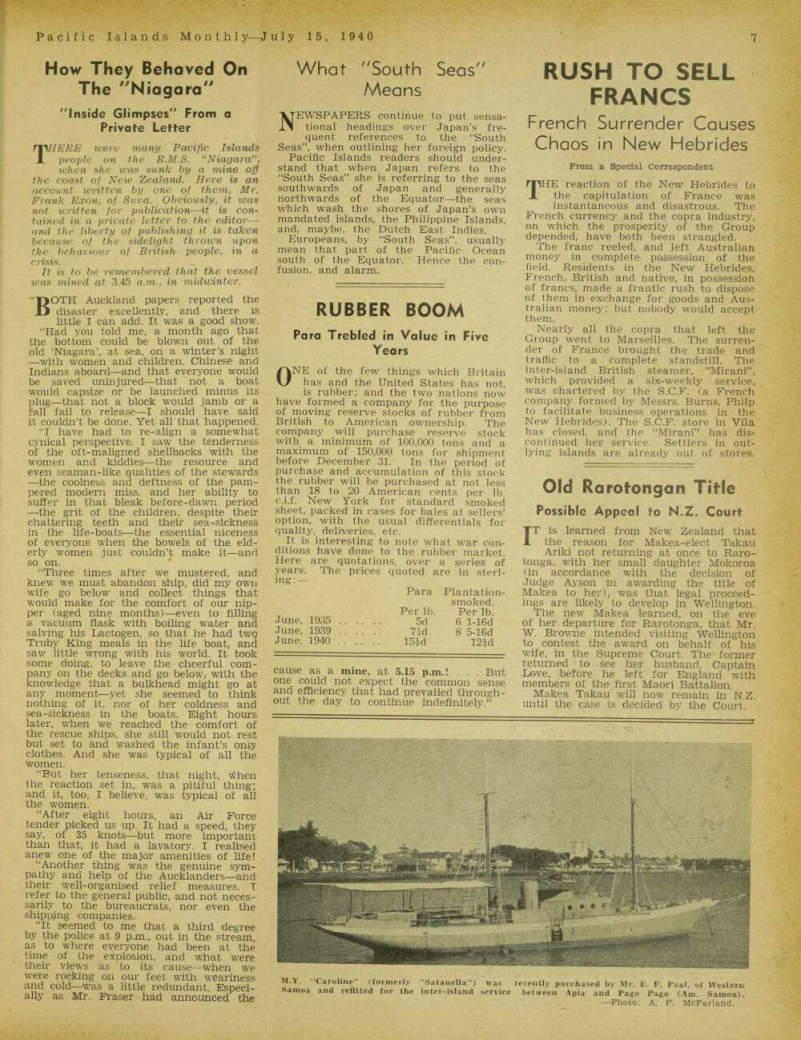
M V “Caroline” (formerly “Satanella”) was recently purchased by Mr. E. F. Paul, of Western Samoa and refitted for the inter-island service between Apia and Pago Pago (Am. Samoa). —Photo; A. P. McFarland.