Accomplished
p. 72 · Read in the full issue
What One Woman
Remarkable Mission Work of Miss Young, Dead at 84
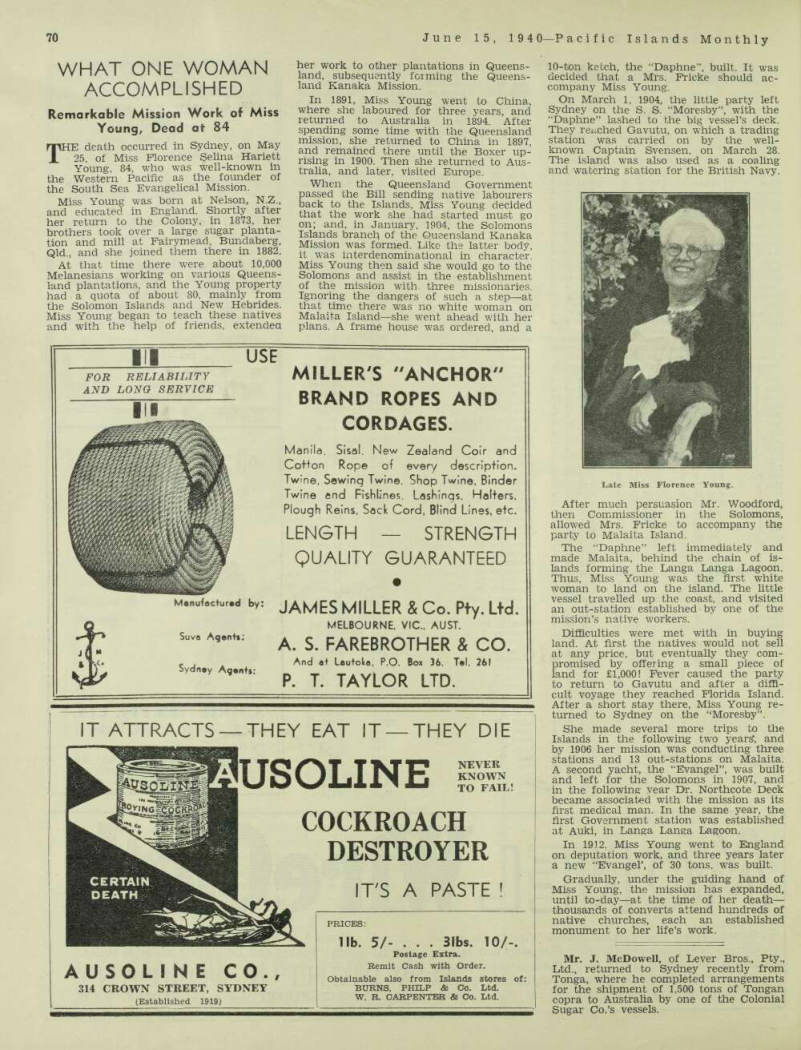
rE death occurred in Sydney, on May 25, of Miss Florence Selina Hariett Young, 84, who was well-known in the Western Pacific as the founder of the South Sea Evangelical Mission.
Miss Young was born at Nelson, N.Z., and educated in England. Shortly after her return to the Colony, in 1873, her brothers took over a large sugar planta tion and mill at Fairymead, Bundaberg, Qld., and she joined them there in 1882.
At that time there were about 10,000 Melanesians working on various Queens land plantations, and the Young property had a quota of about 80, mainly from the Solomon Islands and New Hebrides.
Miss Young began to teach these natives and with the help of friends, extended
her work to other plantations in Queens land, subsequently forming the Queens land Kanaka Mission.
In 1891, Miss Young went to China, where she laboured for three years, and returned to Australia in 1894. After spending some time with the Queensland mission, she returned to China in 1897, and remained there until the Boxer up rising in 1900. Then she returned to Aus tralia, and later, visited Europe.
When the Queensland Government passed the Bill sending native labourers back to the Islands, Miss Young decided that the work she had started must go on; and, in January, 1904, the Solomons Islands branch of the Queensland Kanaka Mission was formed. Like the latter body, it was interdenominational in character.
Miss Young then said she would go to the Solomons and assist in the establishment of the mission with, three missionaries.
Ignoring the dangers of such a step—at that time there was no white woman on Malaita Island—she went ahead with her plans. A frame house was ordered, and a
10-ton ketch, the “Daphne”, built. It was decided that a Mrs. Fricke should ac company Miss Young.
On March 1, 1904, the little party left Sydney on the S. S. “Moresby”, with the “Daphne” lashed to the big vessel’s deck.
They reached Gavutu, on which a trading station was carried on by the well known Captain Svensen, on March 28.
The island was also used as a coaling and watering station for the British Navy.
After much persuasion Mr. Woodford, then Commissioner in the Solomons, allowed Mrs. Fricke to accompany the party to Malaita Island.
The “Daphne” left immediately and made Malaita, behind the chain of is lands forming the Langa Langa Lagoon.
Thus, Miss Young was the first white woman to land on the island. The little vessel travelled up the coast, and visited an out-station established by one of the mission’s native workers.
Difficulties were met with in buying land. At first the natives would not sell at any price, but eventually they com promised by offering a small piece of land for £1,000! Fever caused the party to return to Gavutu and after a diffi cult voyage they reached Florida Island.
After a short stay there, Miss Young re turned to Sydney on the “Moresby”.
She made several more trips to the Islands in the following two year£ and by 1906 her mission was conducting three stations and 13 out-stations on Malaita.
A second yacht, the “Evangel”, was built and left for the Solomons in 1907, and in the following vear Dr. Northcote Deck became associated with the mission as its first medical man. In the same year, the first Government station was established at Auki, in Langa Langa Lagoon.
In 1912, Miss Young went to England on deputation work, and three years later a new “Evangel’, of 30 tons, was built.
Gradually, under the guiding hand of Miss Young, the mission has expanded, until to-day—at the time of her death — thousands of converts attend hundreds of native churches, each an established monument to her life’s work.
Mr. J. McDowell, of Lever Bros., Pty., Ltd., returned to Sydney recently from Tonga, where he completed arrangements for the shipment of 1,500 tons of Tongan copra to Australia by one of the Colonial Sugar Co.’s vessels.
Late Miss Florence Young.