Exploring Central New Guinea
pp. 52-56 · Read in the full issue
Discoveries and Observations of the Taylor-Black Patrol
Section Iv. Of Official Report
(This is the concluding section of the Preliminary Report on the patrol carried out in Central New Guinea, by Assistant District Officer J. L.
Taylor, Patrol Officer John Black and Medical Assistant C. B. Walsh, in 1938-39. The series was com menced in the March issue.) W r HILST at Kelafomin I decided that it would be better to come down the May River, which flowed for the most part through unexplored country, instead of following the Sepik to its junction with the October, which had been done many years before by Messrs.
Karius and Champion.
Black accompanied me as far as the head of the May.
At Mianmin, in the Thurnwald Range, we were fiercely attacked. Until then, the journey from Wabag had been completely peaceful; but at Mianmin we came among a bush people, forest dwellers, with whom we could not make friendly contact. As Black remarked, drily, “They don’t encourage visitors”.
Early in the morning of December 17,
1938, a clever surprise attack was made upon us, and a fine young man, Kwinjil, of' Mogei Kwivi, received an arrow which penetrated 11 inches and entered the region of the heart. He died almost in stantly, at the door of my tent. Pour others were wounded.
Two more attacks were made, within the next hour, but the police and carriers remained perfectly steady and the attackers were driven off. None was killed, as far as is known, though it is oelieved that one was wounded.
We were very distressed at the loss of Kwinjil, a youngster with a bright smiie and a charming manner, a favourite with everjffiody.
After resting the wounded for a day or two, we pushed on to the head of the May.
Black and I spent Christmas together there, and then he returned to Kelafomin, en route to Wabag, by the mountain trail.
I CONTINUED down the May, passing between the mountains Vierkant and Stolle. As the river flattened out, and the country became swampy, I was faced with the problem of travelling by water with my carriers, who were mostly poor swimmers—some could not swim at all.
Also there was the difficulty of passing native communities who though not hostile to pinnaces or power-driven craft, would regard men on rafts as fair game.
Making friendly contact with the first of the low country people, whom we found to be steel-hungry, we bought a number of canoes and made barges.
Every care was taken, but one barge collapsed and nearly ended in disaster.
Fortunately, no one was lost. The barges were altered in design, and a leg of tight timber placed between the canoes to make the barges unsinkable.
We proceeded by water and by land, both parties keeping pace with each other, outmanoeuvred a party of highly decorated and heavily-armed warriors, and camped lower down, where it was found possible to buy more canoes and improve the barges.
The warriors stood on the high bank of the river, with their arms stacked be hind them, and beckoned the canoe party to come in close, where they might shoot down upon them. But, just as the barges drew level, the land party arrived, to the amazement of the warriors.
The entire party then went forward by water.
The next community met with
attempted to prevent our passage down stream. Terrific excitement prevailed in the village. Heavily-armed men roared defiance, and shouted for action, and some beat the water with canoe paddles, cheering as showers of spray rose and fell with each stroke. But, after some parley, we succeeded in passing without conflict, despite the fact that one more bellicose than the rest wished to make a naval engagement of it, and attack us from canoes.
The Lower May is a fine river, navi gable for small craft, and flows through pleasant, well-populated forest country.
Continuing, we reached the Sepik at 2 p.m. on January 13, 1939, and came on under our own power.
THE people of the Upper River were friendly, though Wogumash was a little difficult. They refused to stand clear, and I had to threaten sterner action to make them do so, and ensure my barges against surprise attack.
The conduct of the police and carriers was exemplary. Ten months out, and not a grumble, even when Kwinjil was killed.
The main problem of the journey was that of supply; but this was overcome by our shell currency, which enabled the purchase of food, and by the preparation of sago flour whenever the palm appeared.
The country between Wabag and the Strickland is well-populated grassland for about 30 miles, but on the lower Lagaip (a tributary of the Strickland, which I originally believed to be the Karawari or South-east River) a southern tributary of the Sepik, the grasslands are displaced by a mass of forest-clad spurs and ridges, table tops and serrated peaks, lying be tween Behrmann’s Central Range and an almost parallel limestone chain which forms the highest part of the great cen tral massif, and the Strickland crossing in longtitude 142 degrees 15 minutes.
Black later proved that the Lagaip was the main headwater of the Strickland River, and not the Karawari, as I originally believed.
ON January 18, about 8 a.m. we reached Yessen, the frontier of European influence, where the people told us that a vessel was coming upstream.
We waited about a quarter of an hour, and were delighted to see “Sirius” come round the bend. It was great to see her, and a relief to all of us to go on board, to shelter from the fierce sun which beat down on us on the barges.
We proceeded immediately downstream,
towards Kopar, at the Sepik mouth, meeting ana receiving hospitality from the Catholic Fathers in charge of the Mission Stations at Merui and Marien berg.
At Angoram, I called on Mr. G. Ellis, Assistant District Officer, who received us kindly, and then continued to the mouth of the Sepik, to rest the police and carriers for a few days and enable me to attend to correspondence before re turning to the interior.
Here I received a report and map from Patrol Officer Downes, who in Sep tember, 1938. went to Wabag, and, to gether with Walsh, made a splendid ex amination of the headwaters of the Taruwa and Sau, tributaries of the Yuat River north of Wabag.
After a few months’ arduous work Downes was unfortunately taken ill and was compelled to leave the area. He was relieved by Patrol Officer Pursehouse who, with Walsh, made another journey, thor oughly examining the upper reaches of the Lagaip, but I did not meet him—he had left Wabag before my return there.
ON January 27, the “Sirius” left Kopar for the head of navigation on the Karawari. The river was high, and the going was slow, and it was the after noon of February 1 before we reached Ambramei, after an exciting and rather terrifying journey up the Karawari with my party (which numbered 70 all told) on board, and 30 canoes in tow. However, we got there without accident and camped in the village.
The “Sirius” departed the following morning. Her master, who handled the “Sirius” skilfully and intrepidly, was anxious to see blue water under her again, after his trying and anxious time in the muddy reaches of the Sepik.
Due probably to being cooped up on board for several days, and to a climate that they were not used to, most of the carriers had colds, so we rested at Ambramei on the rainy days of February 2 and 3.
My aim, now, was to transport by canoe my stores, mostly rice, supplies of which I had brought from Angoram, as far as possible upstream, and then begin carrying across country.
There was a high range of mountains to cross before I could reach Wabag.
Whether that was inhabited or otherwise I knew not, and it was necessary for me to get as much rice as possible to the slopes of that range before crossing.
In addition to this, I feared malaria.
The carriers were receiving 15 grains of quinine a day, as a prophylactic, and up to the present were in good condition.
How they would fare in the higher levels, with their mountain mists and icy winds, was yet to be proven.
Canoes took us above Awim, to the Arafundi, which soon ran into shallows, and put further water transport out of the question.
Relaying of cargo then began. There
was too much to be carried, except by this method. This I found one of the most trying parts of the patrol as our progress was so slow, and my work con sisted mainly of waiting.
The country was forest land, not very rough, 2,000 or 3,000 ft. above sea level, but without any definite tracks. Numer ous very small ones were seen but, on be ing followed, they led into thick jungle and faded out. A small population in habits this area, and a few tiny hamlets were seen, but it was impossible to make contact with the people.
I left* some steel articles in prominent places so that the people might find them and. later, become friendly with European
parties who might visit the area.
On March 15 Puruma, the first of the Maramuni groups, was met with. They were identical with the Wabag people, and spoke the same language. This was very heartening, and it meant that we could hardly fail to reach Wabag within ihe next few weeks, though there was still the range to cross.
AT Puruma, we crossed the river, which is very narrow at this point, racing through a channel about 12 yards wide. From here we went on to a settle
ment called Ilia, and then to Ivolye, and Kaiyemrok, at the head of the Liando, following a trade route, and marching southward all the time. Plenty of food was available, and the people were friendly, but did all they could to steal our axes and knives. They knew the value of steel, and were hungry for it.
Beyond the head of the Liando, southerly, was a high forested range running up to 11,000 and 12,000 ft. above We asked the guides about the crossing; and some said five and some
said six days without food.
At this stage, one-third of my line went down with malaria, but I kept the quinine up to them —15 grains a day for all hands, and an extra 15 grains for the sick.
A local guide told me that he knew of another track, leading south-easterly, by which we could avoid the steepest parts of the mountain, and this track we took.
Three days brought us to a place called Tangagilli, the inhabitants of which said they were related to the Kuvine, of the Ambub, and visited there frequently on trading expeditions. I offered a high price for 8> guide to take us through, and one old fellow, who said .that he was a
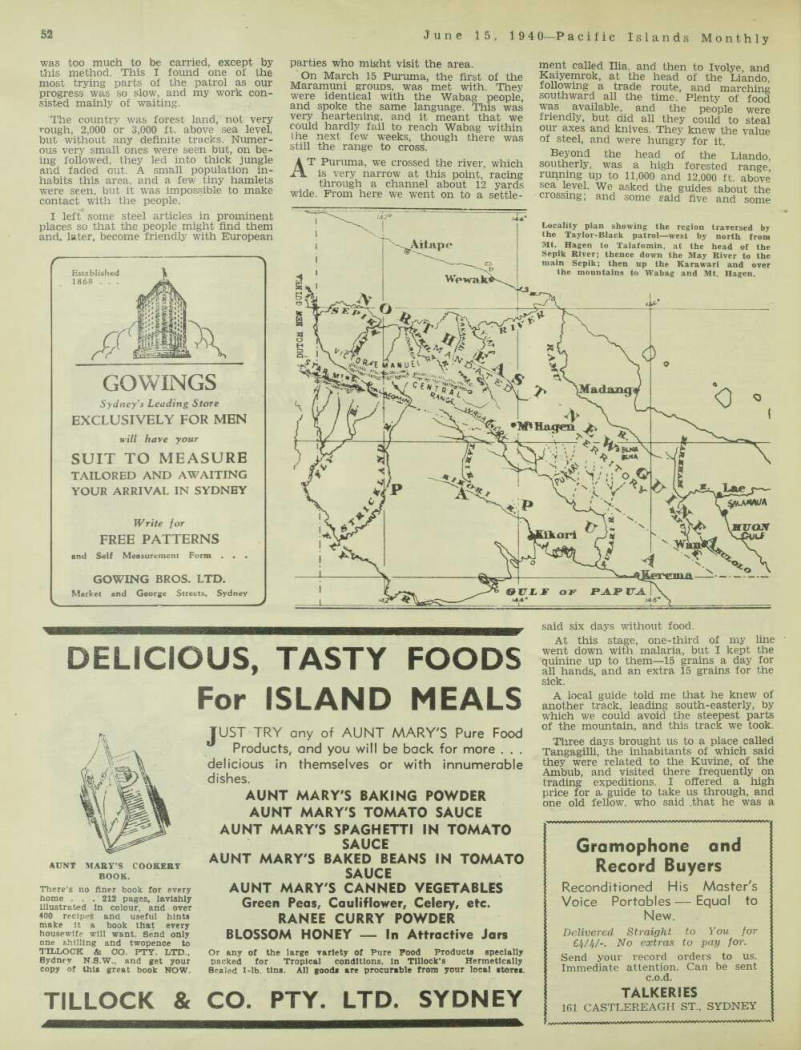
Locality plan showing the region traversed by the Taylor-Black patrol—west by north from Mt. Hagen to Talafomin, at the head of the Sepik River; thence down the May River to the main Sepik; then up the Karawari and over the mountains to Wabag and Mt. Hagen.
fugitive from the Ambum region consented to show us the way.
Three days later we crossed the divide at 8,950 ft. above the sea, and ascended to the grass nlateau country, camping at Muriliam, 8,300 ft., in pleasant weather.
That was my 197th camp.
T . . ’fxr x
HE journey to Wabag was now easy going. The friendly people dancing and singing m front of the line. approached us from group to group, and gave us food in abundance.
Wabag was reached on April 1, 1939, and there I found Walsh in good fettle, after his trying experience, waiting to meet me - Black had not yet arrived, but I was not alarmed, as I did not expect him for another fortnight.
Walsh went off to Mt Hagen, the next day, to arrange about stores, as the radio equipment was at this time out of order. I sat down to wait for Black.
On Sunday. April 16, about 8.30 a.m., I heard that Black had camped at Warumanda the night before, and was now in the vicinity of Wabag; and, about 11 a.m., I saw him through the glasses, about Is miles to the west. Half an hour later, he arrived at the camp and reported all well. He had got through without conflict or casualty. I immediately sent the following radio to the Administrator: “Mr. Taylor’s compliments. Black arrived at 11.30 a.m. to-day with himself and party in first-rate condition. He travelled from Kelafomin, through the Heiwandagar people of the Strickland- Sepik watershed. His route was generally more northerly than mine, and his journey from Hoiyevia, which has occupied 10 months and been without casualty,
I consider the greatest achievement of any New Guinea patrol.” (The casualty in the Thurnwald Range occurred while the combined parties were under my immediate control.) Th Administrator his nipa party, and decided to visit us the next S ay / wit h the aeroplane bringing in further supplies. Shortly aft»r 10 o’clock, on April 17 accompanied by Messrs Sheekey Cox and O’Dea (pilot) the Administrator landed and inspected a guard of police drawn up at the landingground to receive him.
It was a fl „e morning and there was a record market about 2,000 friendly people visiting the camp. The carriers and local people gave the Administrator
Mlowinfta’ hi
moved f about g It nlafn to lee that about « was Plain to siee that neonle were now mm friends ™ people were now our real „ * . . ..
Heavy r^i n . °5 cu - r r ed JJJ P l ®, afternoon, and pilot decided that it would be unsafe Administrator s party tnereiore stayed me mgnt.
In the morning, the Administrator inspected the carriers and remarked on their good physique and condition. He instructed me to bring the patrol to as speedy a conclusion as possible, and departed for the coast. fTIHE patrol was now 13 months’ old, JL and I should have been pleased to withdraw straight away. But I had certain obligations to fulfil to natives from Hoiyevia, on the upper Kikori, who had accompanied our parties to gain experience. Black, also, had found gold. and I thought it wise to make a close
examination of the gold-bearing area, so that I could report definitely whether a ne ' v gold-field had been discoveied.
Accordingly, Black and I left Wabag on April 21, leaving Walsh at Wabag.
The arrangement was for him to move
“ctS
trihntavv v«Hpv known as *thp Talp and ther ‘ iwait our return , e awal “ ° UI r f“ T . .
We marched up the Ive Lai, and separ ated at a Pl ace called Kinarta-Aram, Black making for Poredigar, amongst the Hoiyamo people (on the northern slopes of the limestone range immediately be
peKfKuSwvera?^ and l'toHoly!
evia by the shortest possible route.
T find now TTnivcvin nconle who could J p if £?n E^elish understood our
purpos^
the best tracks and that we were assured of a great welcome to their homes. They explained that at first they thought we were spirits and were suspicious—now that they knew we were men they were proud to know us.
Seventeen days after leaving Wabag, on May 8 1939, j arrived at Hoiyevia. The people gave us a great reception, and rice that I had left in the care of two old men was brought forth in good condition. It had been carefully guarded, and one of the men said that he had fought to preserve it, and hoped that we would support him in a war which he about to n ? a ? e gainst his enemies, Thf-t £ could not do, but I paid them well, and were jubilant, and their friends envious.
I stayed a few days and, saying good bye to those whom I had returned home, I set out to cross the range and meet Black on the other side. Hundreds of young men wished to accompany us, but
I could not take them, as we were not returning.
We travelled north and, on the second day, we reached 10,500 ft. We travelled for three days further at that altitude, over a succession of moors and valleys, covered with light brown alpine grass.
On May 21 we marched into Black’s camp. He had examined the area very closely, and ascertained that his gold discovery was of very little value, and had no commercial possibilities.
On May 23 we moved out on the return journey to Wabag, to Ailemande (where Walsh had built a fine camp and achieved marvellous results with the in habitants) and Mt. Hagen, where we arrived on June 19.
At Mt. Hagen the carriers were paid off amid scenes of great rejoicing.
Walsh f!ew to Madang to make arrange ments for our baggage to be ready for snipment to Rabaul, and Black and I
continued to Bena Bena, returning our carriers to their homes as we went.
From Bena Bena we flew to Madang, and travelled by ship to Rabaul, which I reached on July 11 and reported to the Administrator.
The work done by the patrol included the following: Observations of the climatic conditions were recorded.
Collections of plant specimens, fossils and soil were made. These are now being examined by various authorities.
The rivers and streams crossed were tested for gold.
A large amount of ethnological data was obtained and vocabularies of the native languages prepared. Head and stature measurements were taken.
A photographic record of the journey, the country and the people passed through was obtained.
Interpreters have been trained to assist Europeans, and should be of great assistance to Administration Officers when further steps are taken to bring the area under real and effective control. rE practical results obtained by this patrol are as follows: Examination has been made of the area between Mt. Hagen and the Dutch border, from the Papuan boundary to the Sepik River, and the country carefully mapped. Needless to say, there is more to be done. We should have liked to have done more ourselves, but in the time available that was not possible.
Many thousands of new natives were met, and the advent of the new era— that is, the era of European influence— explained to them wherever interpreters were available —and that covered a large area before the patrol concluded.
The native people have learned that the European is a friend, and that to trade with him is to their advantage.
The future of most of this country lies in agriculture and pig-raising, not in minerals—much of it being of limestone formation and gold free, that is, again, excluding the lowlands.
The natural ingress of this interior is from Lae, via Mt. Hagen, and it is from this direction that progress and develop ment should come.
If a road from Lae is not constructed, this area may be opened up from the Sepik River by establishing police posts (a) at Maramuni (upper Yuat) with a landing stage for pinnaces or small craft on the Arafundi (Karawari), (b) in the vicinity of Wabag or Ailemande on the Yuat headwaters, (c) on the lower May River, (d) at Kelafomin, on the Sepik headwaters. .The upland people are unfit for em ployment on the lower levels unless given quinine continually and in ex tremely large doses.
Further examination is required of the forested lowlands, between the Karawari and the May Rivers, on the northern slopes of the central range. This can be better done with the aid of river craft, operating from the Sepik.