Europe
pp. 11-12 · Read in the full issue
Future Of East
Indies
Awaiting Events in Europe
THE future of the Dutch East Indies is now uncertain. Whatever happens must affect all Pacific Territories.
When Germany over-ran Holland, in May, the Netherlands sovereign and Government took refuge in England, and it was announced that the administration of all Dutch Colonies would be directed from there, and that there would be no alteration in the status of any of them.
Japan and the United States, however, continued to manifest the liv°liest inter est in the East Indies. The attitude of both Powers was set out clearly in the “P.1.M.” last month.
After that, it was assumed that there would be no interference with the East Indies, so long as that Territory of 60.000,000 people was governed in the same way as in the past.
On May 22, the German Ambassador in Tokio delivered the following message to the Japanese Foreign Office: “The German Government is not interested in the East Indies problem.”
There were many guesses at to what this might mean. Did Germany indicate that she left the disposal of the Indies to Japan, or that she did not intend to interfere with the Dutch Colonial Empire?
On May 24, it was reported that Russia, Germany and Japan proposed to hold, at Peiping (the former capital of China), a conference to discuss the future of the Netherlands East Indies.
The same day. the Australian Minister for External Affairs. Mr. McEwen. made a statement. He said that, previously, he had stated that three Pacific powers— Japan, the United States of America, the United Kingdom—together with Aus tralia, had severally declared that the position of the Netherlands East Indies should not be affected by hostilities in Europe.
“The only thiQg that I can add to that statement”, continued the Minister, “is that I have since had an interview in Canberra with Mr. Akiyama, the Consul- General for Japan, when assurances on behalf of the respective governments were given that neither Australia nor Japan would take any action likely to affect the present position in regard to the status quo in the Netherlands East
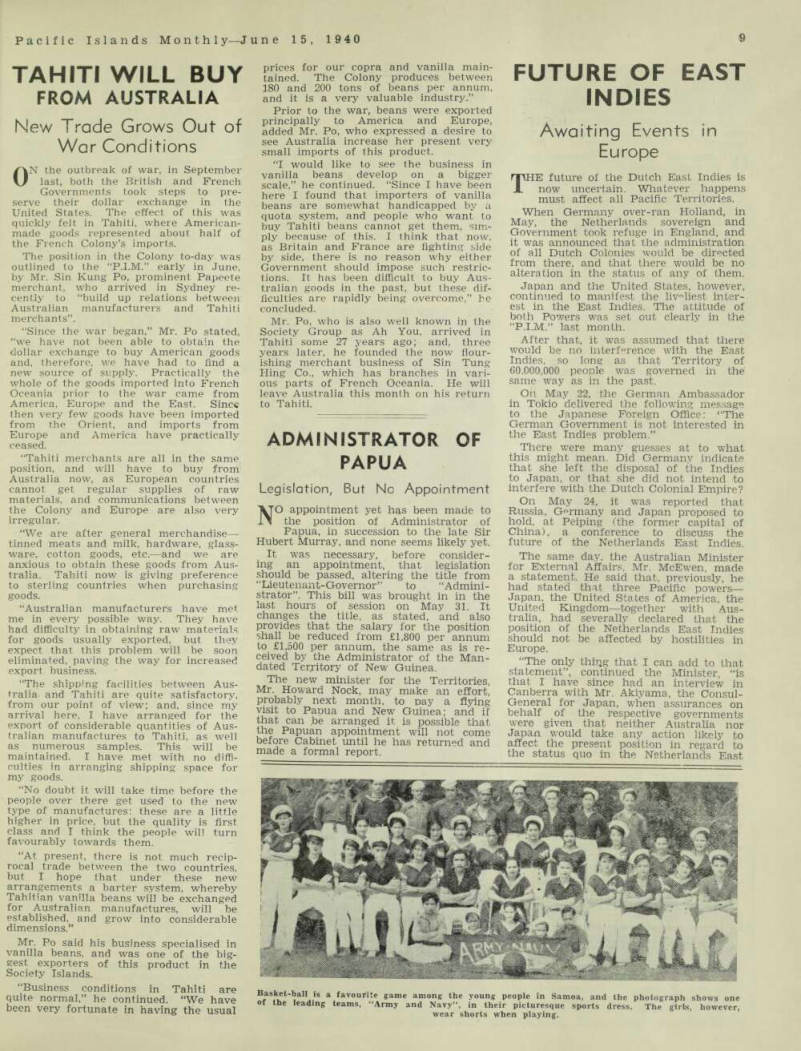
Basket-ball 18 a favourite game among the young people in Samoa, and the photograph shows one of the leading teams, “Army and Navy”, in their picturesque sports dress. The girls, however, wear shorts when playing.
Indies. No specific representations to the Government of the United States of America have been made in this regard; there has merely been the declaration of policy which I indicated previously.”
He said he knew nothing about the proposed German-Russian-Japanese con ference.
ON May 28, American correspondents in Tokio reported: “The activities of certain Japanese high officials suggest that the Japanese Government is making an important de cision on its policy in the Pacific. There is evidence that Japan’s announced policy of non-involvement in the European war may change in the Far East.”
On May 31, this press despatch came from Tokio:— “It is stateJ in official quarters that Japan will demand a voice in any settle ment of the European war in order to protect her interests in the Netherlands East Indies. It is added that Japan can not be indifferent to important changes in the status of territories within the Pacific zone.”
There have been many reports since then, but no alteration in the position indicated above.
Restlessness Of Japan
THE position, of course, is that if the Allies force Germany to leave Hol land, the status of the Netherlands will not be affected, and Japan will not move; if the Allies cannot compel Ger many to leave Holland. Germany will be free to dispose of the Netherlands Indies as she chooses—in which event Japan, as a nation eager for new territory, and the United States, as the protector of the status quo in the Pacific, will become vitally interested.
Meanwhile, Holland has joined the sterling group. Dutch currency has been linked with the pound and the franc. This means, of course, that the Netherlands Indies, in matters of trade and finance, will be tied clos°r than ever to Britain and France.
This, naturally, makes Japan restless —her restlessness, increasing in propor tion to her doubts concerning the eventual outcome of the war.
THE fear that Japan, despite American warnings, may attempt to seize the Dutch East Indies became more real, early in June.
The assembly of a Japanese army of 150,000 at Hainan Island, about June 6, apparently for use as an expeditionary force, caused a stir. A Japanese spokes man assured inquirers, however, that the forces were for use against Southern China.
However, now that all semblance of international trust and goodwill is dis appearing from the earth, it is increas ingly recognised that possession is nine points of the law. That w 7 as the policy of Japan in Manchuria, in Central China, in South China, in Hainan—and we dare not be blind to its implications to-day.