Industries Booming
p. 10 · Read in the full issue
War's Reaction On Pacific Industries
Thin Time For Copra-Growers—But All Other Industries Booming
NOT only has there been insufficient shipping provided to lift South Pacific copra; but, as explained in our main article, the extension of the war has cut off several important mar kets.
Until mid-June, the big trading firms continued to buy copra; but the inability of London to provide ships (despite most urgent appeals from Governments and institutions), and the rapidity with which Germany has over-run Western Europe, must mean that copra-buying henceforth will be cut down to a minimum.
The big trading firms are all following the same policy—assisting planters to survive this difficult, lean period, while insisting on drastic economies, so that funds will last as long as possible.
The South Pacific copra industry is under a dark cloud; but that does not mean that it is “finished”, or that the Pacific Territories are crippled. The Terri tories learned their lesson in the Depres sion and now maintain alternative in dustries —every one of which is booming (as described in an article on page 32).
Copra "Pool" Considered
Impracticable
k PLEA to the Commonwealth Govern- A ment, on behalf of copra producers in Papua and New Guinea, was made in the House of Representatives at Canberra by Mr. A. E. Green on May 23.
Mr. Green read extracts from articles in the "Pacific Islands Monthly” and the “Papuan Courier”, and urged that, if the Government could not provide sufficient ships to take the copra to waiting mar kets overseas, at least it should make provision to store copra in Australia, and advance to the growers some cash against the stocks hqjd. Mr. Green warned the Government that unless something practical was done to help the planters in the Territories, economic dis aster might ensue.
Later, the Minister in Charge of Terri tories (Mr. Nock) said that the plight of the copra-producers in Papua and New Guinea, caused by the shortage of ship ping, was receiving the most urgent at tention of the Government, which was doing everything it could to have ships diverted from the important work of carrying Australian produce to Europe, to copra-carrying.
The suggestion of a copra pool, said Mr, Nock, was not practicable. Copra was a perishable commodity, and soon de teriorated, and the Government dare not take the risk of holding any large stock for any uncertain period. Such articles as wheat and wool lent themselves readily to the purpose of a pool, because they could be stored for a long time and did not deteriorate. But that did not apply to copra.
His Life’S Work In Jeopardy
IN the “P.1.M.”, last month, we pub lished the story of a New Guinea planter who had devoted all his life to the establishment of a plantation, and who now sees his life’s work in danger of extinction, owing to the complete con trol of the market by the buyer, and the apparent inability of the copra producers of the world to create any kind of pro tective organisation. Here is the brief story of another planter—this time a man
in Eastern Papua—contained in a letter received during the month by the Editor: “I came to this Territory, as a youth, 35 years ago, and planted up from virgin jungle. In all those years I have had only two trips South. All my income has been absorbed by the plantation, leaving no surplus for luxuries. Now, at the age of 55, I find that I may have to try to earn a living for myself and my family in a world that asks only for youth, and my only trade is that of a coconut grower. Most of the other pioneer
planters are in a similar position. We are on an isolated island —my wife, at times, has not seen another white woman for twelve months. Yet, if we had an income •that would give us a reasonable degree of comfort, we would not mind the iso lation. Under present conditions, nothing less than £l5 per ton c.i.f. London will be of any benefit to the planters.”
Territories' Copra
Figures For Four Years
BEING under question in the Australian Parliament by that doughty fighter for Pacific Territories interests, Mr.
A. E. Green, M.P., the Minister for Territories (Mr. Nock) gave the follow ing information, which we have arranged in tabular form: —
Copra Shipped From Territories
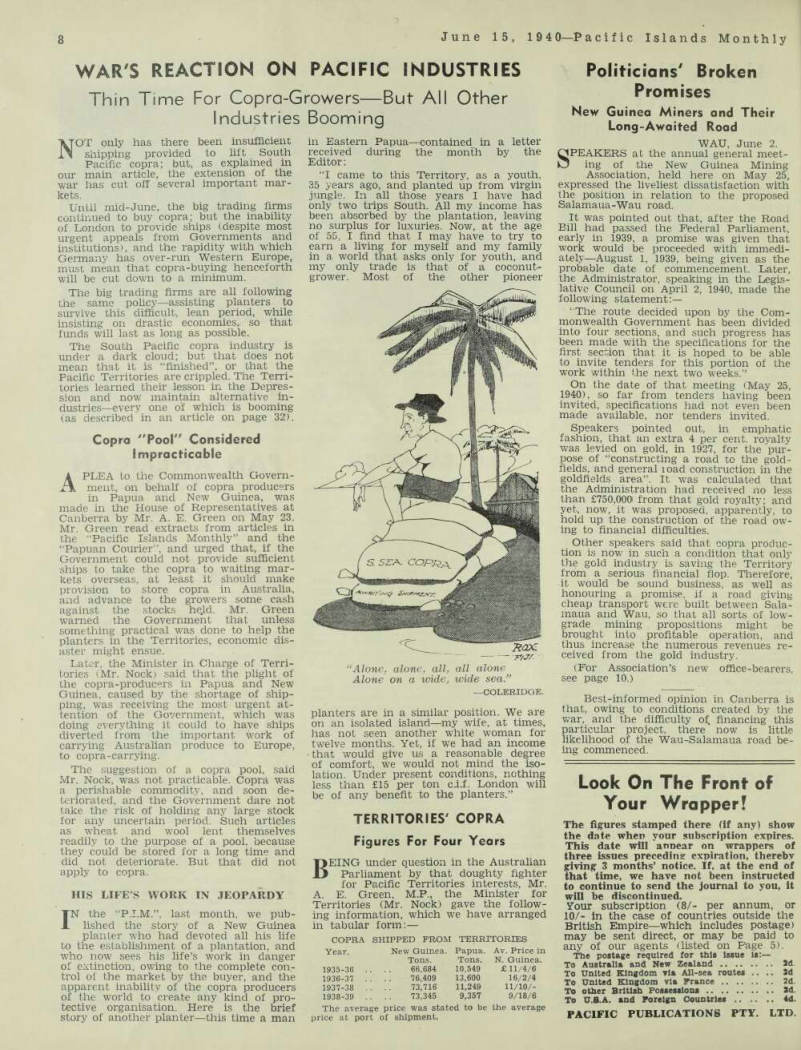
“Alone, alone, all, all alone Alone on a wide, wide sea.”
—Coleridge.
Year.
New Guinea.
Papua.
Av. Price in Tons.
Tons.
N. Guinea. 1935-36 .. 66,684 10,549 £11/4/6 1936-37 .. 76,409 13,600 16/2/4 1937-38 73,716 11,249 11/10/- 1938-39 .. 73,345 9,357 9/18/6 The average price at port price was stated to be of shipment. the average