Intern Them !
The "Peaceful" Germans of New Guinea
r rVHERE will be, in New Guinea, almost J. unanimous endorsement of the fol lowing resolution, adopted on May 24 at a special meeting, held in Rabaul, of the executive officers of the New Guinea Branch of the Returned Soldiers League:— “This sub-branch views with great con cern the unrestricted freedom still being granted to enemy subjects and German sympathisers in New Guinea.
“The anti-British attitude of these persons, indicated by their display of Nazi emblems in their residences and their general bearing of contempt to wards all things British, will, in the considered opinion of local ex-Service men, be the cause of some regrettable action by the patriotic section of the community; and it is therefore recom mended to the State Executive that the Administrator be requested to take action similar to that taken by the British Government, by arranging for the depor tation and/or internment of all enemy aliens and all persons having or suspected of having Nazi sympathies, and in par ticular the following persons,” (A list followed.) The “P.l.M.’', at the outbreak of war, applauded the decision of the Govern ment, to deal with cases on their merits.
Known Nazi sympathisers, and anti- British persons were interned: but many apparently harmless people were allowed to go free, under supervision. That is the British way.
But when the Hitler “Blitzkreig” was commenced, and the Allies suffered re verse after reverse, in Norway, Belgium and France, our so-called “harmless”
Germans in New Guinea could not con tain themselves—they not only cheered, which was perhaps understandable, but also they displayed a hitherto carefully hidden hatred of the British.
So there is only one thing to do—and the old soldiers have indicated it.
There is no need to be squeamish. The events of the past few weeks in Norway, Holland, Belgium and France show the kind of treachery—euphemistically called “Fifth Column”—of which our German “friends” are capable.
Mr. R. W. Gosset, president of the Geographical Society of N.S.W. and a Council member of the Pacific Islands Society, suddenly collapsed and died in Sydney on June 11. He lived for many years in the Cook Islands, and was re garded as an authority on Pacific history.
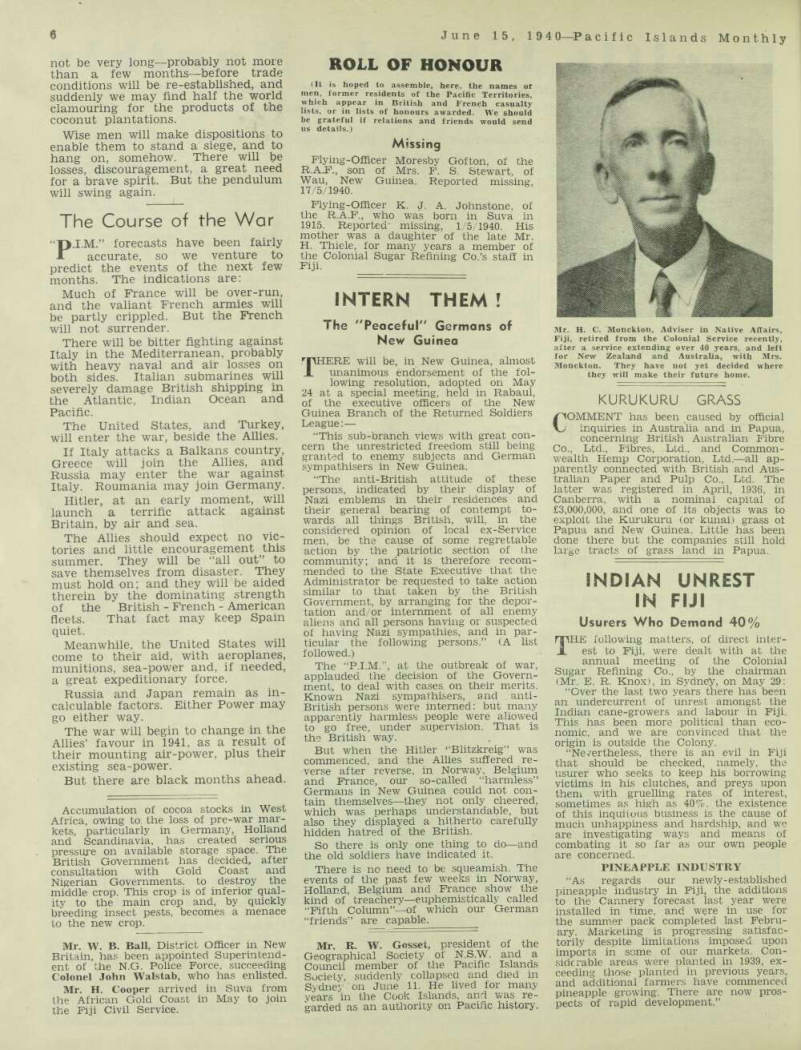
Mr. H. C. Monckton, Adviser in Native Affairs, Fiji, retired from the Colonial Service recently, after a service extending over 40 years, and left for New Zealand and Australia, with Mrs.
Monckton. They have not yet decided where they will make their future home.