Which Was Cook's
pp. 50-52 · Read in the full issue
Marae?
Fascinating Search Among Tahitian Ruins
By A. C. Rowland
MANY years ago—before the beginning of the Great War—Mr. J. A. Phil lips and the writer resolved to identify, if we could, the marae at which Captain Cook witnessed the offering of human sacrifice. This marae—so the. records showed —was somewhere in the district of Atehuru (the old name for the ter ritory now known as Punaauia and Paea) extending from the limits of Faaa to the borders of Papara.
The first object of our attention was, naturally, the great Marae Taputaoua tea at Punaauia. This marae, originally named Nuurua, had been reconsecrated a Taputapuatea marae, in comparatively recent times, by the deposit within its structure of a stone from the ancient marae of that name at Opoa, Ra’iatea.
It had, therefore, become a national marae for Tahiti Nui (Great Tahiti).
Reference is made to it in the Spanish padre’s diary—entry August 2, 1775: “In the morning the same Tahuas took up the bodies and carried them away to the district of Etahur (Atehuru) to offer them to their false god as a sacri fice for the health of the arii, in the marae of that district which is dedi cated for the purpose and where all those sacrificed are kept, and nine be sides. According to what the interpre ter, who has been to that marae, tells us, the number of victims these savage and inhuman people sacrifice in this way is large, for the place is full of bones.”
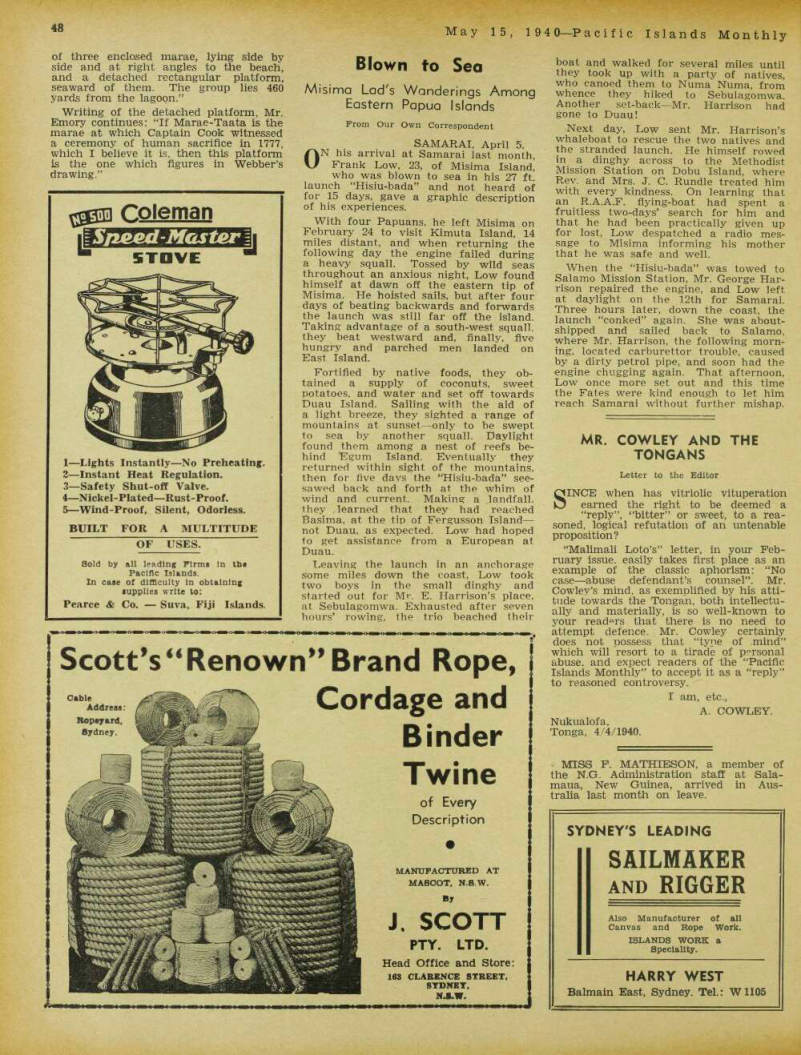
Ellis describes its pyramid: “That which formed one side of the square of the large temple at Atehuru, according to Mr. Wilson, by whom it was visited when in a state of preservation, was 270 feet long. 94 feet wide at the base, and 50 feet high, being at the summit 180 feet long and 6 feet wide. A flight of steps led to the summit; the bottom step was six feet high. The outer stones of the pyramid, composed of coral and basalt, were laid with great care, and hewn or squared with immense labour, especially the tiava, or corner stones.”
All this evidence would appear to settle the question that here, at the great place of human sacrifice at Atehuru, was where Cook witnessed the ghastly rites he records in his diary.
But we were not satisfied. Cook’s account places the site of the marae at a considerable distance inland; whereas the Atehuru Taputapuatea is hard by the seashore, on Punaauia Point.
Furthermore, Cook makes no mention of the massive pyramid So accurate an observer as Cook would certainly have mentioned such a structure had he seen it. In addition, Webber’s drawing of the scene, of which he was an eye-witness, pictures a low stone ahu, or pyramid, not over three feet in height.
For these reasons we were compelled to discard the Punaauia Point marae from consideration. 9 Mr. Sage, whose property adjoined the Punaauia site and who received us with kindly hospitality and assisted us in our search, conducted us to a marae, named Marae Tahiti, situated on terraces about a mile inland, in the Punaruu Valley. We saw there a number of leaning stones and an antique ti’i, carved in red stone,
and were hopeful that we had reached the object of our quest. The natives living in the vicinity, however, dashed our hopes by their assurances that this was a Marae Manahune (Temple of Common People) and that no human sacrifice could have been offered there.
Next, we passed a day in the jungles of the Orofere Valley, in search of a marae described to us by Mr. Tati Salmon as the probable one which Cook visited. Finally, we inspected the still perfectly preserved Marae Arahurahu.
None of them matched the specifications; so we gave up the quest.
Years later, when clearing the jungle from a tract of land called Vaiteahao, inland from Papehue, in Paea, the work men uncovered some extensive stone walls and platforms.
Happily. Mr. Kenneth P. Emory, of the Bernice P. Bishop Museum, was in the island at the time, and he was invited to inspect and study the discoveries.
His researches disclosed that here was a marae of great sanctity, of remote antiquity, and of tapu so strict that none but chiefs of the highest rank and most ancient lineage could enter there.
O Tu (Pomare First) —who had lately achieved a nominal ascendency over Tahiti Nui, but was not at the time of Cook’s visit firmly established in author ity over the proud, warrior high chiefs of Atehuru—was excluded from the inner sanctuary and was obliged to content himself with a place in an auxiliary marae, erected outside the limits of the ancient structure.
Mr. Emory, in the Bishop Museum Bulletin No. 116, describes this marae: "Marae Marae-Taata consists of a group
The great Marae Taputapuatea at Punaauia (Atehuru), Tahiti—the largest and most important single relic of a pagan religious system yet discovered in Polynesia.
The illustration is a reproduction from a drawing in "Missionary Voyage to the South Pacific", published in 1799, by Captain James Wilson, of the L.M.S. ship ‘"Duff". For many years after the occupation of Tahiti by Europeans, the marae remained in perfect condition, but in 1805 or thereabouts material was needed for bridge building nearby and the dressed stones on the outside of the temple were carted away, the consent of natives living in the district having been reluctantly given. The remainder of the marae, mostly limestone, was burned into lime and, to-day, nothing save an overgrown mound marks its site. The location of the marae referred to in the accompanying article, at which Captain James Cook saw a human sacrifice, was eventually discovered inland at Papehue, in Paea, some miles southwards from Punaauia, where the above Marae Taputapuatea stood.
of three enclosed marae, lying side by side and at right angles to the beach, and a detached rectangular platform, seaward of them. The group lies 460 yards from the lagoon.”
Writing of the detached platform, Mr.
Emory continues: “If Marae-Taata is the marae at which Captain Cook witnessed a ceremony of human sacrifice in 1777, which I believe it is, then this platform is the one which figures in Webber’s drawing.”