Wan
pp. 46-48 · Read in the full issue
By Helen Nurton.
WAN was a shining example of what a little black wife should be, and her husband, Kumda, was a shin ing example to the police force.
Each morn, at dawn, he would rise and shine his belts and buckles, and turn out at the sergeant’s whistle, a per fectly-impeccable policeboy. Whilst he was engaged at drill, or in the more important task of hoisting the Union Jack, in the flamboyant garden outside our District Office in New Guinea, Wan would cook his simple breakfast of boiled rice, or yams, over a smoky little fire, before strolling down to my bun galow for the day’s work.
Wan came from Nissan, that island link between the Solomon Islands and New Ireland, where the races of these respective islands met, and mingled.
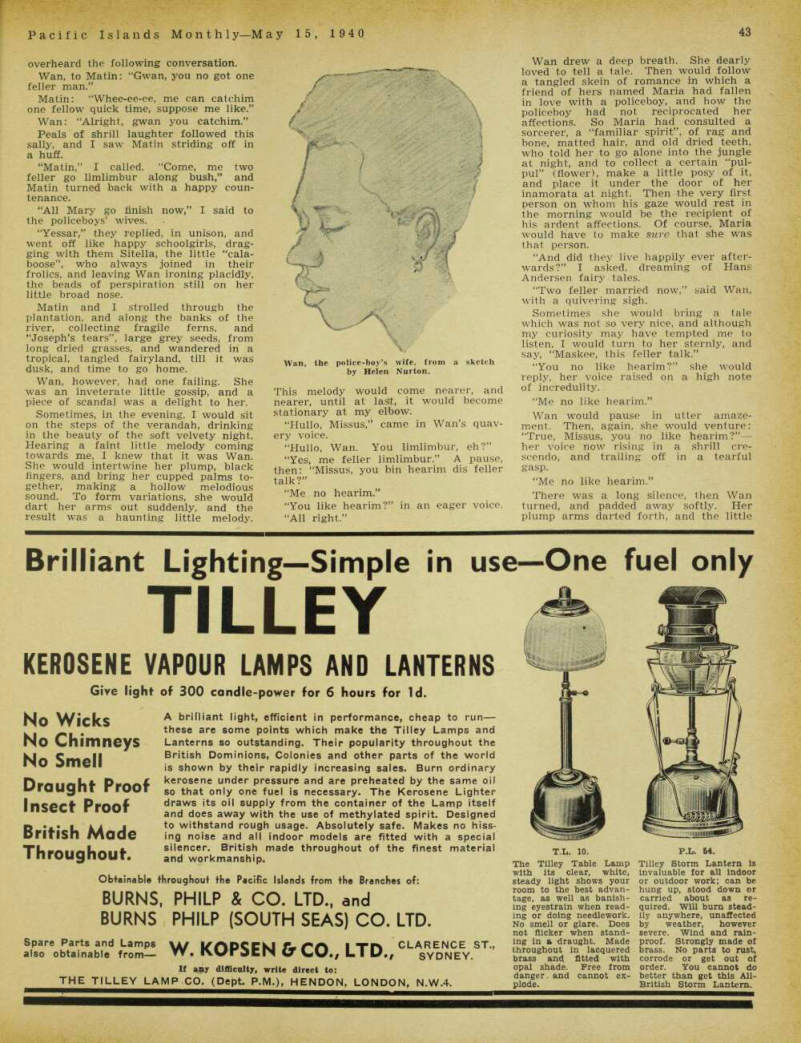
The Solomon strain was predominant in her, for she had a very black skin, unlike most New Irelanders, and close cropped hair, with tiny clusters of curls around her neck and ears, in which she wore small, brass, heart-shaped ear rings. Her nose was broad, and flat, and almost always bespangled with beads of perspiration.
She reflected an imperturbable calm, and serenity, a happy, contented smile, showing good, white teeth, and she pos sessed a voice with a decided “timbre” in it. Added to these characteristics, she invariably wore a clean starched blouse, with little frills over the shoulders, while her plump little black arms were adorned with mother-of-pearl bangles, so that altogether she was quite an ac quisition to the household.
If Wan was an example in her own sphere of life, and Kumda was an ex ample in his zone of action, their united relations certainly bore an appearance of exemplary harmony, and content, and one felt that this state of affairs had existed since their “walking out days”.
“How much Xmas you married now?”
I asked Wan, one day.
“Six feller,” she drawled. “Me lik-lik feller, and me married along Kumda.”
“You no married before along nother feller?” I asked.
“No got,” she shrilled indignantly. “Me married along Kumda, das all.”
Wan was such an excellent laundress that I gave her no other work. Patiently she would tend the boiling copper, bubbling with iridescent soap foam, rinse the clothes in many tubs of clean, fresh water, and hang them out care fully on the line beneath the swaying palm-trees. The following day would see her ironing in the wide, cool space beneath the bungalow. With a large box-iron filled with glowing coconut shell, she would put a satin sheen on damask and linen, while the frocks of the Missus would be ironed with meticu lous care, carried up above, one by one, and draped gracefully around the bed posts in the bedrooms.
Wan would often hold a conversazione under the bungalow while she was working. Here would foregather quite a number of her friends —Matin, who was a single lady at large; the ser geant’s wife; two or three policeboys’ wives; and sometimes Sitella, the little “calaboose” Mary. Oftimes their cheer ful chatter would be a solace to my lonely ear.
A good-natured rivalry existed between Wan and Matin, and one afternoon, I
overheard the following conversation.
Wan, to Matin: “Gwan, you no got one feller man.”
Matin: “Whee-ee-ee, me can catchim one fellow quick time, suppose me like.”
Wan: “Alright, gwan you catchim.”
Peals of shrill laughter followed this sally, and I saw Matin striding off in a huff.
“Matin,” I called. “Come, me two feller go limlimbur along bush,” and Matin turned back with a happy coun tenance.
“All Mary go finish now,” I said to the policeboys’ wives.
“Yessar,” they replied, in unison, and went off like happy schoolgirls, drag ging with them Sitella, the little “cala boose”, who always joined in their frolics, and leaving Wan ironing placidly, the beads of perspiration still on her little broad nose.
Matin and I strolled through the plantation, and along the banks of the river, collecting fragile ferns, and “Joseph’s tears”, large grey seeds, from long dried grasses, and wandered in a tropical, tangled fairyland, till it was dusk, and time to go home.
Wan, however, had one failing. She was an inveterate little gossip, and a piece of scandal was a delight to her.
Sometimes, in the evening, I would sit on the steps of the verandah, drinking in the beauty of the soft velvety night.
Hearing a faint little melody coming towards me, I knew that it was Wan.
She would intertwine her plump, black fingers, and bring her cupped palms to gether, making a hollow melodious sound. To form variations, she would dart her arms out suddenly, and the result was a haunting little melody.
This melody would come nearer, and nearer, until at last, it would become stationary at my elbow.
“Hullo, Missus,” came in Wan’s quav ery voice.
“Hullo, Wan. You limlimbur, eh?”
“Yes, me feller limlimbur.” A pause, then: “Missus, you bin hearim dis feller talk?”
“Me no hearim.”
“You like hearim?” in an eager voice.
“All right.”
Wan drew a deep breath. She dearly loved to tell a tale. Then would follow a tangled skein of romance in which a friend of hers named Maria had fallen in love with a policeboy, and how the policeboy had not reciprocated her affections. So Maria had consulted a sorcerer, a “familiar spirit”, of rag and bone, matted hair, and old dried teeth, who told her to go alone into the jungle at night, and to collect a certain “pul pul” (flower), make a little posy of it, and place it under the door of her inamorata at night. Then the very first person on whom his gaze would rest in the morning would be the recipient of his ardent affections. Of course, Maria would have to make sure that she was that person.
“And did they live happily ever after wards?” I asked, dreaming of Hans Andersen fairy tales.
“Two feller married now,” said Wan, with a quivering sigh.
Sometimes she would bring a tale which was not so very nice, and although my curiosity may have tempted me to listen. I would turn to her sternly, and say, “Maskee, this feller talk.”
“You no like hearim?” she would reply, her voice raised on a high note of incredulity.
“Me no like hearim.”
Wan would pause in utter amaze ment. Then, again, she would venture: “True, Missus, you no like hearim?” — her voice now rising in a shrill cre scendo, and trailing off in a tearful gasp.
“Me no like hearim.”
There was a long silence, then Wan turned, and padded away softly. Her plump arms darted forth, and the little
Wan, the police-boy’s wife, from a sketch by Helen Norton.
melody would start all over again, grow fainter and fainter till all that was left was the utter stillness of the velvety night.
And, lifting up my eyes, I behold the celestial realm ablaze with points of light. Gone was the dance of daily life; the heat of the day, the dusk, and the swaying palms; Wan, Kumda, the wash tubs, the boiling copper; the haunting little melody, and all the hurly-burly of the household. Deeper, and deeper I behold the nebulae receding—receding.
Now and again a star breaks loose from its moorings, and takes a fiery plunge into the Stygian darkness of the un known. Anon, and another breaks loose, leaving a misty iridescent trail, and a velvet void. Another, and yet another, till, forgetting time, the Heav ens seem just a shower of stars.
Wan is again at my elbow. “Missus, plenty lamp belong God fall down to night,” she says.
MR. PAT. COSTELLO, of Suva, who had been spending a few weeks in Aus tralia, returned to Fiji at the end of April.
MR. K. M. NETTLESHIP, of the staff of the Department of Customs, New Guinea, who has been in Australia on furlough, has enlisted in the A.1.F., and at, present is in camp at Ingleburn,
N.S.W.
MR. F. HAYWARD, formerly of Orange N.S.W., has joined the staff of W. R Carpenter and Co., Ltd., Wau, N.G.
MR. P. J. DOYLE has joined the Mel anesian Mission as school teacher at Pawa, Ugi, Solomon Islands.