Fishing
pp. 42-44 · Read in the full issue
New Ways Of
Happy Hours With Natua, of Tahiti
By W. G. Burchett
NO matter what else the Tahitian may have for his meal, he is sure to have fish; and, at big Tahitian feasts, several courses are provided by fish prepared in various ways.
A favourite dish is poisson cru, or raw fish, prepared with lime-juice, and served with a sauce made from shell fish and coconut cream. Sometimes, it is served in salad form, with finely chopped-up raw cabbage. But, in what ever way it is dished up, it is always delicious, and so light that one can eat enormous quantities without discomfort.
In Tahiti, one eats fish of every con ceivable colour, shape and size—raw, baked, fried, boiled or cooked in the native oven —at least once a day.
I was surprised, one day, by the fish erman who lived next door to me. He had worked much harder than usual and caught a lot of fish. I said to him, jokingly, “Hallo, Natua! You’ve got a lot of fish there. Are all your relatives coming to have dinner with you?”
Natua grinned: “Yes, plenty fish all right. I send ’em to friends at Tautira.”
Tautira was at the other end of the island and I couldn’t understand why he sent fish there, because it is one of the best fishing-grounds in Tahiti.
“Your friends are no-good fishermen, eh!” I asked.
“Ah, plenty storm at Tautira last night. Big storm, no fish. Tahiti man can’t live without fish, so I send plenty down to my friends.”
Natua was a fluent orator in his own language, but, like so many of the older natives, he had learned very little French, and he was very economical, even with the few words he knew. It was just typical of Tahitian generosity that he considered it quite the natural thing to send fish to his friends, on the slightest suspicion that they had none. rE ways of catching the fish are as numerous as the varieties to be caught. The Tahitians spear them, net them, entice them to jump into their canoes at night with a bright light.
They fish for them with rod and line in the dangerous waters of the reef, and the more adventurous spirits go far out beyond the reef to the open Pacific, and trawl for the giant tunny fish.
At certain phases of the moon, the women wade out into the lagoon, and stand for hours at a time, fishing with rod and line, for a certain type of mackerel.
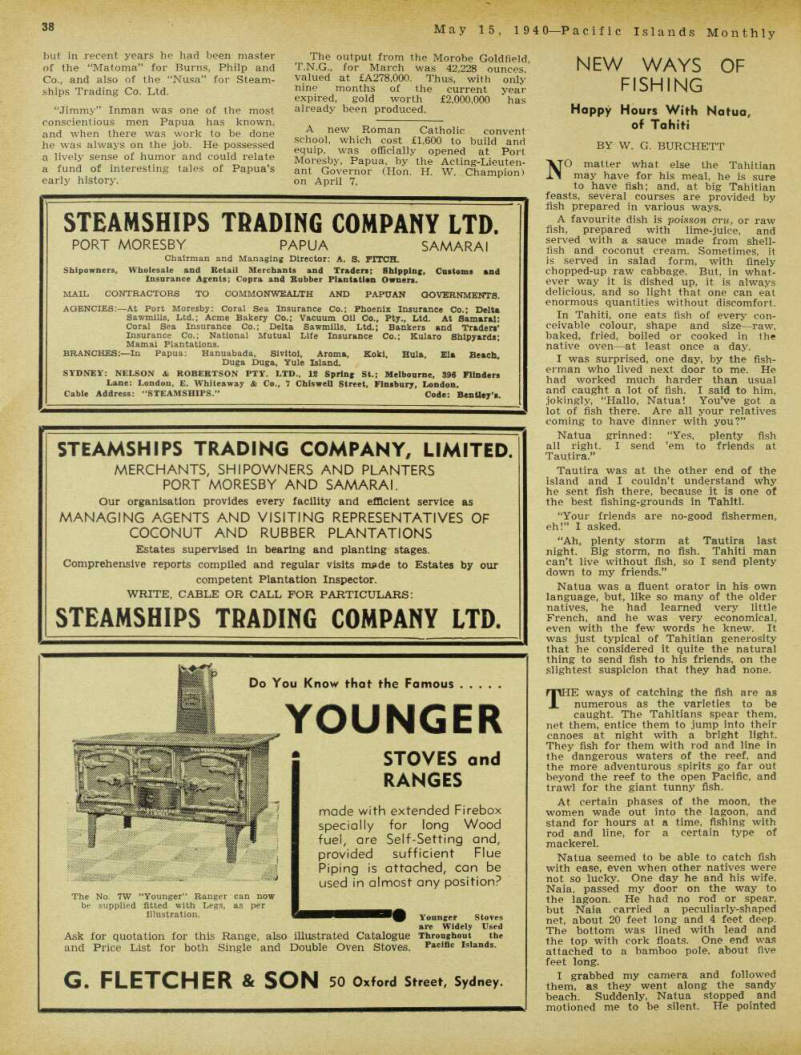
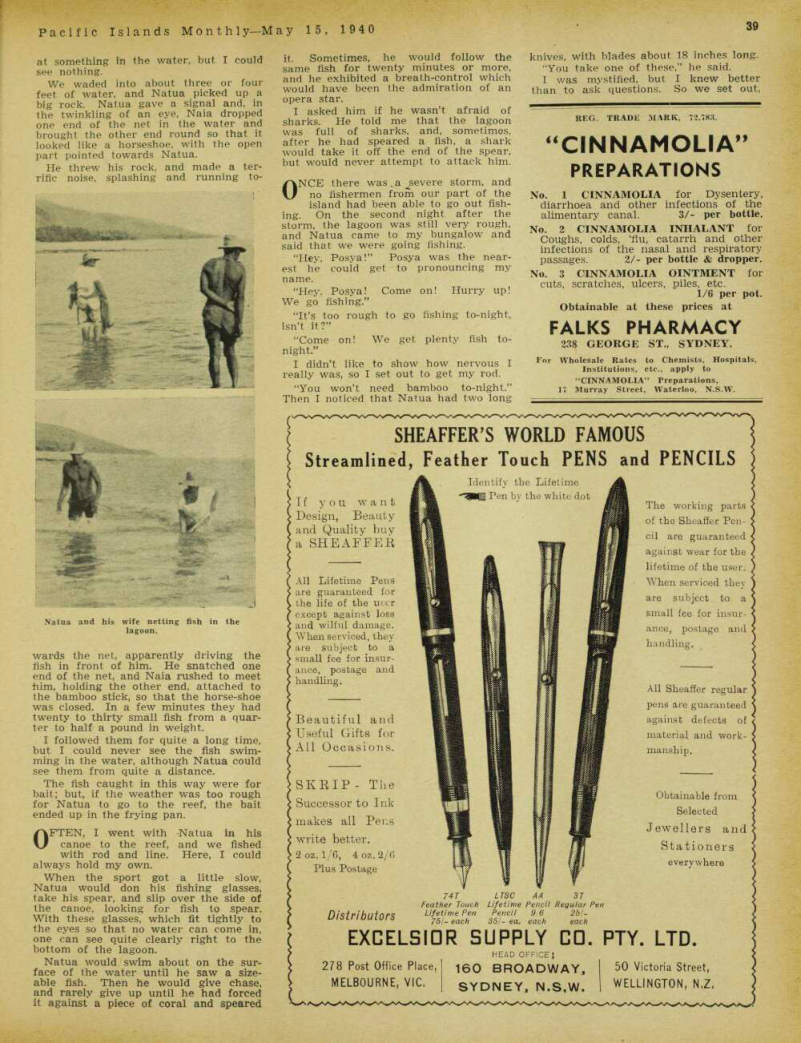
Natua seemed to be able to catch fish with ease, even when other natives were not so lucky. One day he and his wife, Naia, passed my door on the way to the lagoon. He had no rod or spear, but Naia carried a peculiarly-shaped net, about 20 feet long and 4 feet deep.
The bottom was lined with lead and the top with cork floats. One end was attached to a bamboo pole, about five feet long.
I grabbed my camera and followed them, as they went along the sandy beach. Suddenly, Natua stopped and motioned me to be silent. He pointed
at something in the water, but I could see nothing.
We waded into about three or four feet of water, and Natua picked up a big rock. Natua gave a signal and, in the twinkling of an eye, Naia dropped one end of the net in the water and brought the other end round so that it looked like a horseshoe, with the open part pointed towards Natua.
He threw his rock, and made a ter rific noise, splashing and running to-
wards the net, apparently driving the fish in front of him. He snatched one end of the net, and Naia rushed to meet him, holding the other end, attached to the bamboo stick, so that the horse-shoe was closed. In a few minutes they had twenty to thirty small fish from a quar ter to half a pound in weight.
I followed them for quite a long time, but I could never see the fish swim ming in the water, although Natua could see them from quite a distance.
The fish caught in this way were for bait; but, if the weather was too rough for Natua to go to the reef, the bait ended up in the frying pan.
OFTEN, I went with -Natua in his canoe to the reef, and we fished with rod and line. Here, I could always hold my own.
When the sport got a little slow, Natua would don his fishing glasses, take his spear, and slip over the side of the canoe, looking for fish to spear.
With these glasses, which fit tightly to the eyes so that no water can come in, one can see quite clearly right to the bottom of the lagoon, Natua would swim about on the sur face of the water until he saw a size able fish. Then he would give chase, and rarely give up until he had forced it against a piece of coral and speared
it. Sometimes, he would follow the same fish for twenty minutes or more, and he exhibited a breath-control which would have been the admiration of an opera star.
I asked him if he wasn’t afraid of sharks. He told me that the lagoon was full of sharks, and, sometimes, after he had speared a fish, a shark would take it off the end of the spear, but would never attempt to attack him.
ONCE there was,a storm, and no fishermen from our part of the island had been able to go out fish ing. On the second night after the storm, the lagoon was still very rough, and Natua came to my bungalow and said that we were going fishing.
“Hey, Posya!” Posya was the near est he couid get to pronouncing my name.
“Hey, Posya! Come on! Hurry up!
We go fishing.”
“It’s too rough to go fishing to-night, isn’t it?”
“Come on! We get plenty fish to night.”
I didn’t like to show how nervous I really was, so I set out to get my rod.
“You won’t need bamboo to-night.”
Then I noticed that Natua had two long
knives, with blades about 18 inches long.
“You take one of these,” he said.
I was mystified, but I knew better than to ask questions. So we set out,
Natua and his wife netting fish in the lagoon.
armed with two long knives, a strong acetylene lamp, and his son with a kerosene tin. We waded out into the lagoon, and Natua shone the light in front of him on the fairly rough water. Suddenly, he swished downwards with his knife, and almost immediately grabbed at something and threw it on the shore, He swung the light around, and there flapping on the sand, was a glistening, headless, silvery fish. The boy picked it up without a word and put it in the kerosene tin. For an hour and a half,
we waded up and down the beach.
After a while, my eyes got almost as keen as Natua’s, and every now and again I could see hundreds of fish swim ming about on top of the water. I got quite a number with my knife, but I usually cut them in half, whereas Natua neatly decapitated them.
Once the water fairly hissed with what appeared to be green snakes, which wriggled away at incredible speed. Even Natua became excited, and smote right and left with all his force. We both
slashed and struck mightily for a few minutes, and had to enlist the aid of his son to come and pick up the fish as we hit them. When we had finished, Natua told me that we had been very lucky, as these green eels were excellent eating.
Sometimes, Natua would roar out a warning, and I would make a dash for the shore, only to get hit in the middle of the back with a heavy breaker.
It was rather an eerie experience.
Little more than half a mile away, the Pacific Ocean, with heavy roar, was pounding away on the coral reef bor dering the lagoon. The night was pitch black, lightened only by the rays of Natua’s lamp, sweeping the waters like a searchlight. Every now and again an extra big wave would nearly lift us off our feet, to crash on to the shore behind us and rush back down the bank with a frightening, sucking noise.
Natua rarely spoke, except to call out some sharp command in Tahitian to his son with the kerosene tin. I enjoyed the experience, but was glad when Natua decided that we had enough fish, and I was able to go home, satisfied that I had taken part in the strangest fishing experience of my life.
ONE could not wish for a better man, or truer comrade, than Natua.
Everything that he did, and that means everything that was necessary to support his primitive life, he did per fectly.
How many times did I admire his skill, as he fitted an outrigger to his canoe, or as he shaped a canoe paddle. Per haps, most of all, I admired him as I watched him “marrying” the flower of the vanilla plant. With a tiny stick, he opened the female part of the flower and injected the pollen from the sta men, with the same certainty and deli cacy of touch as a famous surgeon might employ in an intricate operation.
Natua exemplified that which was best in the Tahitian. Living far from the town, he divided his time between his vanilla and coffee plantations in the mountains, and the sea. Apart from a few simple tools, such as knives and lamps, he lived quite independent of “civilisation”. Even if Tahiti should become cut off from the rest of the world, life for Natua would go on sub stantially the same, and he would exist as his forefathers had done hundreds of years before.