Exploring Unknown N. Guinea
pp. 36-41 · Read in the full issue
Supplies by Air for the Taylor-Black Patrol— Discoveries and Observations—Police Party Attacked at Wabag
Section 111. Of Official Report
(This is the Third Section of the Preliminary Report on the patrol carried out in Central New Guinea by Assistant District Officer J. L.
Taylor, Patrol Officer John Black and Medical Assistant C. B. Walsh, in 1938-39 .) IMMEDIATELY on arrival at Hoiyevia, steps were taken to prepare a landing ground for aircraft, as I could not undertake the examination of the country towards the Dutch boundary, and the re turn of the main body of the patrol to the Sepik water-shed, without further sup plies of rice and biscuits. A dash could be made to Mt. Hagen, but that would mean dumping our equipment and per haps disaster. It would mean travelling over sparsely-populated areas for long hours, day after day, on short rations, or nothing at all. People who would treat us well while we were strong enough to look after ourselves, might become bitter enemies if they thought we were fugitive.
The site chosen was adjacent to the camp, and was about 450 yards long by 30 to 40 yards wide. The approaches were good and the area adequate, in my
cpinion. The surface required a lot of attention, as it was old garden land, across which ran many of the deep trenches or drains, which are peculiar to these parts.
We told the local inhabitants what we were doing, and why. They appeared in terested though some were fearful, and several assisted in the work. After ten days, the ground was fit to receive aero planes carrying up to 1,000 lb., providing that they were sufficiently powered to take off quickly—preferably a De Havi land 50, with 450 h.n. engines. The ground was superior to those prepared by us in 1933 at Wahgi and Mt. Hagen.
We were in wireless communication with Mr. R. Melrose (Director of District Services) concerning air transport of stores, and he gave us the full benefit of his great organising capacity throughout the patrol.
On May 20 the Administrator spoke to us from the Government vessel “Sirius”, off Avatip, 200 miles or so up the Sepik River, saying that we were to have what stores we required. When I informed the police that the Administrator had spoken and was sending supplies, they replied, “Our father is good. He remembers us.”
Directions were given by radio to Guinea Airways. Ltd., so that we might be easily located from the air.
On May 27 at 9.30 a.m. in perfect weather, a silver and red Stinson mono plane was sighted coming up from the east. It circled around us, and flew leisurely down the ’drome. The Admini strator could be seen clearly, waving to us from the cabin.
The police detachment on parade, with bayonets fixed, waited to salute the Ad ministrator should he land. Our carriers and local natives lined the landing. As the plane passed the carriers cheered with great zest, whilst the local people sat or crouched, silent in amazement.
It was a sight that gladdened our hearts. The weather was perfect, like a spring day in Sydney or the British Isles, and the plane gleamed in the sunshine.
It meant that our anxiety about food sup plies would soon be ended.
We were prepared for the machine to land. Smoke signals to indicate the wind direction were put along the edge of the ground, a white line marked the landing end, and the runway was defined by the soft heart of the mountain palm, laid in straight lines along each side of it.
After circling twice, and flying around the valley, a mailbag was dropped con taining a note from the Administrator, and the plane departed.
We were disappointed that it did not land, but it was wiser, probably, not to do so in the circumstances. There would have been danger in taking off, except in a very highly-powered machine.
On the return of the Administrator to Madang, he had the arrangement to drop stores to us brought to a swift conclu sion, and on Tuesday, May 31, Guinea Airways Ford monoplane arrived and dropped supplies. Benzine was landed by parachute and several thousand pounds
of cargo were delivered almost without damage during the next few days.
The parachutes were thrown out first, at an altitude of 500 ft. and, except in two or three instances, descended gracefully to the ground. The plane then circled and came to within about 200 ft. of the ground. A chute had been constructed at the entrance to the main cabin on the starboard side. The crew could be seen clearly getting the stores into position and pushing them down the chute.
It was a thrilling performance. Each time the machine with its three engines roared down the clearing in front of the camp, rice, flour, axes and goods of all descriptions came hurtling to the ground, With cheers, our porters rushed forward, collected the goods and then stood clear awaiting the next discharge.
The local people sat in awe and won derment, their eyes wide open at the sight. To them, the aeroplane was a mes senger from the heavens, bringing food to spirits who had become stranded on earth.
Some old men actually told us by signs that they were ready to depart with us to our world above. It surprised them, I think, to find us living a pleasant and apparently happy life, for in the minds of the people of many New Guinea corn munities man is thought to be higher and happier than the angels, One parachute did not open, and the package, weighing about 50 lb., fell with in a few feet of us. A few moments be fore this I had said to Black that it would be useless to try to dodge a falling pack, but I dodged successfully, as did Black, Had we remained standing where we were
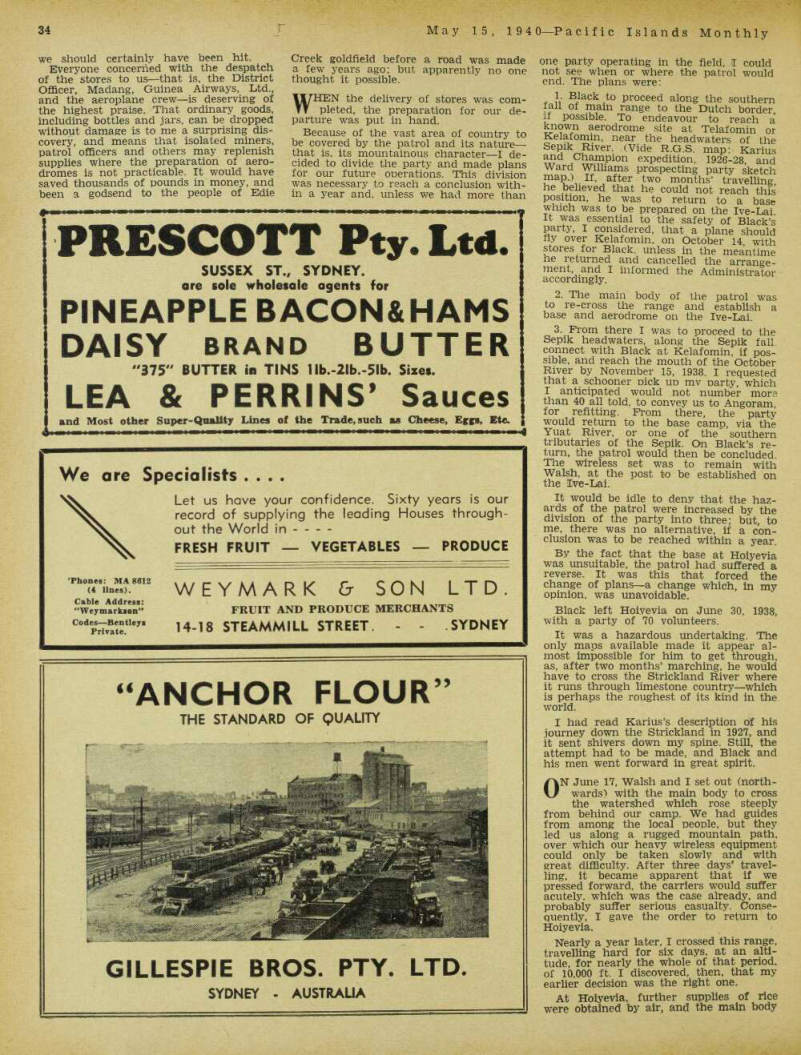
Locality plan showing the region traversed by the Taylor-Black patrol—west by north from Mt. Hagen to Talafomin, at the head of the Sepik River; thence down the May River to the main Sepik; then up the Karawari and over the mountains to Wabag and Mt. Hagen.
we should certainly have been hit.
Everyone concerned with the despatch of the stores to us—that is. the District Officer, Madang, Guinea Airways, Ltd., and the aeroplane crew—is deserving of the highest praise. That ordinary goods, including bottles and jars, can be dropped without damage is to me a surprising discovery, and means that isolated miners, patrol officers and others may replenish supplies where the preparation of aerodromes is not practicable. It would have saved thousands of pounds in money, and been a godsend to the people of Edie
Creek goldfield before a road was made a few years ago; but apparently no one thought it possible.
IIfHEN the delivery of stores was com \f pleted, the preparation for our de parture was put in hand, Because of the vast area of country to be covered by the patrol and its nature that is. its mountainous character—l de cided to divide the party and made plans for our future ©Derations. This division was necessary to reach a conclusion with in a year and, unless we had more than
one party operating in the field, I could not see when or where the patrol would end. The plans were: 1. Black to proceed along the southern tall of mam range to the Dutch border, n possible. To endeavour to reach a known aerodrome site at Telafomin or Kelafomin, near the headwaters of the Sepik River. (Vide R.G.S. map: Karius Campion expedition, 1926-28, and Ward Williams prospecting party sketch map.) if, after two months’ travelling he believed that he could not reach this position, he was to return to a base which was to be prepared on the Ive-Lai It was essential to the safety of Black’s party, I considered, that a nlane should fly over Kelafomin. on October 14 with stores for Black, unless in the meantime he returned and cancelled the arrange ment, and I informed the Administrator accordingly. 2. The main body of the patrol was to re-cross the range and establish a base and aerodrome on the Ive-Lai. 3. From there I was to nroceed to the Sepik headwaters, along the Sepik fall connect with Black at Kelafomin, if pos sible, and reach the mouth of the October River by November 15, 1938. I requested that a schooner nick un mv narty, which I anticipated would not number more than 40 all told, to convey us to Angoram, for refitting. From there, the party would return to the base camp, via the Yuat River, or one of the" southern tributaries of the Sepik. On Black’s re turn, the patrol would then be concluded The wireless set was to remain with Walsh, at the post to be established on the Ive-Lai.
It would be idle to deny that the haz ards of the patrol were increased by the division of the party into three; but, to me, there was no alternative, if a con clusion was to be reached within a year.
By the fact that the base at Hoiyevia was unsuitable, the patrol had suffered a reverse. It was this that forced the change of plans—a change which, in my opinion, was unavoidable.
Black left Hoiyevia on June 30, 1938, with a party of 70 volunteers.
It was a hazardous undertaking. The only maps available made it appear al most impossible for him to get through, as, after two months’ marching, he would have to cross the Strickland River where it runs through limestone country—which is perhaps the roughest of its kind in the world.
I had read Karius’s description of his journey down the Strickland in 1927, and it sent shivers down my spine. Still, the attempt had to be made, and Black and his men went forward in great spirit.
ON June 17, Walsh and I set out (north wards) with the main body to cross the watershed which rose steeply from behind our camp. We had guides from among the local people, but they led us along a rugged mountain path, over which our heavy wireless equipment could only be taken slowly and with great difficulty. After three days’ travel ling, it became apparent that if we pressed forward, the carriers would suffer acutely, which was the case already, and probably suffer serious casualty. Conse quently, I gave the order to return to Hoiyevia.
Nearly a year later, I crossed this range, travelling hard for six days, at an alti tude, for nearly the whole of that period, of 10,000 ft. I discovered, then, that my earlier decision was the right one.
At Hoiyevia, further supplies of rice were obtained by air, and the main body
of the patrol returned to the valley of the Gai, or Ive-Lai (which is the Yuat headwaters) by the mountain pass through which we had come in April and early May.
At Wabag, on the high terrace above this river, a landing ground for aircraft was prepared. Friendly relations were established with the local people, who ex pressed pleasure at our staying among them.
SOME of the most noticeable features observed on the journey to and from Hoiyevai were: 1. The system of drains, or sunken roads, which may be likened to the elaborate trench systems of Northern France during the war 1914-18, it being possible to travel for miles a few feet below the surface of the ground. These works are primarily for defence purposes, but also protect sweet potato crops from the ravages of village pigs, and produce an effective drainage system. 2. The wearing of elaborate wigs made of human hair. These are made in three shapes—Cossack, resembling the head dress worn by Cossacks and, more re cently, the Trans-Jordan Police Force, Napoleonesque, resembling slightly Napo leon's hat; and the mop, or pudding basin type. Every man aims to have at least one of these wigs made of his own hair, in a lifetime, and pays professional wig-makers for their services. 3. The varietv of orchids. 4. A bird of paradise with long white tails. This has since been described by Mr. J. R. Kinghorn, C.M.Z.S., of the Aus tralian Museum, and he states that it is a new genus and has called it “McNicoll’s Ribbon-tailed Bird of Paradise”, in honour of the N.G. Administrator. 5. The fine type of native dog, with a tail like a fox-brush, was conspicuous. 6. The value of pigs and gold-lip shells.
It is possible that they are the bride price, or principal marriage gift. 7. The custom among the Lagaip River people, of men and women walking about arm-in-arm, as may be seen in European communities. 8. The carrying of large net bags by the men. 9. The disposal of the dead. The dead are placed in coffins on a pedestal about 5 ft. from the ground. 10. The lack of trading among some groups. Some are keen traders. To others, barter and exchange appear to be com pletely foreign; and, later, I discovered that the reason for this was that they thought we were spirits and our shell money not real, but magical. When they realised that we were men, they traded freely and were keen to buy our shells. 11. Pan pipes carried by the men which, when blown into, gently emit a faint sound which, I believe, musical people call a minor key—like the sighing of wind in the trees. 12. The craving for tobacco. The people from childhood are inveterate smokers. 13. The pig exhibitions, in which great numbers of pigs are given by one group to another, in reward for assistance in tribal war. 14. The extraction of salt from salt springs, where vessels suitable for dis tillation (that is, pots) are absent. This is done by burning absorbent wood, which has previously been saturated with the salt liquor. The resultant ash is highly esteemed by people near and far; and, in exchange for stone axes manufactured in the Mt. Hagen area, forms the greatest
mercantile business of the people of Central New Guinea. Beaver, the Papuan officer, noticed axes with heads of the stone similar to that found at Mt. Hagen, in the Sambarigi region, in 1911.
IN August, I communicated with the Administrator by radio, and advised him of the necessity for making some aerial reconnaissance over the country between Wabag and the Sepik head waters, because it was my considered opinion that this was essential for the safety of the patrol, and it would be holding hostages to fortune to undertake it without an examination of the country from the air in the first instance.
The Administrator concurred, and the flights were carried out in a 3-engined Ford —Mr. T. O’Dea. pilot, with myself and the native police as observers. I wanted them to see the country from the air, and they were keen to do so. Un fortunately, they found it difficult to equate to ground conditions what they saw from the air, though they missed little or nothing, and on return they were all of the opinion that the journey could not be done. I was not too sure, myself, but that did not matter, and on August 36, the heavily-laden caravan, each man carrying 50 lb. and an additional ration of 12 lb. of rice, set off.
The inhabitants of Wabag, with whom
we appeared to be on exceedingly friendly terms shook hands, The headman was in tears at our departure. Three days later he attacked my police, who were left behind, killing Gershon, the boy bugler, and wounding several others.
I take full responsibility for this incident, as I am afraid that I should have obtained police reinforcements for Wabag before my departure. But I had been working in this upland area for many years, with a minimum number of police, and had found small police parties to be more efficient.
The party which was attacked, I was informed later, had visited a local group for the purpose of buying pigs. This had always been the custom in the upland areas, and had never before been the cause of any difficulty or unpleasantness, Though the highland people value pigs
greatly, they value gold-lip shell more, and are happy to dispose of their pigs, provided that they are paid in shell money. I had intended to give Gershon special training in musketry, as, being a bugler, he knew little about it, but I had refrained from doing so for fear of the local people ’ anci this was ® In the affray that occurred, two native constables and four carriers were wounded, and eleven natives were killed, an d several wonded. All the wounded re covered.
Mr. Edward Taylor, District Officer of Morobe, flew to the scene and dealt with the matter with his customary tact and skill, and in a few days friendly relations were restored.
The part played by Sergeant Fokinau, the senior non-commissioned officer at Wabag post, is worthy of notice, and I
wish to express mv admiration of his good conduct and bravery. Walsh, in his report on the matter, says: “Sergeant Fokinau, with a couple of carriers, went to the assistance- of the attacked party and, by making a diversion at the rear of the natives, enabled the police and carriers to make their way back. By this action Sergeant Fokinau undoubtedly saved the party, and also the personnel remaining at the camp from total extinc tion.” 11THILE crossing the head of the Logaiyu it (one of the Strickland head-waters) early in October, I nearly met with disaster. There being no bridge, it be came necessary to cross on a rone and pulley, the police and carriers us’ing an improvised chair arrangement after the manner in which a breeches buoy is used in rescuing people from shipwreck, and the stores and equipment were in slings.
The pulley, or traveller, used, was a pair of handcuffs. A strong rope of cane was suspended across the river and it be came necessary to test it. I then travelled over it hand over hand and leg over leg, lying horizontally under the rope.
To my utter dismay, when over mid stream. I discovered that I could not go forward or backward. For a few moments, I hung by my legs, in order to allow my arms to regain their strength, but my oiled top boots soon caused me to lose my grip and I dropped like a stone into the torrent.
I knew that my police would risk their lives to get me out. and that I should not go without a struggle. Being used to turbulent water, fl held my breath, and instinctively made for the opposite side of the stream from which I had come.
I was still under water when my hand struck something. It was Constable Karo, who- had dived, almost on top of me.
When he came to the surface I had reached shallow water, and come up for air.
A narrow escape, and one which made me realise my responsibilities to the others, the police and carriers. If I were lost, it might mean the destruction of the party.
A lake was found in the vicinity of the meridian 142 degrees 30 minutes which may rival Killarney for beauty. Kopiago was its name.
On October 27, the Strickland was reached, and a start made to build a sus pension bridge across the stream, which was nearly 80 yds. wide, and in a deep gorge, the mountains towering above It on each side for several thousands of feet. It is one of the deepest chasms in New Guinea. The water level where we were attempting the crossing was only 1,250 ft. above sea level.
When here, we found tracks, made ap parently by Black’s party, as he had crossed the Strickland, but his bridge had been swept away. We hoped that he had reached Kelafomin, but this was at this stage by no means certain. The position of the crossing was approximately 142 degrees 15 minutes E. longitude.
A fine bridge was built, and the party crossed without accident, and began ascending the steep slopes of the Victor Emmanuel Range. The climb here was the most difficult that I had known, but I was greatly aided by the sharp alpine spikes, which are made for ice work, in my boots. The track was over short grass, which grew on crumbling lime stone shale, which caused one to slip back a little at each step.
I wondered how Black had got on. He told me, later, that his marrow froze as
he climbed this 2,000 ft. mountain side without a handhold. It was every man for himself. If one slipped no one could assist him—he must go to the bottom, unless he could save himself by his own efforts.
I crossed and re-crossed the Victor Emmanuel Range, at 11,500 ft. above sea level, and reached the source of the Sepik, the Ok Takin, at the end of No vember, A few days later I was at Kelafomin, where I met Black. He had done splendid work in this area, and was much liked by the local people, who were of an en tirely different culture from those of eastern New Guinea. These tribes, dis tinctive by the fact that they wear penis gourds or capsules, extend hundreds of miles westerly to the Nassau Mountains and Dutch New Guinea, and inhabit the northern and southern slopes of the main range.
His police and carriers were in excel lent condition, despite the fact that an epidemic of malaria had occurred amongst them after leaving the low levels of the Strickland, Crossing the Victor Emmanuel Range, we were several days without food, and our rice was nearlv soent. but during the last few weeks I had bought several sago palms from natives where we had camped, and we had stayed and prepared sago flour. At our foodless camps, sago was issued, and sago dumplings and pan cakes prepared. These saved the situation, and enabled us to reach the populated valleys near the source of the Sepik. (To he Concluded in June ) Mr. J. Allrich arrived at Wau, New Guinea, from Australia in April to join the staff of Greenwood and Laws, Ltd.