Oil In Dutch
p. 11 · Read in the full issue
N. Guinea
PRELIMINARY exploratory drilling has proved the existence of oil in Dutch New Guinea (says Sydney “Telegraph" of April 24).
Exploration in Dutch New Guinea is carried on by a company in which Brit ish, Netherlands and American investors are interested.
Two shallow wells were successfully completed at approximately 500 ft., in Dutch New Guinea last year. Each was capable of yielding approximately 2,000 barrels (300 tons) per day, of 20 degrees gravity, crude oil.
Two deep test wells are in progress, and one now drilling at around 5,000 ft. passed up a showing of oil which gave strong indications of commercial poten tialities around 3,200 ft.
In 1939, 68,507,000 barrels, or 8,770,000 tons of oil were produced in the Nether lands East Indies (exclusive of Dutch New Guinea). This represented 3.30 per cent, of world production.
Opening Up New Country
A DUTCH Patrol Officer, Mr. Stuber, who entered the Dutch Colonial Service in 1936, at the age of 60, has been doing good work in opening up the country south of Humboldt Bay —which is on the northern coast of Dutch New Guinea, near the Australian frontier.
Mr. Stuber. with native police, pene trated some fifty miles into the unknown country to the south of Humboldt Bay, constructed about 100 miles of horse track, and established permanent police stations in the region.
This, of course, is the district which was examined last year by Mr. Richard Archbold’s American Natural History Expedition, with the huge flying-boat “Cuba" —but Mr. Stuber appears to have operated some distance to the eastward of the American expedition’s location.
Mr. C. H. Sturgeon, engineer in charge of A.W.A.’s transmitting station at Rabaul, T.N.G., enlisted in the A.I.F, in Melbourne early in May.
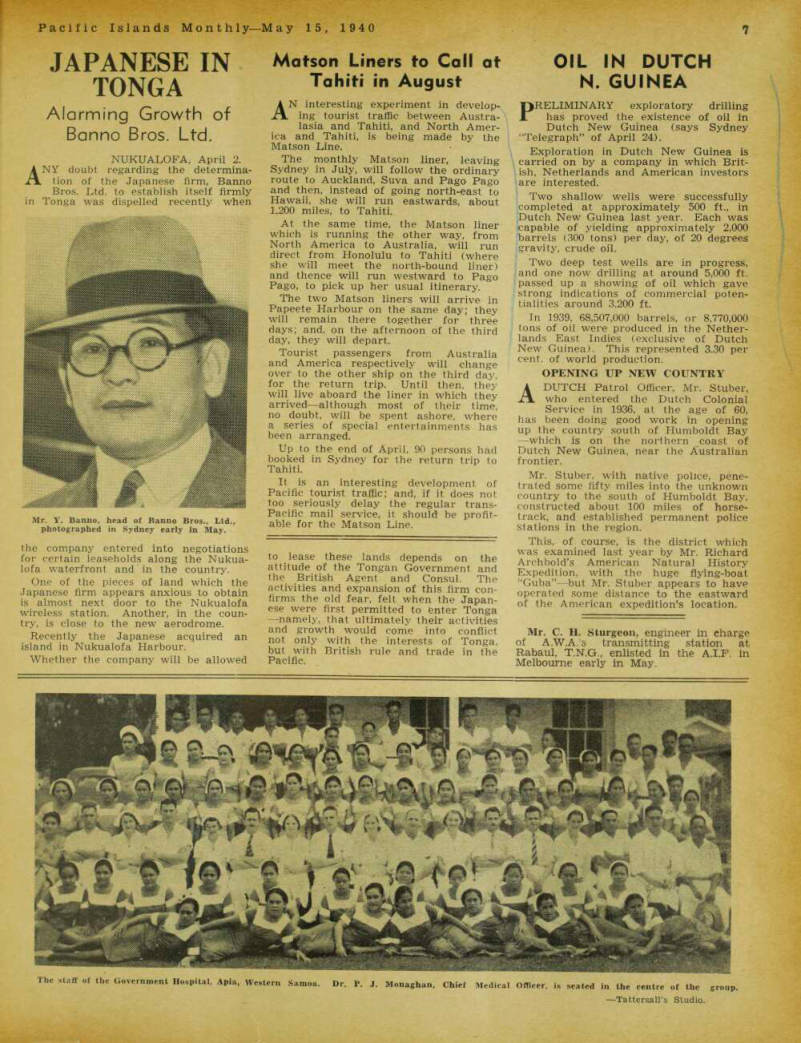
The staff of the Government Hospital, Apia, Western Samoa. Dr. P. J. Monaghan, Chief Medical Officer, is seated in the centre of the group. —Tattersall’s Studio.